Sunday, February 12, 2023

Bishojo Senshi Sailor Moon Act 41 Review


The Dream Arc resumes where the last act left off, with Chibiusa running away from Usagi and Helios after coming to think that the maiden was Helios really searching for was Usagi, filled with embarrassment and insecurity at feeling lesser than Usagi. Chibiusa admits to herself that she always thought it was Usagi, that she never really thought the maiden Helios wanted was her, though it still hurts her.


I love how Naoko draws the eyes of the characters. You can really feel Chibiusa's emotions in her glassy eyes in the last panel; how she's not truly surprised at it, it's exactly what Chibiusa thought, yet it's still immensely painful. 

Chibiusa reminiscences to herself of nostalgia times, times as far back as...last act.... where she was happy he called her "maiden", how she thought she might have been able to do something, but thinks she was wrong, that she's weak and small. I have some contention with how this arc presents Chibiusa. Chibiusa has had one of the largest impacts of any character in the manga, only after Usagi and maybe a couple of other characters. She helped in the destruction of Death Phantom. She outsped the Outers to get to Hotaru first. In-Universe, Chibiusa has seriously and successfully aided in the preservation of the universe and narratively Chibiusa has had some of the largest character focus and progression in the series so far, so it doesn't really make sense to me that Chibiusa would be feeling this useless to the point that it's a major focus at the start of the Dream Arc. Her feeling like she can't measure up to Usagi, sure I get that. It's a classic case of the child of an exceptional parent feeling high pressure to live up to their parentage. But she acts here like she's absolutely useless. On some level, I get that's the point, that in stewing in her own negativity here, she's exaggerating it and that her feelings are meant to be irrational but relatable. If you find Chibiusa really relatable in her struggle here I can understand finding this is a lot more evocative even if, or perhaps especially because, it's not really a "rational" feeling.

Usagi and Mamoru try to find Chibiusa before the storm breaks. Meanwhile Helios appears before her, trying to comfort her. Not knowing how else to show his affection, Helios suddenly kisses her, turning into a mystical horned humanoid boy looking a similar age as her as he does so.


Once we again see Naoko's tendency towards making striking imagery, however there are a few other reasons I think this is well made. On a meta level, Chibiusa is an insert for the younger fans of Sailor Moon and most young girls go through a "horsies" phase, so having a boyfriend whose also a horse would be an appealing idea to them. I like how Naoko uses this to build even more mystery around Helios, and what/who he is, similar to how in the first arc Usagi was initially unsure of who Tuxedo Kamen was, and his motive, though the parallels between the two are pretty vague. Finally because the Dream Arc works on a bit more childlike dreamlike fairy tale logic, it would make sense that the princess kiss would turn the cursed person-turned-animal back into a human, if only temporarily. It's just a horse instead of a frog this time.

Helios assures Chibiusa, telling her it is because of her that Super Sailor Moon can be as strong as she is, and that she is always greatly needed. As Chibiusa blushes from her presumably first kiss, Helios tells her she is surrounded by love and that while he has to go because he can't maintain this form long, she shouldn't cry because he knows they will meet again.

I think it's a pretty sweet scene, even if the logic is a bit wonky. It accomplishes its objectives well; to be a sweet demonstration to Chibiusa of the love others have for her reassuring her of her place, as well to invite intrigue about Helios, the pegasus that can apparently temporary turn into a horned humanoid.

Usagi, Mamoru, and Ami catch up to Chibiusa, Usagi basically pouncing on her with a "we were so worried" mom hug, holding Chibiusa, telling her they need to go home or she'll catch a cold. Chibiusa briefly asks about Helios but Ami confirms that Helios left them without saying a word, implying to Chibiusa that she was the one Helios really wanted to talk too. 


Humorously and cutely Chibiusa never stops touching her face during this exchange and continually blushes through it, surprised as the new romantic feelings blossoming in her heart.

However things are not going so well with Helios at the moment. Helios falls in into darkness, appearing again as a pegasus in a cage. Nehelenia congratulates him on being able to temporarily escape but says that soon the land will belong to her as well, that his little astral projection can't stop her. Helios defies her, stating that she can't break his spirit and that the prince and princess will destroy her. Nehelenia shocks him and he thinks at how the planet is in grave danger.


Nehelenia leaves the prisoner to talk to Zirconia. Zirconia holds a projection of the Earth in her witch hands, marveling at its beauty, saying it's like a crystal ball. Interestingly that sorta parallels how Princess Serenity described it in the first arc...as though Zirconia might also be of Lunarian origin.... Nehelenia tells Zirconia that they will start a new reign here soon, that the White Moon Kingdom people having only newly been reborn to this world are like babies which I think is a pretty cool statement reminding that to immortal lunarians the current age of the Senshi, measuring under two decades for even the Outers, is infancy. 

Nehelenia proclaims she will take the Silver Crystal for herself. Zirconia unwisely tries to mention that only the true heir can unlock the power of the Silver Crystal but Nehelenia asks her dangerously doesn't she know she IS speaking to the true heir of the Silver Crystal? Interestingly though, unlike a lot of these types of scenes, Nehelenia doesn't seem to be mad, nor Zirconia in her apology to be scared, possibly because and spoilers later in the arc but, Zirconia is part of Nehelenia, meaning this is moreso a stray doubt in Nehelenia's mind and her own narcissism deflating it. As though to confirm their union, the two being creepily giggling together.


We cut to Rei, the focus of this act, practicing her archery, however her heart's clearly not in it and her lack of focus is commented on. Immediately after Rei is shown with the other Guardian Senshi reading a book on shrine management, causing a funny comment from Usagi that she looks like Ami-chan. Rei explains her grandpa is sick so she has to take care of the shrine. Ami asks if she's hiring and Rei explains no way, that costs money, it's against her principles to waste money like that.

Minako comes up and says she has the perfect plan, which of course means a hairbrained scheme. She suggests that Rei gets married. Rei, angrily asks why she would do that but Minako comments that while she knows Rei hates boys, she can just think of it as a servant. She can just relax while the man does all the work. Rei is temporarily taken by the idea of having a servant and Ami annoyed comments that this isn't the kind of talk high schoolers should be having. Minako and Makoto then engage in "normal high school girl talk", both proclaiming in chorus that they want boyfriends.


This conversation does well to set up the conflict of the act, involving Rei's lack of romantic attraction the way the other girls do, how Minako emphasizes to her that this is what high school girls "normally" do, but it's also just really funny. Minako is the most cartoon-like of the Senshi and her zany antics are just really amusing. I really like how when she's explaining her nonsensical idea of marrying to have the man take care of the shrine for her, the caption underneath says "Minako's Brilliant Idea"  and the character designs are at their silliest for everyone. I also like that despite both Minako and Makoto being the boy-crazy of the Guardian Senshi, they're very clearly different in what they want. Makoto actually wants a traditional wholesome relationship with romance. Minako, as is seen constantly in Sailor V, is more in love with the idea of having a boyfriend, of the coolness and sexiness of being one of the girls with a man, and falls in love extremely easy for the thrill. Similarly Ami and Rei are the non-boy crazy ones but again for different reasons. Ami does want a relationship at some point, but for now wants to responsibly focus on her studies, while Rei just doesn't want one.

The cats show up and comment that tomorrow is opening day for the Dead Moon Circus, when they'll go to investigate. I guess the parts Usagi and Chibiusa went into in Dream 1 and Ami went to in Dream 2 was just... surrounding shops? Rei returns home and attends to her sick grandfather. He cries out for mercy from Buddha, causing Rei to comment in annoyance that this is a Shinto Shrine, which is pretty funny. 

Rei takes over running the shrine and gives some marriage charms to some teenage girls who get all giddy at the prospect of giving them to their crushes. Rei notices this and thinks back to Makoto and Minako's declarations that they want boyfriends and wonders why everyone wants boyfriends so badly. She comments to herself that she never really had a fanciful dream, she just planned to take the Hikawa shrine because that seemed the most natural course of action. Better to swim with the flow of the river rather than against it, if you can.


It's a very common interpretation that this is a 1990s manga way of expressing a character's asexuality, something which will be supported more this act. Rei doesn't really desire a relationship for its own sake. I'm not an asexual but I have read from asexuals before that Rei's internal feelings this act are a relatively realistic representation of it.

Rei's grandfather goes into a flashback thinking Rei, commenting that she was always a strange child, even when she came to him even when she was still in Elementary School. In the flashback Chibi-Rei rushes after the crows at the Hikawa Shrine which come to her. She tells her grandpa matter-o-factly the way only a young child can without arousing suspicion that their names are Phobos and Deimos. Phobos and Deimos are the names of Mars' moons.


Rei's grandpa that someday she will fly away from this place, though where she will go he doesn't know. 

We cut to the Senshi investing the Dead Moon Circus the next day. Usagi and Chibiusa are easily amazed by all the attractions, though apparently it's extremely expensive with 10,000 yen for the best seats in the main circus tent. In a...surrealist type joke, we see after its mentioned how expensive it is ZIRCONIA giggling to herself surrounded by money. The Quartet would obviously make sense, they're bratty children who would want that money for their illicit uses, but Zirconia's some kind of otherworldly witch type character who serves a QUEEN directly and can manifest all this circus nonsense. What she could possibly want the money for is bizarre.

Usagi tries to keep Chibiusa on track for their mission but Chibiusa gets distracted by all the fun attractions around and everyone slowly starts getting swept up in the circus fun. It's possible that this is all the subtle hypnotic suggestion of the carnival, perhaps not even magically induced but just in the normal mundane trickery circuses and casinos use to warp the perceptions of people inside to let go of their worries. Rei is usually the most focused of all them, yet even though she brought Phobos and Deimos with her for safety, she still finds herself no longer that concerned, saying she feels "like a kid again."


Childhood is obviously a theme this arc. Here Rei associates being a child with the feeling of responsibility-less. Rei obviously never had a normal childhood. Her mother died at a young age and in anger at her cold politician father she left for her grandfather's shrine. Even there she was considered a strange child where we saw in the first arc rumors about her and her mystical sixth sense abounded. It's possible Rei is as perfectionist and stubbornly independent as she is because she's always been set apart by others and filled with pressure. Willpower is admirable, but without an aim it is useless, and this act so far has demonstrated Rei's lack of aim, unclear in what she wants to do. It is natural she will inherit the duty as leader of the shrine, and therefore it's only "normal" afterall for a girl to take a boy as her partner, even if she doesn't want to, so that he can bear part of her burdens for her. At least that is what the world seems to tell her, to flow downstream and not to fight the current. To become as a child, without responsibility, is appealing for someone burdened like Rei is, but it means losing one's independence and following the stream even where it takes one where they don't wish to go. 

Palla Palla watching it comments at Rei's declaration that it's because she is at a circus. Rei, thinking she hears something, turns around finding the mirror house and feels inexplicably drawn to it. The manga emphasizes its magical nature as when Rei enters it, immediately the door disappears and Phobos and Deimos can't follow her. Meanwhile CereCere calls out the show is about to begin and the other Senshi go to investigate, though the cats get kicked out because no cats allowed.


The quartet begin their circus show along with the other Dead Moon Circus members that begins to hypnotize the crowd, including the Sailor Senshi. Much like the second arc with Luna-P, it's kind of confusing how this works on the Senshi know when they've previously shown that brainwashing them doesn't work, and it's not like this is made out to be super strong brainwashing. I guess you could say it's because it's more subtle brainwashing and they're not trying to resist it per se but eh. Still feels kinda weird to have our heroes brainwashed so easily. VesVes wonders whether they should make the captive people their slaves or feed them to the lemure. The Senshi are dizzy and pseudo hypnotized until Mamoru notices there aren't' any exits in this place, snapping him out of it.  

Meanwhile Rei's wandering around the Mirror House, noticing some of them aren't showing any reflection. A small Rei appears in the mirror, and tells her it's no trick, that she's an inner Rei here to guide her. I like how Naoko subverts expectation here. Last act we saw a small Mercury appear before Mercury guiding her, but while both Ami and Rei emotionally regressed symbolically into children this act, this little Rei is a trick of the enemy and not a guide of Rei. 

The young Rei recounts Rei's lifestory, that her mother died young, her busy politician father had no time for either of them, and she's lived with her grandpa since then, that she hasn't been happy since she was young. The young Rei tells Rei that she hates how the others relying on her so much, that she wants to be independent. That she should just get friends who do what she wants, and perhaps a boyfriend who adores her, showing an image of the young Rei in the arms of Tiger's Eye.


Rei is a perfectionist type of personality, who strives hard, yet has lost focus of what she is striving for. In the first arc, she was unsure of whether even to BE a Sailor Senshi or not. For someone like that, having less perfectionist friends, especially when working as a team, would seem like they're just taking advantage of her. Of course, that's not really Rei's mindset, but the little Rei is introducing the idea as though they were Rei's thoughts to further confuse Rei. I like the subtle difference between Ami and Rei's confidence demonstrated in their nightmares. Ami's nightmare involved being abandoned and left alone. Rei just naturally assumes she could get more friends, sycophantic ones even, and a boyfriend who would do anything she wanted, if she wanted and her nightmare is more one of betraying her convictions and independence. 

Rei easily banishes Tiger's Eye with a mystic charm, though is clearly drained from the experience. PallaPalla is annoyed but claims that because of the charm she put on the Mirror House, it won't be broken so easily. PallaPalla resummons Little Rei and Tiger's Eye, with Little Rei commenting on how even if she has to kiss boys she doesn't like, that's all it takes to live a life of luxury being married and never having to work, claiming that's what happiness means to girls. 
 

Everything here is made to play on Rei's insecurity that she is not like her peers by deliberately framing it as this is the norm for all girls. By some combination of nature and nurture agreeability is more common among young women and to defy the norms of your peers, to defy what is natural and easy for hard work is looked down upon as arrogance. Rei has the will to defy this, but having lost her aim, Little Rei uses this as a weapon to attack Rei's insecurities. 

Rei tries to transform but the transformation doesn't work due to the darkness preventing anyone from transforming Usagi and Chibiusa saw two acts ago. PallaPalla laughs at her misfortune and tells Tiger's Eye to devour the girl with beautiful dreams, in body and in mind. 

Outside the cats notice Phobos and Deimos flying erratically. The two caw violently and crash through the mirror house, distracting Tiger's Eye temporarily before appearing to Rei in the form of two small flying humanoids. 


This is a really interesting little bit of the lore which will get a bit of expansion in the fifth arc, but Phobos and Deimos are sentient entities who help "Princess Mars" just as Luna does Princess Serenity. Either through Phobos and Deimos' magic or via her sixth sense, Rei senses the others are in danger without her, and Phobos and Deimos grant her the Mars Crystal to transform. 

Mars is reminded of her passion, and feels a new fire arise within her, a stronger fire, that she swore a life of chastity to her princess and transforms. She hears the advice of Sailor Neptune in her mind, that she is the psychic senser of the Guardian Senshi the same way that Neptune is for the Outer Senshi, and it's her job to guide them, but she must hone her focus like an arrow, and as she hears these words she uses her new attack, a bow and arrow made of flame to kill Tiger's Eye. 


Once again we see the contrast of dreams idea. Mars material dream was to take over the shrine, something that made her feel in a daze because it was something she was just doing naturally, and it made her apathetic to the world, feeling like she was just following the flow of things. However, her true dream is to fight for her princess, to guide them with her psychic powers. It's these things that make her feel alive, like she has a "fire" within her. It is in remembering her true dream that she can focus her heart, make her feel like she's putting all her will and passion into something. Her material dreams made her feel alone because she wasn't like the other girls, but her true dream made her feel connected to the others because she remembers she where all her passion is directed, why she has no interest in the things of this world. 

The Mirror House disappears, and Mamoru notices an exit has reappeared. It's a bit of a weird thing time-wise but apparently all that stuff with Mars happened in the time Mamoru was looking for an exit. Possibly a reference to the warped perspective of time in dreams, but I think more likely it's just dramatic timing. The Senshi exit none the wiser about the danger they were in, while the Quartet and Hawk's Eye get annoyed and upset respectively at the death of Tiger's Eye and the failure of their mission. Mars finds the other Sailors and fills them in on the details.

Later the Quartet are brooding on their latest defeat with PallaPalla getting upset. VesVes wants to just attack the Senshi but JunJun reminds her Zirconia told her they'd get crushed in a direct attack. CereCere suggests they just toy with them a little longer and the four face into the distance menancingly.


Act 41 has the unfortunate quality of coming immediately following one of the best acts in the arc, and especially given its similarities in structure, will sort of inevitably be compared to it in my mind and coming up short. While Act 41 touches on subjects as deep as Act 40's, Act's 40 were brilliantly interwoven and interconnected, while Act 41's are harder to connect together. It's not a bad act, it just has a hard act to follow.

Talking about Act 41 itself, it's a bit of a mixed act. I can say numerous things in its favor. I think Helios and Chibiusa are cute together, and Helios' defiance towards Nehelenia is a pretty classic heroic scene. Zirconia talking to Nehelenia is interesting foreshadowing, the Phobos and Deimos stuff was conceptually interesting, and the scene with Minako advocating Rei getting betrothed to get a man-servant was a funny scene that led naturally into the act's symbolisms by contrasting Rei's desires to the feelings of her peers. Rei's character exploration as well touched on numerous deep ideas that are central to understanding Rei; personal independence vs having others rely on you, aromanticism, focus and intuition, the archery metaphor, doing what is natural, what is normal, what is expected of you vs having the ambition to be different, and of course the theme of the arc; the division between the material dream and the unifying beautiful dream.

But that's where my criticism of the act comes in, it only touches on these ideas. It takes a large amount of ideas, more than any Dream Act and briefly alludes to them all. I say this as someone whose quite good at picking out patterns and symbolism and who adores this series, has read it a thousand times over, this act is one of the hardest to explain the symbolism to because the patterns in all these ideas are there but scant and only lightly made. There are some connections; like the connection made of Rei's insecurity expressed by the Small Rei that in her aromantic nature, she is not following the natural course the way the others girls do, but these connections are ones I struggle to make because they're only lightly implied at.

On some level, I would accept that this was intentional, that the broad metaphor being made is like Rei's flame arrow, that for the shot to be fired the act must amp up the tension backward and focus it on a target. similarly this act has a problem a lot of earlier Dream Arc acts have, things just sort of happen. I understand to some this is a feature, not a bug, it makes it more "dreamlike" to just suddenly have Phobos and Deimos break into the other dimension and give Mars her crystal. But for what additions these may give to the atmosphere they gain, in my opinion, by sacrificing plot/thematic cohesion, the sense that everything that happens is meaningful. 

My feelings towards this act are definitely not negative overall. I view this act as an ambitious act that is perhaps a bit disunified. I will say some parts are genuinely great as mentioned at the start. I think pretty much all the parts prior to Rei's sub-plot, the first third or so of the act is classic atmospheric Dream Arc stuff, and I think the Rei plot is pretty good, it just could have been tightened up and focused. I get that Naoko wanted to mix things up and didn't want to do the exact same thing as the prior act with Ami, and things like Little Rei being the one tricking Rei rather than guiding her as happened to Ami is a good misdirect, but the solution still could have been more sensical narratively and thematically. It wouldn't have taken too big a change, perhaps Young Rei in the flashback saying something to Phobos and Deimos as crows about her true dream, to find companions like them and guard them with her life, and then have them reiterate that to her when they rescue her, maybe giving her some kind of expression that they're showing her the same loyalty she did them would have really tied the themes together more clearly. 

As a few more minor notes I'd also add: I think Tiger's Eye was an alright episodic villain and I thought it was cool Rei actually had some success against him using her mystic charm even without transforming since Naoko doesn't really use Rei's miko background often in the narrative outside arguably the sixth sense. I think the Quartet really differentiated themselves personality-wise even if narratively they basically act as a group, though it's a bit weird PallaPalla seems to cast all the spells. It was pretty amusing both when Rei's grandpa called out for Buddha and Rei chastized him that it was a Shinto Shrine, and when Ami was annoyed and commented that their talk was not the talk of High School girls. Pretty good act overall. 

Sunday, February 5, 2023

Bishojo Senshi Sailor Moon Act 40 Review


After a couple of splash pages reminding the reader of the dreams of the Guardian Senshi, the arc resumes. Mamoru's narration comes up as he comments he can't breathe, as though something is blocking his chest, with the visual of a black flower being shown. I think it's a pretty spooky and evocative visual.

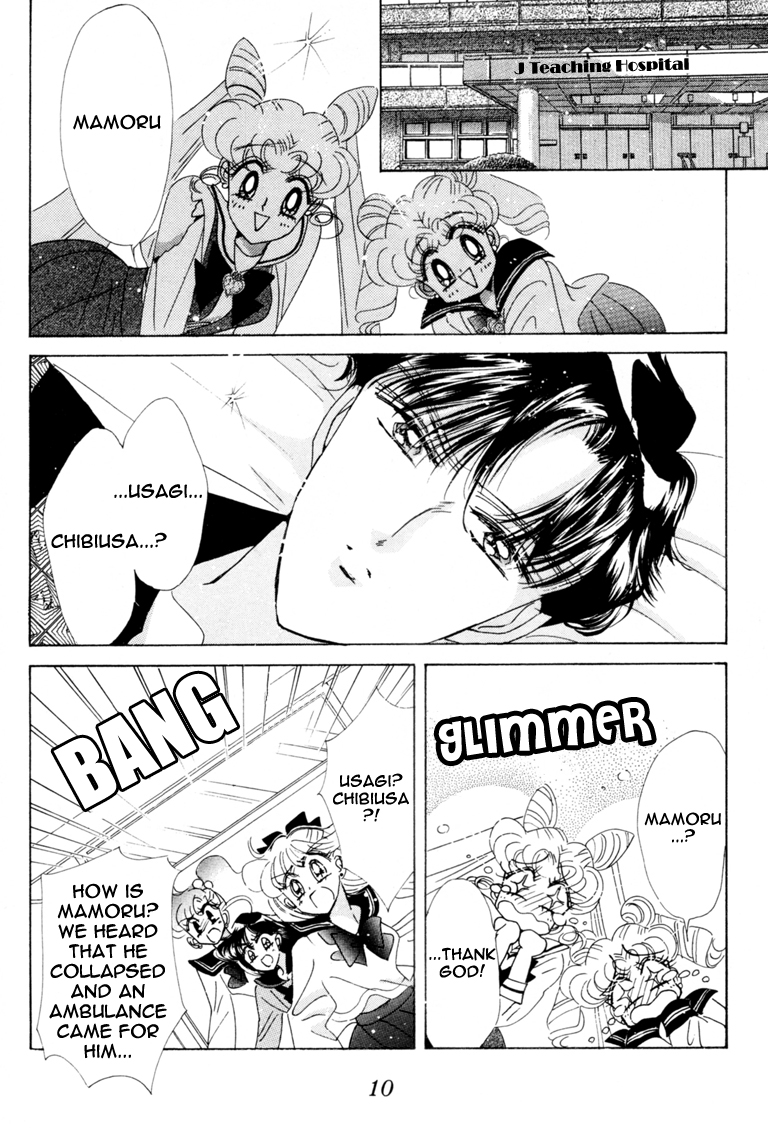
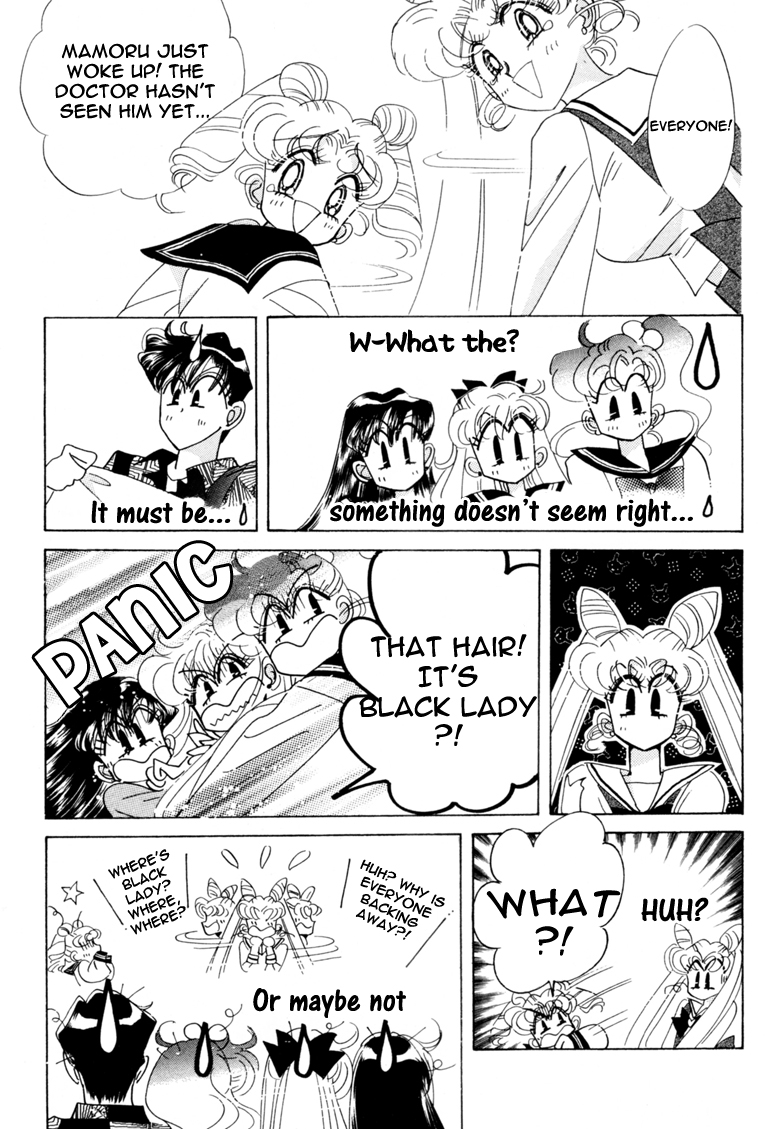
Mamoru wakes up and in confusion sees Usagi looking like a child, while Chibiusa looks like a young woman, both happy for him to be awake and alive. In one of my favorite gags in the entire series, the Guardian Senshi burst in having heard what happened, and see Chibiusa in her older state, in fear proclaiming it's Black Lady. 


I love continuity gags like that and Chibiusa's reaction is also really funny. Even Usagi pulls away as though she's completely forgotten what's going on and thinks Chibiusa is Black Lady.

Usagi and Chibiusa explain the situation to the others, how when they returned to their civilian forms, they ended up like this, and Luna suggests that it was the work of the enemy. This prompts Usagi and Chibiusa to mention the part with the tiger, which I guess they just didn't mention before?  Ami analyzes them, and Usagi comments that it doesn't seem like they are any different on the inside, just their outside appearances have changed. If you wanted to really stretch you could argue this has to deal with the themes of maturity; that we feel like the same person as we age, despite thinking we would feel different, but I feel like that's a stretch.

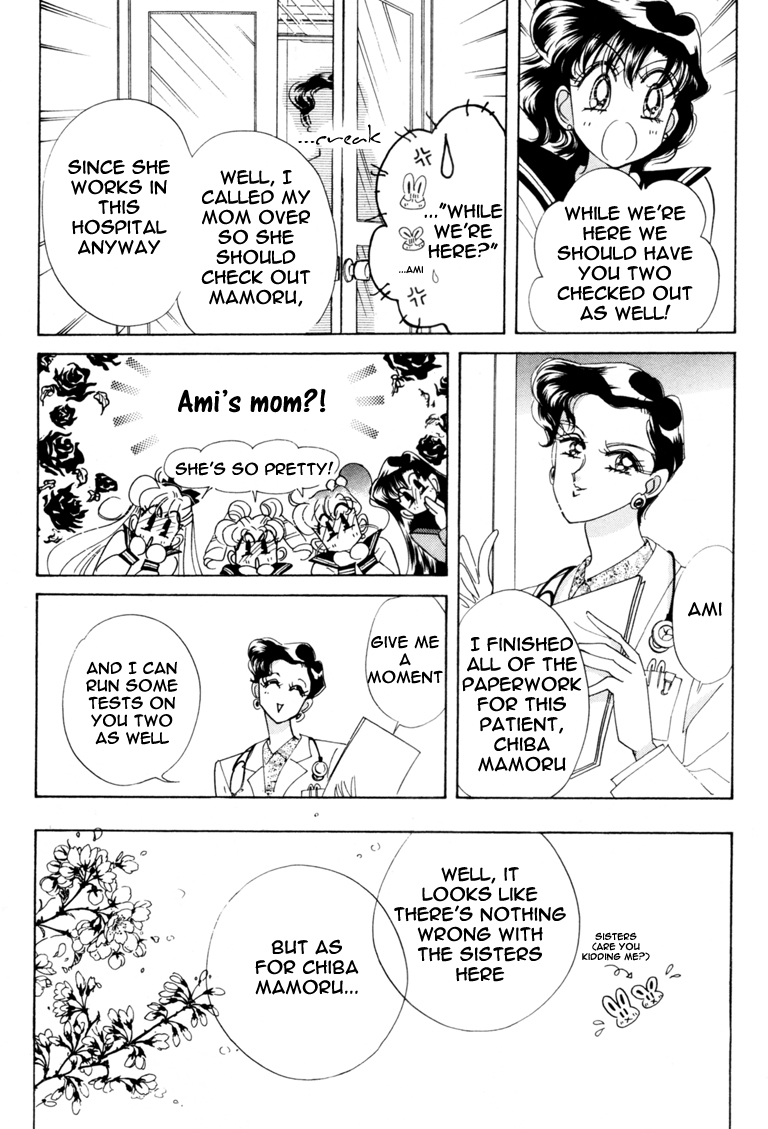
Ami asks her mother to look at them, as it was previously established in the first arc and Ami's side story that her mom a doctor, and for the first time in the series Mrs. Mizuno appears, causing all the other characters to get shocked at how beautiful she is. I don't know what Ami told her mom was wrong but she says that Usagi and Chibiusa seem fine


We cut to Mamoru where a doctor is telling him he has a shadow over his lungs, unlike anything he's ever seen. Mamoru completely lies to Usagi and Chibiusa telling them it was nothing serious. I feel like this was maybe the wrong step. Not morally speaking, that much is clear, but narratively speaking. I get Mamoru is trying to be brave and not burden them when they have bigger concerns, but if they try to rely on him and he suddenly collapses again, it could cause serious problems. This doesn't make Mamoru look like the stubborn but noble man Naoko was probably intending, but short-sighted. 

Mamoru in a paternal sort of way off-handedly compliments Chibiusa's appearance, who blushes as a result. Chibiusa says she's going to go home and use a magic trick on Ikuko and Kenji since they obviously can't go home without causing questions. The others comment on how self-reliant Chibiusa has become. I get both of these scenes are meant to show the maturation of Chibiusa, but it feels pretty soon in the arc for it and more so comes across as the magic turning of Chibiusa mature "makes" her mature.

Ikuko gets a comical confused look on her face at grown-up Chibiusa but she throws Luna-P at her and she's brainwashed into just accepting Chibiusa as Usagi. Ah, comical casual brainwashing, that's our Chibiusa. Chibiusa mentions feeling guilty for what she's done, but then thinks back to Mamoru complimenting her, and blushes.

The Crystal Carillion chimes again and Helios appears. Helios exclaims she's grown up, she really is the young maiden he's been searching for! This is both comical and thematic, as Helios just assumes she is how she appears. It's comical because of how he just assumes she just aged numerous years in a day, and thematic from how Chibiusa protests that this isn't the real her, reflecting her inner insecurity at not being the young maiden he wants. 


Helios says at the moment he doesn't have his sensory powers, but this transformation's dark magic could only be the work of their enemy. I don't know if it's intentional but I find it's an unintentional parallel with the first chapter, where Usagi has to uncover the bandage on Luna's forehead which freed her locator abilities. Chibiusa asks Helios who he really is. He begins to tell her, before saying it's too soon and just pleading with her to believe in him and give him her power.

A cage appears around Helios' form as he begins to fade back into dreams. Helios tells Chibiusa that she is the one holding the key to free him, a young maiden with beautiful dreams, protected by the light of the Moon. A princess soldier, one who can break the seal on the Golden Crystal. Chibiusa wonders if it could really be her that can save him, before running back off to Usagi and Mamoru.


Chibiusa's struggle here I believe is very evocative and relatable. Chibiusa is here the young girl in her mother's oversized clothing and poorly applied make-up. She is a little girl thrust into a duty and an adult world she is not prepared for, unsure of whether she can really fulfill the role equivalent to her exceptional mother. All of us must struggle to live up to the virtues of our parents, in our own ways. But what Helios looks for are terms that could be applied to both herself and her mother, making Chibiusa wonder if the one he really wants is her mother. This is where the pseudo-Electra complex comes from. It's because she is being described with words that are usually only given to Usagi. It's that she admired Usagi's beauty last chapter, and now these terms are applied to her.

Back with Usagi and Mamoru, Usagi is trying to be a supportive girlfriend, asking Mamoru if there's anything he needs as he is resting, despite her child-like appearance. Usagi notes that for the first time in a while, the two of them are alone and attempts to flirtatiously come on to Mamoru, though given her looking like a child, Mamoru obviously can't get into the atmosphere, telling her she looks like Chibiusa. Usagi settles for cuddling up to him.


Usagi emotionally vents to Mamoru about Chibiusa, but Mamoru defends her, talking about her bravery in the face of the loneliness she must be facing. Usagi promises to protect Chibiusa, looking rather comical as she does so due to her tiny stature. Mamoru comments to Usagi that he feels like he's only holding her back as he only has a fraction of her power, most likely referencing her Super upgrade. Isn't this just a repetition of the theme in the second arc?

Mamoru falls asleep in front of Usagi, showing his vulnerability physically now alongside emotionally. Little Usagi comments that she feels like she's causing Mamoru pain, dragging him into things. She feels drawn towards him but wonders if it's wrong for her to bring him along. It's a classic superhero's romance dilemma...except Mamoru also has powers. Usagi tells Mamoru's sleeping form her dream though is to always be with him and plants a gentle kiss upon his face, before snuggling up to him. 

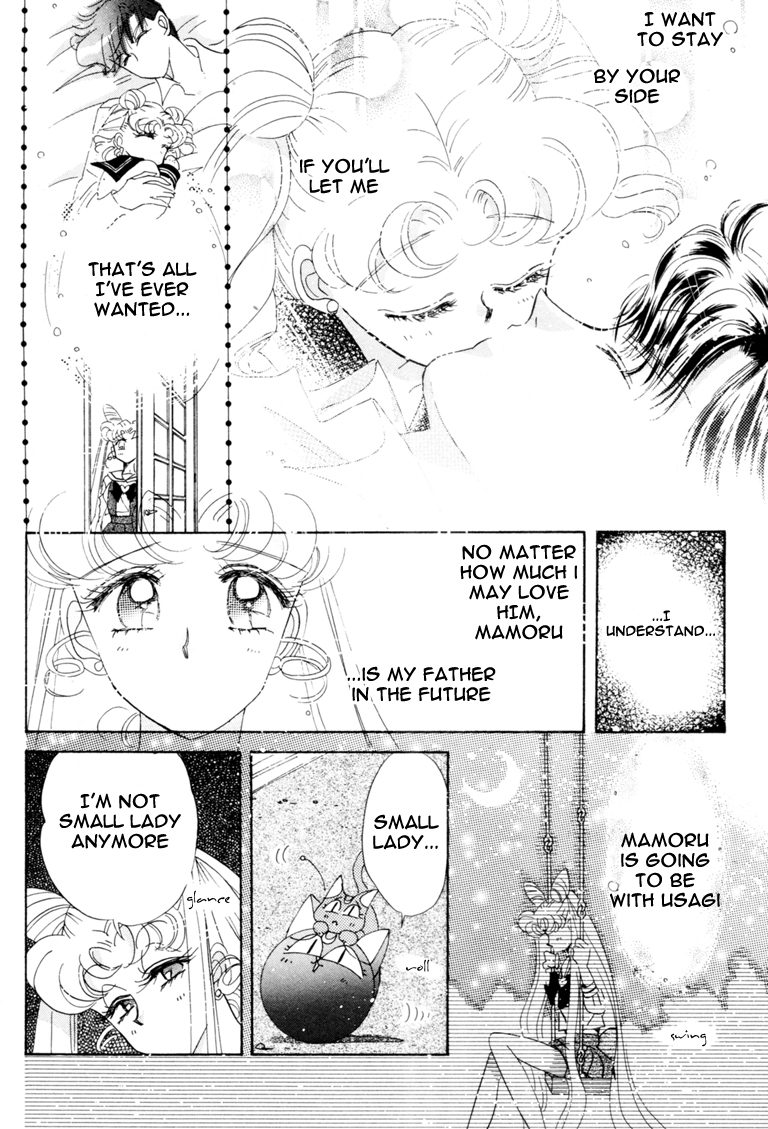
Meanwhile, big Chibiusa is swinging on a swing, feeling sorry for herself that Mamoru and Usagi have each other, and she doesn't have a love. Diana and Luna-P come up to her, trying to console her. Diana says with tears in her eyes that she's become so beautiful, that if the king and the queen were here, they'd be bursting with pride. Chibiusa looks up at the moon and says her dream is to become an amazing lady someday, and then she'll find a prince of her own.


This part I think is really well done here, contrasting Usagi's maturity and Chibiusa's immaturity. Usagi wonders at whether she should be with her love or if she will cause him pain, a mature painful adult feeling to have, putting someone ahead of oneself. Chibiusa in contrast here represents the perhaps slightly selfish but also important developmental desire of a child to grow up and get what an adult has; to become big and capable and to develop a relationship of her own. With Chibiusa abandoning the false childish pursuit of her father, towards an actual love interest, this part represents the blossoming desire in the child not to remain the beloved doted-on child, but to start a family of her own and take on the responsibilities of adult life. I also think the other elements are funny and cute. The way Chibiusa self-assuredly corrects Diana that she is just "Lady" now, or Diana's proud emotional reaction, or how atmospheric the adult-bodied Chibiusa on a swing set looking up at the moon is. Naoko loves putting striking imagery in her artwork, and sometimes that's not over the top, dark, or sexual images. Sometimes it's just images that reflect a particular atmosphere.

There's a brief interlude between the two halves of the act where Helios comes out from the mirror in Mamoru's bedroom asking the sleeping prince to forgive him for being unable to protect Mamoru or Elysian and asking the prince to please help him find the Golden Crystal, causing Mamoru to jolt from his sleep.

We cut to Ami, hard at work on her computer late at night. She's analyzing the aura around the Juuban shopping center, deducing it's a barrier set up by the Dead Moon Circus. Ami has a memory of Setsuna speaking to her, telling her to be confident in herself and to have calm judgment, as she is the "brain" they all rely on. Ami comments to herself that Setsuna always seemed to have all the answers, but she's not here, so they can't rely on her.


This is going to be a recurring motif for the first half of the Dream Arc, the Guardians comparing themselves to the Outers, the Outers being viewed as these idolized figures, to set up for the Guardians' development. However, as will be seen it's not so much that the Outers were right and they just needed to be like them. It's that the Guardians have false impressions born of their own insecurities about what their duties as Sailor Senshi are. Ami is attempting to become like Setsuna by taking on all the responsibility, of isolating herself in a sense. But one of the major themes of Sailor Moon as a whole is the pain of isolation, something Setsuna had to bear at the spacetime door.

Ami feels within herself a new flow of water, a new power being born, but can't tell what it is. This contemplation is cut short by Ami's mother getting home, surprised Ami is still up at 1:00. She apologizes for being home late, asking if Ami already ate but Ami, being the dutiful daughter she is, just smiles and says that she threw something together. Mrs. Mizuno comments that Ami is such a responsible, independent girl, and guiltily says she's a bad mother, devoting her life to helping strangers instead of her own daughter and that she "made so many mistakes." Ami knows what that means and internally thinks of her father, a Japanese watercolor artist who just abandoned them one day to go live in his studio in the forest, only sending back postcards on Ami's birthday. He says Ami works too hard.


This is one of the most real moments in Sailor Moon. The pained look on Ami's face as she looks at a card she got from her father, as though that could ever possibly be enough to fill the hole in her heart. And of course, diligent studious Ami doesn't say a single bad word about him, because of course she wouldn't. Ami says that her parents didn't match at all, and it's painfully evident. Ami's mother is a hard-working woman in the STEM field, representing the rational diligent side of the mind. Her father represents the flighty artistic side of the brain and the sort of irresponsible type of person that would tell people not to work too hard and just abandon his family. With the abandonment of her father, Ami has clung to her mother, becoming like her and making it her dream to follow in her footsteps. It shows so painfully where a girl like Ami comes from. It's a lesson I feel like people would do well to learn, which is not to judge purely on material conditions. Ami's probably the richest girl in her town, and she would definitely give it all up to have her father back. 

Back with the villains, Zirconia is speaking to the mirror again. Nehelenia in the mirror tells Zirconia that now that they know the members of the White Moon Kingdom have been reincarnated, that they cannot be ignored which Zirconia agrees with. Zirconia goes over to start ranting at the Quartet that it was the power of the White Moon that destroyed the Lemure, and how in ancient times they drew from the power of the Silver Crystal to destroy their family, the Dead Moon, basically being a supernaturally expanded version of the "old person yelling at young people about how hard things were back in her day" trope. Zirconia demands they feed them to the nightmares and the first of the Amazon Trio, Fish Eye, submerged in water and floating on a ball tells her to leave it to him.


Fisheye uses his mirror to spy on the Sailor Senshi, asking it to show him one of the Moon Kingdom. Naturally it shows him Ami, which excites him given they are both hydrokinetics. I do like how the design on Zirconia's cloak forms to look like the evil face of a wicked queen, aka Nehelenia, alluding to their connection. 

Meanwhile Usagi and Chibiusa call up Ami proclaiming in tears they didn't turn back when they went to sleep last night. Ami questions why they thought that would work, mentioning that thinking like this is thinking like a dream.


This is funny but also connects to the central theme of the act, and really the arc as a whole. Usagi and Chibiusa think in a childish dreamlike manner which usually works this arc, but it happens to not work here. Meanwhile Ami is a rationalist. She was forced by the abandonment of her father and stressful work life of her mother to grow up fast, be responsible and abandon fanciful thinking, which is what the conflict of the act is. Her rationalist thinking, while correct in this instance, is actually going to cause her trouble trying to conflict with the Dead Moon Circus, whose powers and themes run on dreamlike logic.

Ami goes to investigate the Dead Moon Circus on her own, to see what information she can find, trying to be all responsible, and possibly feeling inspired by the solo mission she did last arc. She comes across a fish shop where she finds a cool aquarium inside. Palla Palla, who Ami has not met before comes up to her telling her that when people long for the water, it's because they are under a lot of stress. She recommends a particular tropical fish to Ami, which Ami agrees to take, with Palla Palla giving a devilish grin as Ami leaves.

Later that night, Ami is looking at her fish, hoping her mom gets home since she hoped to show her the fish before falling asleep, which both literally and symbolically is really sad. The fish is supposed to represent an escape for Ami, yet she's distracted from her escape by the responsibility of her position. Ami awakens to find her mom engaged in a passionate kiss with a stranger, and then bad-mouth Ami, saying that her daughter is no concern, all she does is study. Things start to distort around Ami as she looks around, looking into a mirror to see she has become a young child again. She sees her papa who tells her he can't be weighed down someone who only studies all the time and leaves despite little Ami pleading with him to stay. Ami tries to be rational and tell herself this isn't right, she's never thought this way about her mama and papa.


This part is absolutely fantastic. It perfectly treads the balance of dreamlike and painful reality, symbolic yet potently directly emotional. It's the basic fear of a girl with separated girls; that her parents will give their love to someone else abandoning her or that she made her parent leave. Symbolically with the departure of Ami's father, the artist, the emotional side, Ami was left feeling all she had, all she was, was what her mother represented; the logical, the responsible, the hard-working. She constantly stresses studying to the others because as she showed with her memories of Pluto...she thinks she's just valued for her mind, for her responsible logical abilities, her intelligence, rather than her heart. Though she tries to be an adult, here in her dream that exposes the truth, she is reverted to a child representing her inner sensitivity, her feelings of helplessness. 

Ami sees in another mirror Usagi, Mamoru, and Chibiusa, all together and happy without her. The small Usagi says they don't need anyone else to be happy. Fisheye emerges from the fish Ami got, the thing she got to help her stress revealing that stress' origin. Fisheye clings to Ami, telling her to be honest, that she's jealous of them, right? 


Fisheye lulls Ami into a hypnotic sense, who says that she's always been lonely, wishing for someone to love her...anyone....before Ami snaps out of it declaring angrily it's a lie, it's not true, leaving it ambiguous how much of it was actually true. Ami's mother and the man she saw earlier distort into monstrous visages as the entire building's space distorts and she realizes she's lost in a maze of Lemure, in one of their demented nightmares.

Ami desperately calls on her communicator for help but before she can explain what's happening outside of the enemy is there, she starts getting sucked into a mirror. In a watery mind-space, Fish Eye speaks to Ami telling her it's the dead of night and no one will hear her scream, and that her Lemure have turned this place into a manor of nightmares. Ami feels sleepy and collapses with the wish that no one wake her up, referring to her desire to be free of her responsibility.


This is an area Naoko's particular writing style and the atmosphere of the Dream Arc come into alignment. The strange and surreal atmosphere she's been cultivating allows her to create a strange space like this where the characters' feelings can be made literal, where the space, like water or a funhouse mirror, reflects an imperfect version of reality useful for directing the gaze elsewhere. 

In Ami's mind, however, someone calls for her, and she sees a small part of herself as a Sailor Senshi, who tells Ami that she is a part of her. To me, this immediately connects back to last arc when Hotaru wondered why she kept going on when she felt she had nothing left, but she felt a "greater her" deep within her pushing her on. The small Ami tells her to remember her real dream and Ami thinks of the people she loves realizing that her dream of studying and getting smart was ancillary, it was a secondary dream to her real dream to give them love and protect them, she wanted to grow smarter to protect the ones she loved for. 


This is the major theme of the Dream Arc expressed. We all have a deeper dream rooted in love, a dream that unites us and makes us better. We also have dreams that are more shallow, and that are meant to be tools to draw us closer to our deeper dreams. But if we mistake the lesser for our true dreams, if we forget the purpose of our dreams, it will break our souls and our connections to others. People have material dreams for things like fame and fortune and power. But they want these things for example to feel validated or to feel secure or to feel admired. To forget the reasons why we had our dreams and to mistake the material dream for the emotional dream will end tragically, with us losing the reason we had our lesser dream in the first place. It reminds me of an interesting idea I learned of while studying Dante which stated that the reason idolatry is the most warned against sin in the Abrahamic Faiths is that it is the root of all sin to mistake the created for the creator, lust is to make sex one's god, greed is to make money one's god, pride is to make oneself one's god and so forth. Similarly here the notion is that the development of a proper understanding of the self and proper motives is to recognize that our material dreams are secondary consequences to bring us closer to our true dreams, dreams which unite us. Ami has fixated the whole arc on studying and get smarter, thinking it was all she was good for, but forgot that the reason she wanted to get smarter was to help her show her love to the ones she cares for and protect them and focus on herself as the Senshis' mind alone is detrimental to that goal. 

With her burst of understanding and her true motivation revealed to herself again, Ami's transformation brooch shines blue and she transforms into Super Sailor Mercury. She summons a harp which similar to the Moon Kaleidoscope before is shown to be aware, and attacks with "Mercury Aqua Rhapsody" destroying the nightmare she was trapped in.


Mercury's super attack is a musical attack which is... so perfect. Music is long understood to be closely related to mathematics and through that the classical Greeks thought could be logically understood. But it's an emotional artistic tricky beast, possibly most subjective of the arts, blurring the boundary of the left and right brain. Ami thought she was only one but is now unified again, able to be logical and emotional; a rationalist acting on the principle of love. Incidentally in Greek Mythology, the lyre was made by the trickster god Hermes which the god made as an infant to play songs in honor of his father and mother, similar to an intellectual girl who feels like a helpless child on the inside, honoring her parents nonetheless. Hermes was known to the Romans by the name Mercury. 

Usagi and Chibiusa arrive and decide to try transforming which...returns them to their original ages, kinda robbing that subplot of any real conclusion. They attack and destroy Fish Eye, with Palla-Palla commenting through her mirror first anger, and then in an odd mood whiplash thinking it's interesting, how they were able to transform.


This part is admittingly kinda weird. I would have liked it if Mercury could have defeated Fish Eye by herself, but Naoko seems to have had some kind of necessity, either by her own inclinations or by her editors that Sailor Moon HAS to be constantly the focus, with even last arc there being an added bit by Sailor Saturn on how it was "really" Super Sailor Moon that saved the day by trusting in her. This isn't totally speculation, there is some evidence suggesting that Toei and Naoko had some agreement to really push Sailor Moon as the central focus especially strongly due to brand recognition or something. Though the part immediately after at least tries to narratively justify it. It does also have elements of deus ex machina, with the Lunar Senshi transforming somehow restoring their ages making that plotline feel kinda... arbitrary. It's also not super well explained how unlocking one's crystal unlocks one's super form. The Stars Arc will retroactively kind of explain it with the understanding that the crystals are their Star Seeds, but it still feels kind arbitrary. At best I would say, if the true dream is a force of unity, then coming to self-realization of it might create the unity of hearts that was required for the Super Form. I think that's what was intended, though it's not that clear. 

Mercury greets Moon and Chibi-Moon, happy they've returned to their normal ages but Chibi-Moon gets all insecure again at how strong Super Sailor Moon was, how Chibi-Moon could never compare to the beautiful strong Sailor Moon. This kind of narratively justifies Moon killing Fish Eye since otherwise this would make less sense, though still doesn't feel great. Chibi-Moon starts thinking that her by herself she's useless, going so far as to summon Helios and tell him that Sailor Moon is the one he's looking for, not her. 


It's a show of on some level humility, but mostly of Chibiusa's dramatic nature as a young child and the scope of her sheer insecurity. It doesn't help that Helios' prophesized chosen one is, as he admits, ambiguous such that it could apply to either of them. But Chibi-Moon doesn't view that as a possibility, of it might be her this time, because in her mind she can't possibly compare.

Helios explains the one he needs criteria to Moon and Mercury: a maiden with beautiful dreams, protected by the moon, a princess and a soldier whose crystal can unlock the Silver Crystal. Helios confirms that Sailor Moon is the Princess Serenity, surprisingly seeming to know who that is (which will be explained with his backstory) and Chibi-Moon hearing that and essentially deciding that his asking is proof Usagi was the one he wanted, not her, dramatically runs off ending the act.


Act 40 is a great act, and one of the best acts in the Dream Arc. Sailor Moon has 15-16 of these acts focusing on one of the Guardian Senshi and Act 40 is, next to Act 29 (The Minako Mugen act) is the best of them. Though with Act 29, the stuff with the Lunar family was the best part of the act, with the actual Minako part being not quite as good. Act 40 is the opposite. The lesser part of the act is the part with the Lunar Family though not without merit. However the best part is actually the exploration of Ami, which is the best exploration of any of the Guardian Senshi in the entire manga, and arguably some of the best in the entire Sailor Moon franchise, next to parts of PGSM and Codename: Sailor V. 

Going over Ami's section, it's truly fantastic on a multitude of levels. Just on a basic level while I have seen more evocative expressions of the turmoil left behind in a broken home, and the plight of children in said situation, I have never seen anything that gets the feeling across so efficiently and quickly. It what amounts to a few pages, Naoko shows you everything about where a girl like Ami comes from, the complexity within her character, and what you can learn from her. Ami is a girl dutiful and studious to the extreme because she feels it's all she has representing the mother she clings to while the artsy, irresponsible, and childish seems to have left her with her father, the tragedy of that which is fanciful being that of course it always leaves and never when it should. Ami is introduced in Act 2 as a girl isolated for her intelligence and seeming fortune, yet the people assuming her life is great for those things make the same mistake she makes and develops past in this act; mistaking the secondary goods for the primary good they are used as tools to get. Part of the reason I love this act is one of the reasons I loved Ouran High School Host Club. Without going too much into my personal details, when I was growing I saw numerous kids who were rich, and some were smart and seemingly elite. They still had family problems, some of them were far more troubled than I was regardless of status because no amount of money can buy the value of a loving home, no amount of rationalism can convince yourself you don't need it. 

Similarly I believe the development shown here was really good. Obviously this is one of those broad-scale problems of humanity that there aren't any universal answers for, but for Ami specifically I think the resolution to her internal conflict felt fitting. This is because it is connected to the broad theme for the arc, which in turn is connected to the overarching theme of the series that bleeds into every character's progression. One of the most central themes of the Dream Arc is the division between the primary dreams and the secondary dreams used as tools to achieve the former. The former are unifying between people and ennoble us. The second are useful, but are often material in nature and putting them above primary dreams is forgetting their purpose and will only serve to isolate someone. This in turn connects to the two major themes of the series; the ennobling power of love and the pain of isolation. Ami was lost in the haze of her material dream, her need to be smarter to feel validation, her insecurity that she was only useful to the Guardians as their brain, and her insufficiency as a Sailor Senshi compared to someone like Sailor Pluto, ironically giving her the same pain of isolation that Sailor Pluto herself suffered. It was only in realizing that her material dream was actually a branch of her true deeper dream, her desire to show love to others and to help them, this love being the same force that empowered her by making her realize she was most than just a rationalist mind, that she was her loving heart, that she still had both halves of her within her the same way the spirit of both her parents would always be in her even if they weren't physically there.

The stuff with the Lunar family isn't quite as good, as it suffers from some repetitive beats already seen in the story such as Mamoru worried he's holding Usagi back, Chibiusa feeling like she's not as good as Usagi, and both Usagi and Chibiusa defeating the bad guy yet again. With that said it still has some fairly strong parts. It uses evocative imagery and actions such as Chibiusa in her young adult form lightly swinging on a swing while looking up at the moon, contrasting her outer maturity and inner immaturity, or Chibiusa summoning Helios to tell him that Usagi was the one he was looking forward before running away. It also has the hilarious part where the other Senshi think older Chibiusa is Black Lady temporarily, one of my favorite gags in the entire series as well as some cute parts with Helios and Chibiusa.

Overall Act 40 is great, a real step up to me from Act 39, where the surrealist elements were used to much stronger effect, being a lot more focused on giving an impression and contrasting with the painfully realistic subject matter. I thought the Ami section was an absolutely fantastic and remarkably efficient character study of one of the story's secondary characters and the Lunar Family was mixed, mostly suffering from some repetitiveness, but had some definite highlights making it at least a suitable complement. I almost wish the entire act was about Ami, but as it stands her section is the defacto section of the manga I think of when people try to tell me that "the manga Guardians are boring" or "Naoko is bad at character writing."

Tuesday, January 31, 2023

Death Analysis: Dragon Shiryu


The Dragon Saint, Future Libra Saint of Athena, Pupil of Dohko, a Knight of Justice, The Warrior of Rozan, Medusa Shield-Slaying, Waterfall-Reversing, Suplexing into Space, Indestructible Shielded Warrior, the Legendary Bronze Saint Shiryu!

They were the epitome of true courage and power. They didn't use weapons to fight, for their own bodies were weapons. Their fists were known to rend the Heavens and their kicks to crack the earth. The ages tell that wicked times would inevitably come again, and that the saints would be the warriors of hope. They are the Saints of Athena, armored holy warriors protecting the Earth in the service of the goddess Athena. To protect the latest incarnation of the Goddess, Mitsumasa Kido adopted 100 orphan children and began to train them to potentially take up the mantle of one of Athena's 88 saints. 

One of these children was the young Shiryu. After a few years of training as young children, the children drew a raffle to decide where they would train. Young Shiryu in the raffle was sent to the Five Lushan Peaks in China to train under the Old Master Dohko, the Libra Gold Saint, in order to attain a Dragon Cloth, the armor of the Dragon Constellation, said to be a dragon incarnate. These were also the days in which he met his love and inspiration the young girl, a fellow orphan, named Shunrei

Dohko gave Shiryu a task simple but impossible; reverse the flow of a waterfall. It was a task Shiryu thought impossible but Dohko trained him and taught him about the universe for six years straight, telling him how the mighty Yangtze river flows in the opposite direction it "should", that the laws of nature humans look for are only their way of understanding the incomprehensible


Shiryu punched and punched at the waterfall with all his might. It should be fruitless, to fight against the laws of nature so. But what are the laws of nature but man's attempt to force nature to be understood? Shiryu fought the water, gravity, inevitability itself until the day where with a mighty blow...


he made the waterfall itself flow upwards in the shape of a dragon, earning him the right to use the Dragon Cloth. Dohko also found, to his approval, that unlike most of the Saints who fought for personal reasons, Shiryu was truly a saint who fought for justice itself. For this Dohko gave to his pupil the dragon tattoo, a marker for the Saint who will become the Libra Gold Saint, a Saint who will be a judge of good and evil for the Saints of Athena


Shiryu returned to Japan to test the power Dohko have given him in the Galaxian Wars, a tournament of the newly appointed Saints beginning a sequence of events where Shiryu and several other Bronze Saints would realize that the Sanctuary, the place that was meant to serve Athena's interest, had been corrupted from within which was the reason the newly manifested baby Athena was given to their adopted father in the first place. Shiryu along with his friends would be drawn into a massive political and physical war between the Gold Saints and the Gods themselves, though were able to protect Athena and the Earth.

This blog will be covering Shiryu from the manga continuity. There are two Dragon Shiryus, the one from the original manga, and the one from the anime adaptation. While the anime adaptation is relatively similar to the original manga, the manga continues with the manga sequel "Next Dimension" while the anime continues with the anime sequel "Omega." Similarly, this is not using the Shiryu from Episode G: Assassins, as that is a possible future timeline which has not yet come about and as such is unclear whether it will come to pass or not.


Cosmo:
Almost all fighters in the Saint Seiya universe use a power source known as "Cosmo." All things in the universe are made from atoms, that were once one in a singular mass that expanded outwards in the Big Bang. Persons are comprised of those same atoms that were once at one with all things. Internally each person contains a micro-universe that they can utilize as a form of energy source. To have even a basic awareness of cosmo is to feel the universe within oneself. The Saints with their battles make the universe within themselves "explode" or expand growing their energy to affect the atoms of the physical universe.


Atomic Manipulation:
The most famous trait of cosmo is the ability to destroy on the atomic scale. It's one of the most reiterated statements in the entire series. While it's the most common use of the power, it can be used for a far vaster array of abilities. When one uses cosmo, it causes the body to erupt in a burning aura of energy that can both passively burn away enemies as well as protect the user from numerous types of abilities. A saint's aura reflects their true nature, and Shiryu's is a dragon. Just as atoms can be accelerated to make heat, they can also be slowed down to freeze though Shiryu has not done this in particular. Shiryu has also used his cosmo to manipulate water, sometimes using it to travel around on. Via the manipulation of atoms hypothetically anything should be possible, though the primary usage of cosmo is to imbue oneself with a supernatural energy and superhuman physical capabilities.


Superhuman Physical Strength and Durability:
The most obvious facet of Shiryu's cosmo is his superhuman strength and durability, which continually grows throughout the series. His normal level is variable as cosmo and the level of one's cosmo can change based on the emotional state of a person. Becoming angrier or growing in determination can cause one's cosmo to rise during a battle. As of Next Dimension, Shiryu has grown in strength to the point of being equal with his master the Gold Saint Libra Dohko, who is claimed to have the greatest strength of the Gold Saints, though this kind of a claim is far from unique for the Gold Saints and was evenly matched with Aries Shion, who could destroy and recreate the entire universe into something else. While this was a younger Dohko, Dohko has only aged 243 days since that time due to the divine power of Misapethamenos. Shiryu has other Gold Saint tier feats as well in his base form, casually blocking a strike from the Angel Tenma without looking, catching Capricorn Shura's strike with his bare hands, kicking Shura away with Shura directly calling Shiryu stronger than him, and along with the other bronze saints was even durable enough to withstand an attack from the God Thanatos who was trying to kill them. Thanatos is an even stronger entity making three of Gold Saint-tier Generals of Hades look like infants in comparison and killing Pandora with a thought yet Shiryu and the other main character Bronze Saints withstood his attack.

These feats are impressive as Taurus Aldebaran, a lower-tier Gold Saint was able to stop the attack of Pegasus Seiya, Shiryu's ally after first unlocking the Seventh Sense comparable to the Big Bang. This same Taurus Aldebaran as a younger Saint was able to shatter the Sin Scale, a dimension comprised of human souls weighing more than the stars with his special attack that Seiya was able to overcome and reverse it back at him as well as break the maintain stay pillar of Poseidon which would withstand even the end of the universe. Other Gold Saints have universal feats as well such as Aries Mu erasing the sealed Titan Iapetos' dimension before creating his own bigger universe, Leo Aiolia's attack "Photon" Burst being compared to the Big Bang, Virgo Shaka and Virgo Shijima engaging in a mental battle of Ungyo the sound representing the end of the universe and Agyo the light representing the birth of the universe in which countless universes were made, Sagittarius Aiolos killing the Sun Goddess Apophis who as a goddess would have unlocked the Ninth Sense which granted Anti-Pope Aiolos enough power to rival the Big Bang, Gemini Kanon being able to match the power of Anti-Pope Aiolos, Aquarius Camus and Cygnus Hyoga's clash in Episode G Assassins disrupting the boundary between the worlds of the living and the world of the dead, and a general untranslated statement saying Gold Saints have the power to destroy the universe. Shiryu would easily scale to these feats given his scaling to Thanatos. 

Superhuman Endurance:
Shiryu is pretty infamous for beating his opponents via sheer endurance and willpower, often brutally injured to win a fight. He easily fought through being stabbed through with a lance, withstood his own attack reflected at him, withstood a beating from Angel Tenma without his cloth, took Scorpio Escarlte's scorpion stingers which inject people with poison and pain to the point of driving them insane until they die affecting his entire nervous system to the point it should paralyze gushing blood until he lost all his senses and continued to stand and fight, survived being between the gates of life and death for seven days, gave most of his blood to repair two of the Bronze Clothes which weakened him and made him less durable yet still withstood blows from Black Dragon his dark equivalent, was stabbed through the heart by Shura and only got stronger from his determination, and most famously of all gouged his own eyes to fight the petrifying gaze of Perseus Algol's shield. It is one of Shiryu's most famous traits, to be brutally injured, and to persist regardless through sheer willpower. It was for this indomitable spirit that the Dragon God Ryujin recognized Shiryu's worthiness and granted him a stronger cosmo. 


Superhuman Speed:
Like with his power, Shiryu's speed can rise during a battle. He and the his allies Seiya, Hyoga, Shun, and Ikki, have a famous over-the-top speed feat, flying from the Underworld to Elysium, the Greek Heaven, through the hyperdimension in minutes. The narration describes this as flying past billions of galaxies, though it's unclear if it means through a space that would contain billions of galaxies like a universe which would require speeds quadrillions of times the speed of light, or through literally billions of galaxies lined up in a row, requiring a speed quintillions to sextillions of times the speed of light depending on one's assumptions. 

There are numerous other speed feats for Seventh Sense tier entities in the range of quadrillions to quintillions of times the speed of light. This level of speed is fairly consistent with Thanatos sending attacks across universal distances nearly instantly. Even in the Sanctuary arc Ikki believed he could flee to the edge of the universe in his fight with Virgo Shaka and Shun was able to send his chains through the dimension of Saga to hit him. Anti-Pope Aiolos was able to launch an attack quickly between universes, likely quadrillions of times the speed of light but Gemini Saga and Capricorn Shura reacted to it and blocked it. Shiryu can likely push himself even further however, as he was able to as mentioned earlier, catch the blow of the Gold Saint Capricorn Shura, who performed the fastest finite speed feat in Saint Seiya, overcoming the speed of the initial expansion of the universe with his Excalibur Technique. At the very beginning of the universe, it expanded from the size of a proton to the size of a grapefruit in an unfathomably small period of time between 10^-45 seconds from the beginning to 10^-35 seconds, a rate of expansion calced at 30 septillion times the speed of light. It should be noted that this is technically a mid-end. Estimates of the final size of the universe after the initial expansion can vary from as small as a grain of sand to a grapefruit, with resulting speeds ranging from quintillions to septillions, however, various depictions of Big Bangs in Saint Seiya, depict them as reaching the size of grapefruit or larger, often the size of people or greater after the expansion, which would increase the value even more by several factors. As such Shiryu likely reaches septillions of times the speed of light with his Bronze Cloth.


Bodily Manipulation:

Potential Attack Reflection:
Numerous cosmo users in the series have independently shown the ability to reflect attacks without any special techniques, something Shiryu due to his skill with cosmo should be able to do as well. However, it's unknown if this can be done to attacks not comprised of cosmo. Given how the reflection is depicted, it seems likely that it can. 


Non-Physical Interaction/Conceptual Destruction:
Any cosmo user in Saint Seiya can destroy ghosts and evil spirits, something Shiryu himself demonstrates. Cosmo can even be used to hit conceptual things like curses, the Dryads which mankind's evil given human form, and even the Gods who are conceptual entities. 

Saints have regularly shown that not only can they interact with non-physical entities as though they were physical, they can also destroy the incorporeal parts of a person without even destroying their physical bodies. Ikki even during the Galaxian Wars showed the ability to destroy a bronze saint's soul with his strikes rather than his body, an ability clearly not exclusive to him as Pegasus Tenma was said to be able to destroy someone body and soul. Gold Saints have numerous times shown the ability to destroy 20,000,000,000 souls at once, which Shiryu should scale too. Likewise given they can strike conceptual entities, they should be able to essentially destroy someone on any plane up to the conceptual. 


Attack Techniques:
As mentioned, Shiryu's cosmo has its own unique form like any other Saint, which he can form into various combat techniques. The most well-known is "Rozan Sho Ryu Ha" (Rising Dragon Punch), a technique in which Shiryu uppercuts an opponent his cosmo taking the form of a Chinese dragon. He also has a variant "Rozan Ryu Hi Sho" (Soaring Mountain Punch) where he dashes forward striking forward instead of upward. His master Dohko taught him two more strenuous techniques later of greater power. The first of these was "Rozan Hyakki Ryu Ha" (One Hundred Dragons Blow) where his cosmo takes the form of 100 striking dragons that attack Shiryu's foes. The other, "Rozan Ko Ryu Ha" (Ascendant Dragon Blow), is a last resort move where Shiryu grapples his opponents and rises into the heavens with them, the two being disintegrated from the sheer force. Dohko describes the move as a technique that could kill any human, himself included at the cost of the user's life.

From the Gold Saint Capricorn Shura, Shiryu learned the additional technique of "Excalibur." Shiryu is not as skilled as Shura with this technique, and can only use it with his right, arm, as opponent to any limb, but Shiryu can encase his arm in cosmo sharped to the point of being able to cut anything, even the unbreakable gold spear of Chrysaor Krishna. Excalibur has shown the ability to truly "cut anything" as it is warranted, including the fabric of space itself. It cut through the infinite light of Brontes Kido and cut off the arm of Zeus's astral body, Zeus being the multiversal top tier of the verse. It is likely that Excalibur completely ignores the durability or size of the target. Excalibur, as a divine weapon, also has the property of negating regeneration as Shiryu used it to kill the dragon faceless, a spiritual entity that regenerates when harmed. This happened in Episode G-Asasssin but should apply as a general property of Excalibur. 


Higher Senses:
While cosmo is the sheer energy of the internal universe within a person, the Saints and others come to skillfully utilize this cosmo through the development of the senses. 

Much as the perception of a sense can become more intense when the other senses are cut off, so too does a Saint's higher senses grow stronger as their senses are restricted. Phoenix Ikki took advantage of this by allowing Virgo Shaka to restrict his six senses to aid his awakening of the seventh sense. Both that fight and Shiryu himself demonstrate that restricting the senses also causes cosmo to strengthen further. Virgo Gold Saints are famous for using this to their advantage whether it be  Virgo Shaka keeping his eyes closed to control his cosmo or Virgo Shijima refusing to speak so that words would become imbued with his cosmo.


Sixth Sense:
The sixth sense refers to mind, and development of this sense can grant psychic powers. The sixth sense is suggested to be made of "premonition, signs, suggestion, intuition, perception, foreboding, and inference." Usage of the sixth sense can allow the user to fight even without the other senses, essentially replacing them and it gives them access to telekinesis which Shiryu demonstrates by shattering a boulder with a gesture and a command. 


Seventh Sense:
Stronger than the first six senses, and the source of them all as well as a person's cosmo is the seventh sense. The seventh sense was a sense all people had in the time of myth and was the source of heroism. The seventh sense can completely heal any of the prior senses if lost, as it did to Shiryu's sight, and can compensate if any are lost, allowing the Saints to fight even while unconscious. At this level a Saint's manipulation of their own atoms that Leo Aioria was able to regenerate his arm and heart's molecules from will. Due to the manipulation of their atoms, a Saint at this level can only be defeated if they can no longer will their bodies to regenerate, a difficult feat given the seventh sense will compensate for lack of consciousness. 

The Seventh Sense, when extended to the maximum, the supreme seventh sense is also linked to the capability to use a unique power called "miracles," which will be explained later.


Eighth Sense:
Beyond the Seventh Sense is the Eighth Sense, Arayashiki, or "Enlightenment." It is referred to as the essence, the source of one's karma. Shiryu has unlocked the usage of the Eighth Sense. The Eighth Sense allows the user to "overcome death" and gives one control of one's own soul, allowing one to stay in the land of the living even after death and reconstitute bodies for oneself, a form of low-godly regen. Hypothetically this would have been possible with the seventh sense given the ability to reconstitute the atoms of matter, but upon death, the soul would have left for the underworld normally. It also allows one to enter and exit the underworld alive, where normally the underworld robs one of all their senses.


Sainthood:
Dragon Shiryu is a Saint of Athena, a human serving the goddess Athena's holy will, with special skills and ways of way developed for the Goddess' protectors separate even from the powers granted to other users of cosmo in the verse.


Reactive Evolution:
Perhaps the most famous ability of the Saints is their ability to adapt and grow in combat. It's one of the most quoted statements about a Saint, that the same technique never works twice on them, due to them developing resistance from experiencing or seeing an attack technique being used. The Saints also grow stronger from battle, growing stronger every time they're knocked down. Shiryu himself has gone from half-dead and being stomped by Cancer Deathmask to powerful enough that his aura burned Deathmask in moments. 


Divine Protection/Resistances:
All Saints have the protection and grace of their guardian constellation. Combined with Shiryu's immense cosmo and the divine blood (ichor) of Athena that has fallen upon his cloth, Shiryu has developed numerous resistances. As mentioned above Saints can generally destroy not just the physical bodies of people but up to their conceptual bodies, yet Shiryu especially can resist the attacks from other Saints trying to destroy him completely, with even the Primordial Deity Uranus being unable to erase Shiryu, forced to seal him away in another dimension. This gives him a resistance to astral to conceptual destruction equivalent to his durability. Higher plane destruction resistance is not the same as actual manipulation of those things, however, in the same way that having physical durability is not the same thing as matter manipulation resistance. Shiryu does however have resistance to these forms of manipulation. In Episode G we see the battle between the Gold Saints and the sealed titans, the sealed titans creating their own universes with their own planets of people with their own cosmo, souls, and minds, and which they can control freely to do things like miniaturize the planet to use as a weapon. These dimensions are likely the size of full universes, containing countless stars. This would likely be universal reality-warping resistance, and at least planetary levels of soul, mind, and size manipulation resistance as well as multi-stellar or universal energy-matter manipulation resistance. Shiryu's mental resistance may be even higher, as the Gold Saint Virgo Shaka, who is not even the most accomplished psychic of the Gold Saints, is known for mental trap referencing the story of Sun Wukong and Buddha where he traps an enemy within a mental reality large enough to contain at least multiple galaxies shown several times as well as being able to have his mental battle with Virgo Shijima containing the birth and death of countless universes. However, while it's very likely Shiryu would be able to resist this, as it's extremely unlikely he'd be able to just do this to someone like Hades who God Cloth Shiryu had grown somewhat notable in power to, it's not technically confirmed.

Saints also have other resistances as well. Saints have shown on numerous instances a resistance to fate or destiny manipulation. After awakening the Eighth Sense, Saints have a resistance to death manipulation as the Underworld instantly kill anyone who enters yet doesn't kill Saints who have awoken the Eighth Sense and can survive the presence of the god Hades, who even as an incarnated baby killed everyone in a castle around him with his presence. In Saint Seiya Omega it is also stated people with enough cosmo can move even in stopped time. While Omega is part of the anime timeline, the two series are both universes in the same multiverse, and so the basic properties of cosmo should be the same. Shiryu also possibly has a limited resistance to petrification. While Perseus Algol immediately turned the others to stone with the Medusa Shield, Shiryu only had one-half of his body turned to stone instantly, and was able to still fight after looking into it. This was possibly because of the bandages covering his eyes but Algol says the Medusa Shield can penetrate past it.


Miracles:
Probably the ultimate tool of the Saints, the weapon that can surpass even the Gods is "Miracles," a representation of humans being able to improve infinitely while the gods, great as they are, will always be the eternal concepts they embody. Miracles are a uniquely human power and are considered an extension of the seventh sense, created by combusting the cosmos within oneself. Miracles have infinite potential and can generate unlimited power. It is the power of miracles, of raising one's cosmo infinitely that brings about the ultimate upgrade of the Saint's Cloth, the God Cloth. While miracles are broadly used to raise one's power greatly above where it normally is temporarily, it can also be used to manipulate possibility itself to turn an impossibility into a possibility, defying what can and cannot be done.

Miracles are stated to be raise one's strength "infinitely." Aristotle the Greek philosopher divided infinite into "actual infinity", a completed infinity, a set with infinite elements, and "potential infinity", a quantity that is never completed, which grows and continues with no last element but always with finite elements. Thematically the infinity referred to here is "potential infinity", just as humans have a cosmos in them that expands from their big bang with no limit, so too does human power grow without limits. This means that a Saint can grow stronger and faster towards infinity without limitations, which unlike actual infinity does not cause contradictions here. 


Dragon Cloth:
Like all Saints, Shiryu wears a distinctive armor, his being the Dragon Cloth which he can summon to him at any time. Clothes are partially sentient and can act to protect others and can abandon a Saint who is evil enough that they no longer wish to protect them. Even when a Saint is dead their spirit can move their armor, the way Sagittarius Aiolos moved his Cloth to cover Seiya and aid him. Contrary to popular belief, clothes do not empower a Saint, their power comes from their cosmo. The armor just protects them and without it their bodies are extremely vulnerable against each other. The Dragon Cloth is a dragon incarnate, hammered by the water of the Milky Way for eons, making it the toughest of the Bronze Clothes. The shield and gauntlet of the Dragon Cloth are considered invincible, and while that's not technically true, Shiryu is noticeably more durable than the other Legendary Bronze Saints due to his cloth. The Bronze Cloths normally freeze at -240 Degrees Fahrenheit/-151 Degrees Celcius though due to Shiryu's burning cosmo imbued in his Cloth, this amount drops to an even lower temperature.
 
Also with its final evolution, the Dragon Cloth grew wings and gave Shiryu the ability to fly.


Dragon God Cloth:
An ultimate form of the Dragon Cloth brought about by the power of miracles and Shiryu raising his cosmo to the infinite. With the power of his God Cloth, Shiryu was able to one-shot the God Hypnos alongside God Cloth Hyoga, a god equal or stronger than Thanatos who could one-shot all the Legendary Bronze wearing Gold Clothes earlier. Hypnos also tanked an attack from an entire generation of Saints together, including the Pope and all 12 Gold Saints, which is even more impressive given that any 3 Gold Saints together can recreate the power of the Big Bang. Shiryu, along with Hyoga, Shun, and Ikki were able to push back the God Hades with their God Cloths. Hades for comparison created Hell, Elysium, and the Hyperdimension, maintaining them with his will. The Hyperdimension alone using the higher end of the speed calc mentioned above would have a diameter of over 2.5e33 meters, a diameter of about 2,841,000 times the observable universe's, and with a three-dimensional volume 23 quintillion times the observable universe's. While much larger than the observable universe's size, this is much smaller than the real universe's lower bound size estimate for the full universe, so what you make of this is your prerogative. Technically both Elysium and Hell are referred to as infinite as well, however because the God Cloth Saints are finitely weaker than Hades, this would cause a paradox as it's logically contradictory for something to be finitely greater or smaller than an infinite quantity. As such I wouldn't use this.

The God Cloth would also easily have speed superior to that of Capricorn Shura's by an unknown amount but likely a large amount, and has a freezing point hundreds of times below Absolute Zero. In the process of anointing a God Cloth, Athena gave the Dragon Cloth some of her blood, divine ichor, which grants an eternal statue to its wearer, making them resistant to history and causality manipulation attacks, it's stated to give protection against "everything" and healing. Ichor also gives a more obscure resistance to information/paradox manipulation as they can resist the "black hole paradox problem", a paradox trying to erase Saints that exist in multiple places at one due to diverging timelines which usually forces there to only be one version of a character in a timeline.

The God Saints were able to fight alongside Athena against Hades, though they were significantly weaker. Seiya was able to actually catch a blow from Hades and surprise him with his strike. As mentioned above Hades' power created and maintained the underworld which is stated to have limitless space, which means his power would be infinite, which in turn means Shiryu with his God Cloth might have infinite attack/reaction speed. This is potentially supported by Hades in Episode G is considered relative to Cronos, preventing the underworld from being destroyed by his power, indicating he was able to react to Cronos' power. Cronos' power was able to wipe out all time from the multiverse in finite time, the Saint Seiya Multiverse being infinite in size with Athena traveling across an unknown portion of it to aid Shura in Episode G.


Skill/Intelligence: 
All the Saints are master hand to hand fighters, but Shiryu is especially gifted in this regard, being considered the best of the Legendary Bronze Saints at actual martial arts. He was one of the first of them to awaken to the Seventh Sense and defeated the strongest of the Marine Generals save Kanon primarily through skill and recognition that Krishna's "chakras" were his equivalent of the Saints' Star Points. He was able to disappear into darkness, has knowledge of pressure points, and while blind and paralyzed restarted Seiya's heart with a punch. His martial skill is superhuman and he and the other Legendary Bronze Saints were able to aid Athena in her battle with Hades, overpowered but not outskilled by Hades, Hades and Athena being likely billions of years old and Athena being the goddess of war.

Shiryu is also a skilled tactician, intentionally exposing his weak point to manipulate Shura into attacking how he wanted him too. He was clever enough to figure out that there was a second hidden Black Dragon Saint and like all Saints is well-versed in mythological history, knowing how the mythological hero Perseus defeated the mythological Medusa. Shiryu has a reputation of being the most level-headed and wise of the Legendary Bronze Saints, befitting the impartiality called for by the Libra Gold Cloth.


Weaknesses:
Shiryu originally had the weakness that when he struck, he left himself vulnerable for 1/1000th of a second which any blow would kill him. With the recent upgrade from the Dragon God Ryujin, it's not clear if this upgrade is still there. Shiryu has the same weakness as the other Saints, that he's vastly more vulnerable without his cloth and even if a Saint can resurrect themselves, they can't necessarily resurrect their Cloth.

Shiryu's biggest weakness though is his absolute nobility and sense of justice and fair play. When he was battling the evil Gold Saint Cancer Deathmask, Deathmask proved so evil that his own cloth abandoned him but refusing to take advantage of his opponent's vulnerability, Shiryu removed his own cloth so it would still be a fair fight. Due to his durability, willpower, and temperament, Shiryu sometimes takes blows for others, especially his friends. Like Superman or Captain America, he's the shield of his team. 


Personality:
During the 2004 popularity poll of Saint Seiya characters, Dragon Shiryu came first before immensely popular characters like Phoenix Ikki or Gemini Saga and before the protagonist Pegasus Seiya. I believe this is partialy because while every other character in Saint Seiya fights for personal reasons, whether good or ill, Shiryu is one who truly lives for justice, to protect the weak and innocent. In a classic 80s battle shonen filled with hot-blooded characters, Shiryu is the most mature, wise, and level-headed, the one who truly embodies the idea of a Saint, one who fights purely for justice's sake rather than any personal vendetta. The reason he is often blinded in his fights is a reference to the notion that justice is blind, it is wise and without prejudices based on appearances reflected by Shiryu's ability to "see" without seeing, immune to illusions and false appearances. 

In their own ways, each of the four Bronze Clothes that Seiya befriends models a trait he would need as a Saint; devotion for Hyoga, compassion for Shun, and power for Ikki. However, what Shiryu demonstrates is arguably the defining trait for the entire series; willpower in the pursuit of justice. Befitting one chosen of the Libra constellation, Shiryu is able to calmly and maturely take in information, without compromising his ideals and faithfulness to the cause of justice. In the Hades Arc when Shiryu returns to Sanctuary to fight the Sanctuary Dohko reprimands him, asking if he doesn't understand love, that Athena knows she and the Gold Saints are likely to perish in this battle and Athena in her love was trying to spare the Bronze Saints that battle, asking if he can't just accept a quiet life with Shunrei's love. However Shiryu refuses and continues to try to fight Aries Shion along his master, even as he is beaten down. Shiryu explains to Dohko that a Saint is what he is, that telling him to not fight for justice is the same as telling him to kill himself because he can't turn his back on his comrades and continue to live. Dohko relents and agrees to fight with Shiryu, saying he will personally beg Athena's forgiveness on Shiryu's behalf. This is perhaps the only time in the entire series that the wise old master Dohko is wrong, and it's because even he could not see how deep the quest for justice goes down to Shiryu's soul, that he can't just live peacefully because to abandon his quest is the same as to spiritually die. 

For most heroes in Saint Seiya, and indeed it seems most series, nobility and ideals are virtues to aspire to, but not the character's natural orientation. For Shiryu, however, they are the stuff of life, that which he persists on. They are the animating components of his soul, lived in his actions. It is the source of their many crippling tragedies Shiryu has faced as he sacrifices himself for others; it is why he gave of his own blood to restore the Pegasus and Dragon Cloths, why he blinded himself to fight Algol, why he refused to abandon the fight against Deathmask when he had the chance, why he tried to sacrifice himself against Shura. Yet just as the spiritual transcends over the physical, giving it meaning, no matter how much damage Shiryu takes, he remains standing. It was his willingness to sacrifice himself that finally convinced Shura that the Bronze Saints were really serving the true Athena and his true strength of character that allowed him to overcome Cancer Deathmask. Shiryu is a representation of the true meaning of a Saint, someone whose ideals are not just a detached virtue to reach, but are shown in their every action, where goodness and justice are truly not things they do but something they live.


Summary: 
+Universal Attack Potency, Durability, Metaphysical Destruction and Metaphysical Destruction Resistance. Macrocosmic with God Cloth. Can rise higher infinitely via miracles.
+MFTL (Quintillions normally, can reach as high as Septillions), Higher with God Cloth. Can rise higher infinitely via miracles. Potentially infinite attack/reaction speed. 
+Energy Manipulation/Aura
+Various Attack Techniques he can channel his cosmo into
+Matter Manipulation (Atomic)
+Regeneration (Low-Godly)
+Superhuman Endurance/Bodily Manipulation
+Potential Attack Reflection
+Can ignore durability and negate regeneration with Excalibur
+Telekinesis, Telepathic Sensing (Inter-Universal), Precognition and Enhanced Mental Facilities with Sixth Sense
+Can fight while unconscious
+Power-Amping and Probability Manipulation with Miracles
+Control of his soul, can enter and exit the underworld at will
+Reactive Evolution
+Flight
+Holy Emanation
+A Tier Skill, Potentially High A Tier Skill (Comparable to Hades and Athena)
+Basic Stealth
+Possible Healing (With Ichor)
+Acausality
+Resistance to Multi-Stellar, likely Universal Reality-Warping, Spacetime, Existence Erasure and Matter-Energy Hax (The Primordial Uranus could not erase him, Uranus being a superior user of the Dunamis of Gods than the Titans who create dimensions called universes and with countless stars)
+Resistance to Planetary+ Soul, Mind, and Size Manipulation (The Sealed Titans can create and manipulate planets of people and change their size yet could not affect the Gold Saints, Shiryu withstood Cancer Deathmask's attack which could manipulate 20 billion souls), Possibly Higher (May be able to resist Virgo Shaka's psychic power)
+Resistance to Sensory Sealing, Freezing, Fate Manipulation, Paradox/Information Manipulation, Death Manipulation, Causality Manipulation, and Time Stop
+Some level of resistance against "everything."
+Possible Limited Resistance to Petrification
-Dragon Tattoo possibly turns into a weak point for 1/1000th of a second while he attacks
-Is completely fair-minded and refuses to take advantage of any vulnerabilities of his opponent
-Wolves?


Recommended Opponent:


Naofumi Iwatani (Rising of the Shield Hero): 
Two Heroes that are known for their shield above all else, entering the world's strongest turtling match. End of Web Novel Naofumi could be a real threat to Shiryu and it would be a fair matchup to think about vs wise where a lot of factors from both like Shiryu's resistance to Naofumi's causality manipulation, seemingly his biggest weapons, though Naofumi's poisons and curses, more modest would also plausibly work...though Shiryu's would be defenseless against their with the Eigth Sense, Bodily Control, and the ability to attack curses. The biggest interest is the thematic side. Naofumi is a hero driven by his hatred and want for vengeance after his false accusation and exile from civilized society and I think there could be a really cool theme about the difference between justice and vengeance. The two would be such opposing personalities, and were both popular for being different kinds of heroes for their time; Shiryu for being a morally noble, wise, and mature hero in a hot-blooded series and Naofumi for being a pragmatic, realistic, and cynical hero in a time of generic Isekai protagonists. An exchange of words between them would be as interesting as an exchange of fists, or shields as it were.


Next Time:


Thanks to my friend Thor for making this trailer that really captured the....eccentric nature of the two combatants I'm doing next time.