Wednesday, March 8, 2023

Rating my Favorite Series on their Girl Power

 Happy International Women's Day! As a celebration I decided to rank all my favorite series into terms of how much girl power they have. This list is going to be a bit more.. subjective as girl power isn't really defined by any one or two elements in the story itself but moreso how the audience is supposed to feel watching it, so these are ordered roughly in how much they give me that feel. When a franchise has multiple series on this list, I'm focusing on the series within that I personally consider favorites.


Tier 5:

These are series which depict power in a very specifically masculine way and are kind of the opposite of girl power

33: God of War: The original Greek Saga of God of War operated on manliness and testosterone.

32: Yu Yu Hakusho: Has some strong female characters, but broadly is about a troubled young man's attempt to integrate his aggression in a positive way with almost all the fighters being male.

31: Saint Seiya: Basically a "knights rescue the princess plot" themed around mythology, where Saints are all male or have to cover their femininity in masks. That's not me saying that, that's literally how the series frames it. Saintia Sho is a feminine version and is the sole reason it's at the top of this tier.


Tier 4:

These are series I feel are pretty neutral in terms of girl power, usually because they have a predominantly male cast. 

30: The Stanley Parable: Technically there are female characters but there are really only two characters, arguably only one, and both are male.

29: Magicka: The gender of the protagonist wizards are ambiguous, but all the major characters outside that are male.

28: Over the Garden Wall: Of the four major characters, only one is female and Beatrice is probably the least major. Not a strong female influence in general.

27: Yu-Gi-Oh!: There are some female characters of note in the original series but Anzu and Mai serve primarily token archetypal roles of love interest and specifically feminine antagonist. All the major characters are male.

26: Hetalia: Hungary's great but all the major characters are male. Male nations outnumber female names by a wide margin.

25: Commedia: This comes from a very different time period and while the work is respectful towards women for its time, and one of the female characters is one of the most important characters in the story with a lot of agency (Beatrice), she only shows up herself for about a third of the story, with the majority just being Dante and Vergil. It DOES show a significant amount of respect though. 

24: Xiaolin Showdown: One of the heroes is female, Kimiko, and one of the major antagonists is female, Wuya, though it is a heavily male predominated cast.

23: Ouran High School Host Club: While the cast is almost entirely male, the protagonist herself is female, and in particular one who is shown to be very intelligent and full of agency. 


Tier 3: 

These are series that have a more even mixture of female to male characters and generally do a better job of giving the female characters agency and power.

22: Freedom Force: Despite taking place in and being an homage to storytelling mostly from the 1960s, Freedom Force has some superheroines with one being the arguable main character of the story (Alchemiss) with the most agency, and several major female antagonists with the second game having a main villainess (Entropy.) Still a series with a larger male to female cast, but less dramatically so.

21: Danny Phantom: While still a story mostly focused around a teenage boy and his struggles, has a roughly even female to male good guy ratio, as well as numerous female antagonists and a roughly even mixture of female to male supporting cast. This is roughly around the average for most series. 

20: Wander over Yonder: Another roughly evenly split cast with the two main heroes being a girl and a boy, and two major antagonists one being a villain and one being a villainess. While the supporting cast is mostly male, Lord Dominator is treated as the undeniable unstoppable character with the most agency in the story and the story takes pains to emphasize her gender.

19: Undertale: Almost perfectly even cast mixture by gender, with female characters ranging in archetype and having both power and agency in the story. Toriel is stereotypically feminine in archetypal being a maternal figure but has an iron will to her and both Alphys and Undyne are non-traditional female archetypes with major influences on the story.

18: xxxHolic: Once again, the major cast is evenly split in gender, though the supporting cast is primarily female. Yuuko is also just such a cool character while also being feminine in iconography that she pulls the series upwards.

17: Cardcaptor Sakura: Similarly, major cast is evenly split in general, though the supporting cast is primarily female. However the supporting cast of female characters is a lot important, and the story is about a girl, Sakura, as opposed to Watanuki, and her relations with everyone in her life.

16: Shamanic Princess: Outside of the antagonist which is a non-gendered eldritch horror, all the characters with the most importance in the story are female and are presented as awesome and full of agency. Tiara, Lena, and Sara are probably the three most important characters, all have huge importance to the story and make important decisions.


Tier 2: 

These series are ones that do give me the girl power feelings and which depict a specifically feminine form of power or the main character being a girl I felt was a meaningful choice to depict the positive traits of femininity. 

15: The Owl House: Fairly evenly divide of important male and female characters, tending towards female but the most important are the main character and her girlfriend who are witches which in the real world is a type of magic that are often associated with femininity, though in TOH it is used for both genders.

14: Okami: Not especially explicitly girl power-y, but Okami is about the goddess Amaterasu, the supreme goddess of Japan and her unique power which is often couched in feminine language, with the series never showing Ammy as remotely unfit in her capacity to rule the universe. Admittingly this may only be as high as it is due to my feelings on the real world Amaterasu being one of the few supreme deities of any religion to be explicitly female. 

13: Panty and Stocking with Garterbelt: Even though it's a very fanservice-y series, P&S is not a series about two shrinking violets getting sexualized against their will but about two bad*ss, if obviously heavily flawed comedic protagonists that are completely confident in themselves and are depicted as shameless and confident in their desires.

12: Tokyo Mew Mew: Like a lot of Magical Girl series, Tokyo Mew Mew is about a team of girl using feminine magic, wearing feminine outfits, and using feminine iconography. The theme song is even explicit about it being girl power-y saying "any girl can become fearless, by knowing a special kind of magic!

11: Magic Knight Rayearth: Magic Knight Rayearth is similarly another Magical Girl series with feminine iconography. While it's less girl-y then TMM, it is more power-y as the characters are depicted as cool and venerable. Also the secret antagonist of the first arc is female as is the main antagonist of the second in the anime.

10: Yuki Yuna is a Hero: Another Magical Girl series, this one darker. I've heard argument that these darker magical girl series are less Girl Power-y because they feature the girls not achieving their goals and suffering more and while that is true for some of them, for these darker MG series Yuki Yuna is on the least dark side, having the friendship between the girls ending up saving the world multiple times over, reverse all the effects of Sange upon them, and ending the hero system that had caused so many to suffer. There's also a whole thing about how pure maidens are the only used as sacrifices but how this system was broken by the girls friendship and trust in each other, coming to believe more in their friendship then Taisha or the Shinju. 

9: Cutie Honey: While some of the Cutie Honey series are clearly meant for guys, my favorite Cutie Honey series is Cutie Honey Flash which is the Shojo one. When Cutie Honey was made, it surprised the creator that it attracted a younger female audience who appreciated the awesome action-y female protagonist who was confident in her body and treated as ultra-capable, so a Shojo version was made, making Cutie Honey Flash kind of an emblem of girl power in its own right. 

8: Princess Tutu: Of my favorite series I would say Princess Tutu is the msot feminine of them temperamentally, and presents power and competence in a distinctly feminine way, appropriating a lot of fairy tale imagery to depict the heroine's journey.

7: Metroid: For Metroid it's not so much the content itself which typically doesn't mention Samus' gender in anyway, it's moreso symbolic of what it represents, being an 80s action game of a female protagonist in power armor. People have talked to death about the revolutionary genius of it, having the player play the whole game thinking Samus was male only to show they had been playing a female character the whole time, attacking the notion that the default hero was always masculine. Every series prior to 9 was girl power-y only really incidentally, and while Cutie Honey Flash and Princess Tutu had a self-conscious element Metroid fully invoked the idea. I like how Samus can be a female protagonist whose relatively emotionless yet isn't depicted as tomboyish or somehow masculine for it. She's simply highly composed and stoic. 

6: Puella Magi Madoka Magica: My favorite Madoka series are original and Tart Magica. Madoka is a series that pulls one of the most effecting reversals I've ever experienced. Magical Girls are representations of idealized femininity, of the wishes and dreams of young girls. Madoka is about the painful clash between that and the darker parts of reality, the foolishness in people, a world that is uncaring towards gentle feelings. However the climax holds that even in the face of ultimate suffering and death, girls feelings' dreams and wishes are meaningful, that if the world contradicts it, we will break it down and rebuild it, that the feelings of a young girl are both so important that the universe's laws seem to harvest it for energy, and it can change those laws. Granted it's not very Girl Power-y for a lot of it, which is why it's 'only" 6. 


Tier 1: 

These are the series that I really think of when I think of Girl Power. These five really could be in any order.

5: DC Comics: It's hard to talk about DC Comics "in general" because DC is such a massive franchise with so many different tones, themes, and content. However one of my favorite DC series is Wonder Woman which...should speak for itself. Wonder Woman is an icon with a massive historical legacy representing female empowerment. My favorite DC series also includes Starfire, Zatanna, and Harley Quinn all of which have girl power-y elements to them. It's the bottom of Tier 1 because, once again, DC's kind of inconsistent just from pure size.

4: The Powerpuff Girls: VERY similar in this regard to Pretty Cure, it's about three little girls using Kryptonian superpowers to beat up usually kaiju as well as supervillains. This series is very clearly a girl power series both in and out of universe with episodes that are meant to show that such as Equal Fights and Members Only.

3: Pretty Cure: Pretty Cure is such a clear example of Girl Power, I'd find it hard to explain. It's about young girls given Magical Girl Powers punching around villains with the magic of friendship. Pretty Cure is what I think of when I think of "Magical Girl Anime", a genre with a heavy emphasis on girl power. Pretty Cure vs PPG is probably the hardest comparison in this whole list. Pretty Cure's powers are usually depicted as more explicitly feminine, and it arguably has a higher proportion of female antagonists. 4 and 3 really could be swapped.

2: Sailor Moon: Ah, my favorite series! Sailor Moon is another series that's explicitly girl power-y, Naoko wanted to make a magical girl that was a relatable everygirl and took the negative stereotypes about girls making them into the sources of Usagi's strength, her heavy emotionality is the source of her powers. It's very explictly about putting femininity together with power hence the title "Bishojo Senshi", Pretty Girl Soldier. I could write many paragraphs on it, but Sailor Moon is a series that wanted to express to its young female audience that they could be feminine and a cool hero, that being flawed didn't mean you couldn't save the world. There is a series I think could arguably be more girl power-y. 

1: Bayonetta: Once again, I could go back and forth on 2 and 1. Sailor Moon was intended to be more girl power-y then Bayonetta but I think in actual content Bayonetta is, albeit both are high in both. Bayonetta is a series about the Umbran Witches, making the traditional feminine scapegoat into the protagonists, using feminine magic and iconography such as fashion, dance, long hair, butterflies and more while also being a series as action-y and over the top as God of War. Bayonetta is a series predicated on being a stylish bad*ss women whose awesome in ways that are explicitly powerful and feminine at the same time, in harmony, completely confident in her sexuality and competence. I find it hard to imagine a more girl power-y idea then that. 

Sunday, March 5, 2023

Bishojo Senshi Sailor Moon Act 44 Review


The act begins with little Hotaru reciting a poem by Yeats called "The Second Coming."


The Second Coming was written by Yeats in the seemingly apocalyptic aftermath of the first world war, and the political chaos going on in Ireland at the time. It describes the aftermath of a world-ending apocalypse, and that with the nearing 2,000 years of the first coming of Christ, soon shall he return. It also mentions a Sphinx emerging from the Spiritus Mundi, the world soul. The usage of this poem here is absolutely brilliant on Naoko's part. Obviously, a world-ending threat is there, but Sailor Saturn is the one reciting it, Saturn being the one that ends the world in the cycle of life and death corresponding to the cyclical theme of the poem and Yeats' personal mystical views of history being cyclical. The part she speaks of here is specifically that the sphinx, pitiless emerged from the world-soul... you may recall that last arc the alien world-soul Pharaoh 90 emerged into the dimension and born from it was Sailor Saturn known for her eerie otherworldly gaze. It speaks of the second coming which not so subtly foreshadows the fate of Hotaru in this act.
We cut to Haruka either imagining or recalling Usagi talking about her dream. Usagi expresses her dream is to live with the one she loves and child in a small house surrounded by flowers, the picture of domesticity.


To my shock, there are some that believe Usagi's domestic dream corresponding to her stated dream of being a housewife is sexist. I have...a lot of problems with this position. Chief among them is that there is nothing dishonorable about being a housewife; it is my solemn belief that the greatest honor given to woman is to be a good mother just as the greatest honor given to man is to be a good father, and wanting to focus on this, if possible, is wholly understandable. Secondly, this is meant to reflect Usagi's personality; she doesn't like to be alone and her dream emphasizes the togetherness of living with her loved one and child, it's not intended to be any kind of position on the place of women or anything. It is explicitly Haruka, the least traditional of any of the Senshi thinking about Usagi's particular personality. In conjunction with that, the Sailor Senshi have a wide variety of goals and dreams which are meant to show the young female reader the wide variety of paths available to them from the traditionally feminine (Usagi's dream of being a housewife, Makoto's of running a bakery or flower shop, Michiru's position as a musician) to the traditionally masculine (Haruka's job as a racecar driver, Ami and Setsuna working in the STEM fields.)

Finally, there's another narrative reason that Usagi is presented with this dream and it's an overarching theme of the arc that I feel those who have a negative response to this dream might benefit from learning. It's the same reason Superman is usually depicted as wanting to humbly live with his family as a farmer. It's meant to show the humility of our hero. We know Usagi shall one day reign over the world as Queen, but she is not someone who strives for power for its own sake. That is a major theme of the arc, that grand material ambitions are fine in service for noble goals like love but for their own sake are corrupting. Nehelenia seeks the entire universe for herself and is struck down. Usagi wishes only to be with her loved ones and is exalted.

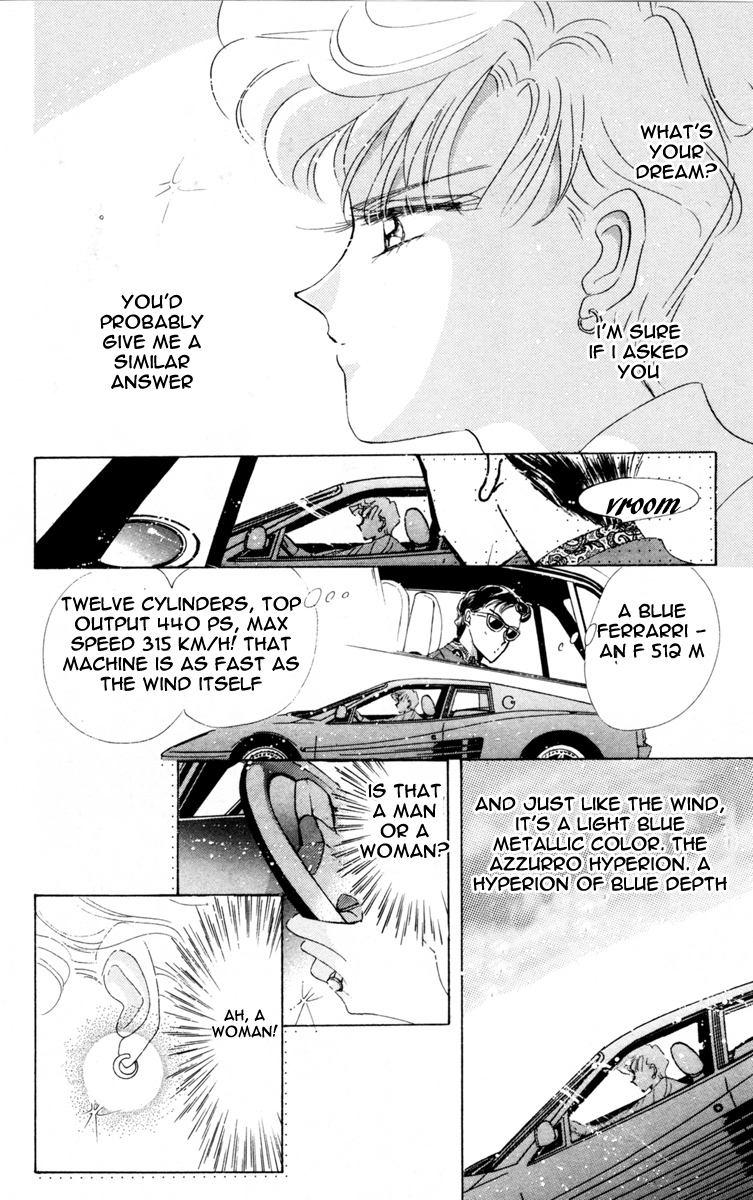
We cut back to Haruka, where in a slightly odd sequence of events, a driver next to her notices how cool her car is and then wonders whether Haruka is a man or woman, before seeing her earring and, figuring that means she's a woman, immediately hitting on her. Haruka hilariously gives a cool comment and leaves him in the dust.


I don't think there's any page that better exemplifies Haruka's personality. I especially love how she refers to herself as "Haruka-sama." 

Paralleling that we cut to Michiru who is browsing for CDs when a man approaches her, telling her he's a big fan of her, having all her CDs and trying to ask her out. That said Haruka comes out of nowhere and literally goes between them, giving a fake cordial handshake. I like to imagine Haruka was nowhere around them but her "someone approaching my Michiru" sense went off and she used her superspeed to just flash step over there. Michiru seems annoyed, possibly at Haruka overprotectively breaking her fan's hand or possibly for making her wait, it's not entirely clear. 

Haruka asks if a fan got her the white flowers but Michiru replies that she bought them as a commemoration for six months of their new life. Haruka and Michiru are drawn looking all pretty together as onlookers gawk at the power couple, wondering if the rings on their hands mean they are married.


As they drive home, Haruka notes that there's a sale on diapers and milk but Michiru comments that she guesses Haruka isn't used to it yet, but their little princess has "long" outgrown milk and diapers, an unusual occurrence given it has only been six months. 

We cut to the Outer Senshi residence where Setsuna is trying to work on the computer when Hotaru breaks something and starts to cry. Setsuna gets an exasperated look suggesting this is a common occurrence, commenting that she was reading quietly just a moment ago. Haruka and Michiru get home and Hotaru runs up to them wanting to play more of "that game yesterday" but Haruka tells her it's time for her violin lesson and tries to get her to get dressed. Meanwhile Michiru gets angry at Setsuna for allowing Hotaru to break her Royal Copenhagen Dishes with Setsuna apologetically explaining she was reading quietly just a moment ago. This leads them into discussing Hotaru's supernatural development, that she's already reciting Vergil from memory, with Hotaru growing to the size of a child several years of age in just six months. Haruka comments that everyday is.... "like a dream." Right. 


There actually is some precedence for this earlier in the manga, interestingly enough. In the Black Moon Arc, the Silver Crystal kept Chibiusa from developing in age until she was ready, so it's not out of the question the Saturn Crystal might age Hotaru up quickly if it needed too. 

As Haruka playfully scolds Hotaru that she was once such a calm child and now is an energetic brat as a joke, Michiru and Setsuna both agree it's felt like they're living in a dream. Setsuna thinks back to a few weeks after their new life began, how she was at the observatory observing the eclipse when she felt something immense no one on her team did, that space itself warped. She tried to transform but found she couldn't due to the same darkness barrier that was blocking the Guardian Senshi.


Setsuna comments to herself that the fact that she couldn't transform she took as an indication that their duties were no longer to fight as Senshi, that their path had changed yet Hotaru's quick growth makes it seem as though she's awakening, questioning that idea. She wonders if Hotaru without meaning too is trying to them something. It's a strange thing children do where sometimes they will tell you what is needed without realizing just by a change in their behavior, possibly because they don't know or can verbalize what is happening around them.

Hotaru and a bunch of other children take Michiru's class where Hotaru plays the violin. This causes the ghost image of a Pegasus to appear before everyone.


This frightens the other children continuing the trend from Hotaru's past life of her powers freaking the other children out. I do have to say they say that this happens every time she plays...you have to wonder did the children not say anything to their parents? Also, why does Michiru keep letting her do this with the others if it keeps scaring them?

Hotaru sees the ghost of a young girl, Chibiusa, chasing the Pegasus and chases the two ghosts around the corner. When Michiru goes to find her she finds Hotaru watching the ghostly Chibiusa crying over the ghostly pegasus dead, with her eyes glazed and far-seeing like Sailor Saturn's, a connection Neptune also makes.


One of Naoko's great strengths as a writer is creating atmosphere, and this chapter without question has some of the best atmosphere in the entire manga. Part of this has to do with Hotaru's influence. Sailor Saturn is a threat the reader knows very well how threatening she can be from last arc and Hotaru's immediate shift from cutesy to scary is somehow both jarring yet inevitable feeling. If you've ever had the displeasure of seeing a truly troubled child, you'll recognize the eerie silence and focus Hotaru demonstrates her.

Michiru hugs Hotaru and she returns to normal, the other children leaving quite cheerfully as though nothing happened. The Outer Senshi go on living their blissful mundane lives, yet in their hearts know something is wrong, and feeling unsettled comparing it to knowing you're in a dream that's going to end sometime soon. Hotaru and Haruka decide to play "that game" Hotaru mentioned earlier. Hotaru releases her stellar energy which they use to create a simulation of the Solar System at fast forward speed, Haruka controlling the energy and restraining it.


You know just a normal fun household game. There's a lot of little details about this section like how Hotaru mentions she sees the asteroids which aren't part of her plan, they appeared on their own and she's not sure yet whether she's gonna let them live or die like the tiny goth she is.

Haruka comments on the white light of the moon saying it always surrounded her, Usagi, and that she misses her with Michiru giving Haruka a supportive hug. However as they get to the moment of the eclipse, the present day something goes wrong...


the moment of the eclipse happens and then refuses to end, shrouding Earth and Moon in darkness. Haruka sends Hotaru to bath and then bed so the grown-ups can talk.

Setsuna confirms that the vision Hotaru saw was true, that the Earth and Moon are covered in a darkness barrier, raising temperatures, spiking plant life and more. The three wish they could help but they can't transform with Haruka commenting that the fact that they can't transform means they're no longer needed as Senshi, and that the Guardians can protect the princess now by themselves. She wonders if maybe the Princess has abandoned them. 


This parallel with the Guardian Senshi is so good. The Guardian Senshi for the last four acts have felt inferior to the Outers and that they need their help but had to learn to internalize the messages the Outers had given them and thus be able to be self-sufficient. Conversely, the Outers worried the opposite, that the Guardians had no need of them, that their duties have changed such that they can no longer help them, but have to learn that the Guardians even if self-sufficient can still have need of their aim and that it's not that their duties have changed, it's not that the princess has abandoned them, but that and spoilers for the rest of the act but that the princess freed them such that they can not help for their duties but for their love and friendship with the Guardians. This arc is a contrast between the true dreams motivated in love we have, and the material dreams we have that are used as a tool to achieve our deeper dreams, and the emotional turmoil of putting the latter above the former. For the Outer Senshi because of their eons-long servitude in duty, their material dream is only to achieve their duties. Narratively they're already all massively successful as people so they couldn't really have dreams based on jobs, but their material dreams, in this case, are just to fulfill their responsibilities, yet the reason why they want to fulfill these duties, their true dream is in love and service to the Lunar Royalty, not seeing that the Princess has freed them from the heavyweights they bore in the last arc.

In the bathroom little Hotaru sees Sailor Saturn in the mirror putting her hand up against the mirror as Saturn reaches back and presses her hand on the other side, looking into her eyes with a cold elegance. It is a common idea in folklore that mirrors reveal the true nature of things, something seen before in SM. Here we see that Hotaru in the mirror is seeing her true deeper self, the self that she felt within her in the third arc giving her a strength she didn't know she had, the self that bears her true dream. Hotaru asks Sailor Saturn who she is, and Saturn replies "I am the you that sleeps within you." As an aside, I love how the Saturn Spirit introduces herself with "Don't be afraid" like an angel. After all, she's easy to mistake for the angel of death.


When we dream, whether be is in physical sleep or whether we wander through life in a daze, the dream the Outer Senshi talk about being in now, a state of dormancy where images come before us we find that we are not the unified beings that we pretend we are. We find more parts of ourselves we never through we had through our idle fantasies and our sleeping dreams. This was the pattern that the first sub-arc of the Dream arc is meant to show. That our material dreams, the material ambitions we gather when not unified with our deeper dream divide us, make us into multiple selves within us. This is why the tiny selves of the Senshi appeared before them, to show the idea that we are not one within ourselves, but that in living out material dreams in contradiction to the true desire of our heart, even if only because we'd forgotten that desire with the passing of the years, that we divide ourselves internally into many. Likewise, little Hotaru has forgotten her true self, born into this new life without memories, existing in the dream of an idyllic domestic life away from the war of the Senshi, and so she too is divided internally. What this arc will go on to show is that not only can the one be many, but the many one. The spirits of others can live within us, and the deeper desire of our hearts, dreams of love, will unify us so that just as the one may be many, so too can the many be one again!

The Saturn Spirit speaks unto little Hotaru telling her the time has come to awaken again, to begin a new mission, calling on her sleeping soul to awaken. It's an immensely evocative call to action that works on a physical, emotional, conceptual, narrative, metanarrative level all at once. The Outer Senshi had been lulled into this false dormancy, and their very souls must be ignited again in passion, connecting with Hotaru literally awakening as Sailor Senshi, a soldier.

Hotaru sees visions of the other Senshi while bathing, and says to herself she must hurry. She climbs out of the bath and approaches her reflection pressing her hand against it, older now, and the reflection now resembles her again


If the mirror is showing the true her, then she become her true self, the internal has been made external, she has awoken to her true identity. Also coming from a bath can be seen as purification or as rebirth both of which, especially fit nicely here. 

Hotaru goes to the other Outer Senshi continues the poem she began at the start of the act. "The darkness drops again; but now I know that 20 centuries of stony sleep were vexed to nightmare by a rocking cradle." 20 centuries, 2,000 years, it seems like a long time to us between the first and second coming of the messiah, but the poem compares it to the single sleeping night of an infant, just as the Outer Senshi marveled at how quickly time seemed to pass in this dream of theirs, just as time itself in this arc is warped like a dream. The cradle is imagery associated with something just born, referencing the newly reawoken Sailor Saturn, vexed to nightmares in her sleep by the rocking of the cradle referring to the visions. Naoko uses the poem masterfully as a generalized representation of the shaking of the collective dream we inhabit together.

Hotaru looks at the Outer Senshi and gives another quote to them, this one by Einstein. "A person starts to live when he can live outside himself" before telling them that time has come for a new awakening for them.


In our material dreams, in the general wanderings, we have as we go through the universe, guided by material ambitions we are not truly alive, our souls are asleep. It is only in living for those outside of us, only in living in love and empathy and understanding that our souls can truly come alive. This once again coincides with the arc's expression of the two dreams. 

Hotaru tells that no matter times they reincarnate, it's clear who'll they be fighting for. The others are shocked she has regained her memories, looking at her in worry of the fearsome Sailor Saturn. Yet Hotaru tells them that she is not the same person she was before... that none of them have to fight alone anymore because they had been reborn along with their princess.


This is the climax of the Outer Senshis' development over the past two arcs. Repeatedly they have had to bear the extremely painful weight of their duties even when they wish nothing more than to follow their hearts. Repeatedly their isolation from the others has been emphasized. But Sailor Moon has an overarching Messianic themes, and the Messiah is known for relieving people from what they thought the law was to follow the spirit. The Outer Senshis' material dream was their duties, was their isolation, was everything they had to do, suffering alone and performing unthinkable acts. Yet in the love and trust of the princess they have been showing their new duty as Sailor Senshi, which is not the material dream that isolates them but the dream of the heart that unites them.

Hotaru thanks Haruka-papa, Michiru-mama and Setsuna-mama for raising her but telling them it's time for her to lead them, a beautiful moment expressing that beautiful reversal in life as the parent takes care of the child until the day the child takes care of the parent. She shows them her Saturn Crystal, gained from her awakening earlier and unity with the hearts of the distant Guardians and shining to meet it, the other Outer Senshis' crystals shine in unison which Hotaru proclaims is the sign that they are new Senshi. 


The Saturn Crystal manifests the Holy Grail...somehow.... and the Outer are shown visions of the others in danger. Hotaru shows them an image of a rose wilting, representing the Earth and the Prince and tells them that their prince and princess are facing a terrible crisis. I really love the subtle show of their new duty in that they now think of Mamoru as their prince. He was the prince of the Earth, not of the Silver Millennium, but with the changing of the eras, Serenity and Endymion are joined together and in their mission to protect Serenity and the royal family of the Moon, so too are they to protect Endymion. He is now their prince just as Usagi is their princess.

The insignia of the Outers shine on their foreheads and they discard their promise rings, as their duty of raising Hotaru representing their old life is complete and the Outers race off to that place, that place that holds their "true dreams." To be by the side of the Princess.


Permit me to just fangirl a little here but the Outer Senshi are SO COOL! Unfortunately, the act's not quite over yet, and the rest of it, while fine can't live up to the Outer Senshis' section. 

We cut back to Artemis holding Minako from falling as Palla-Palla summons rubble to crush him. Minako thinks back to her times with Artemis their fights and fun together all the way back to Sailor V, and is hit with a massive way of anguish realizing that the pain he feels, she's feeling too, that he's and she are two sides of the same coin. 

However a humanoid hang grabs Minako's and Artemis' voice comes through telling he understands now why she hadn't been able to transform. It's because he wasn't good enough as a partner, revealing humanoid Artemis.


I'm all for the first part of this section for Minako and Artemis's sweet connection and on some level the idea of Artemis being Minako's other self the way the small Mercury and Jupiter or the Saturn spirit were for Ami, Makoto, and Hotaru respectively I can appreciate. Sometimes we find the other half of ourselves in other people. What I don't like about this sequence is the Guardian Senshis' dream chapters and their transformation into Super Senshi all showed something about them. It was an exploration of their characters. While this is a sweet moment between Artemis and Minako, as Artemis says its about Artemis not being "strong enough" which is something that has had no build-up, nor does it say anything about Minako. If Naoko wanted to focus on a bit more of a minor character like Artemis, that'd be fine, though this feels like the wrong way to go about it, since it doesn't really say anything about Artemis.

With Artemis' help, Minako transforms into Super Sailor Venus and goes to stop the villains, declaring herself "Venus-sama, Goddess of Love and Beauty." She then quite easily dispatches Xenotime and Zeolite.

Good Night, sweet monsters of the week, we hardly knew ye. And I mean that literally. I will say Venus is pretty cool in this sequence regardless from how acrobatic her combat style to her declaration of herself as the literal Goddess of love, to using her chain weapon so masterfully.

Anyway Minako reunites with the others who are relieved to see she can transform and she gives them her signate "V for Victory" sign while Artemis looks on in approval. However their victory celebration is cut short when the quartet arrive and ensnare them with vines. The Quartet finally introduce themselves to the Sailor Senshi as the descendants of the legendary Amazons, hailing from the Amazon Rainforest (despite the fact the Amazons lived in the Mediterranean) 


This part is a little confusing to me. If the Quartet could just..do that the question arises why they never have and why they always seemed so scared of the Senshi, even like earlier this act. Likewise why did Zirconia not to try and face off with the Senshi as they'd get blown away. I could maybe accept the answers are "the Quartet were just playing around earlier, as is their nature as brats" and "Zirconia was talking about Sailor Moon doing so with the Silver Crystal and she's not here right now" but it still feels kinda...off.

Sailor Mercury, Sailor Mars, and Sailor Jupiter all start falling under the sway of the lemures brainwashing while Sailor Venus wonders if even this level of power isn't enough. Meanwhile Chibiusa is watching the night sky while waiting for Usagi, thinking that things don't feel right and wondering about the condition of Helios and Elysion. Usagi gets back but seems more tired then usual with the last page showing that just as Mamoru feared, Usagi has caught the curse.


Act 44 is probably the best act in the Dream Arc, but that doesn't really do it credit. If there was a chapter or episode of this quality in almost any other series including most of my favorites, it would be my favorite moment from that series, it's an act better than most series in their entirety. 

The first two third of the act, the part with the Outer Senshi has writing that is so elevated and beautiful. I knew when I was going into the Dream Arc that this would be one of the most emotionally impacting parts to write about. This sequence is extremely well liked in the SM Fandom and it's not hard to see why. Of course a lot of people like it just for the fact that it's showing a home where a little girl is being raised by essentially three moms, two of which are in a lesbian relationship. The Outers in general are extremely popular characters because they're very cool and mature type characters who give everything they do an extra layer of style and class. 

The part with Hotaru however is why I love it. This part is so rich with meaning, and on themes that mean a lot to me, yet also not just connects to the arc's main theme, but is the centerpiece explaining it. Hotaru's encounter with her "other self" is the Dream Arc taken to its absolute pinnacle, happening at the exact center of the arc, explaining everything that's happened before and foreshadowing everything that will happen from that point. It feels like the Dream Arc is a mountain building to that point, as you climb towards it and as you descend away from it, it expresses the logical consequences of that point.

As we journey through this material world, we acquire material ambitions, material dreams of what we want. But in trying to acquire that, we can put them above what we truly want, and even in attaining those dreams if they didn't bring us that which our soul yearned for, then we will be restless in even within that paradise. Even if we acquire our material dreams, we will become divided within ourselves, the one becoming many. But even just pursue-ing our deeper dreams we will be united within ourselves and with others, holding them in our heart, the many becoming as one. The Senshis' dreams were manipulated by the enemy, until they were able to discover their other selves with the spirit of their friends in their hearts and unite with them, reach the Super Form, symbol of their unity. 

This is shown and finally expressed directly in Hotaru's section where Hotaru meets the Saturn Spirit, her other self, who tells her that her soul must awaken, showing her visions of the other Senshi. That imagery, of the soul awakening is immensely evocative to me, I can relate to it, the feeling of the emotional state being sent into a state of dormancy before being brought to life, excited into a state of passion with the awakening to a realization. 

There's also just a whole bunch of other great stuff in this act. The usage of quotations from Yeats and Einstein are very well integrated and so directly contribute to the subject matter. The domestic situation of the Outers is funny and wholesome and just alien enough to be cool such as the scene where Haruka plays controller and lets Hotaru simulate the solar system with her energy. The sensation of time being warped both literally by the Dead Moon Circus but also in the symbolic sense that in any dream, whether literal or a waking dream that one inhabits, time can seek to move differently subjectively is a really evocative analogy. As always Naoko does an amazing job building atmosphere.

The last third is....fine. You could probably tell by how much less I talked about it compared to the first two-thirds that I don't find it nearly as stimulating. I appreciate the Sailor V reference, and I think Minako and Artemis relationship is sweet and all but as I said I feel like it doesn't really say anything about Minako's character, instead focusing on Artemis who, as much as I love him, is a pretty minor character in Sailor Moon. Minako fighting Xenotime and Zeolite was as cool as Minako could make it given she was fighting guys who just throws knives at people. And as mentioned the Quartet suddenly beating the Super Guardian Senshi feels thematically out of place given they just unlocked their super forms the Quartet were super afraid off. The ending cliffhanger is a pretty strong one though as the Senshi have always relied on Usagi using Silver Crystal ex machina to beat most of the big bads and the threat of her being taken out of comission is a great way to build tension at the end.

Overall Act 44 is fantastic, a real stand out of the Dream Arc, and something that is meaningful to me on a lot of levels. 

Sunday, February 26, 2023

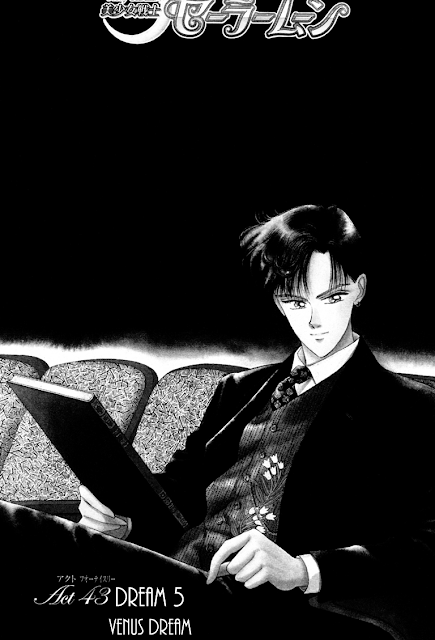
Bishojo Senshi Sailor Moon Act 43 Review


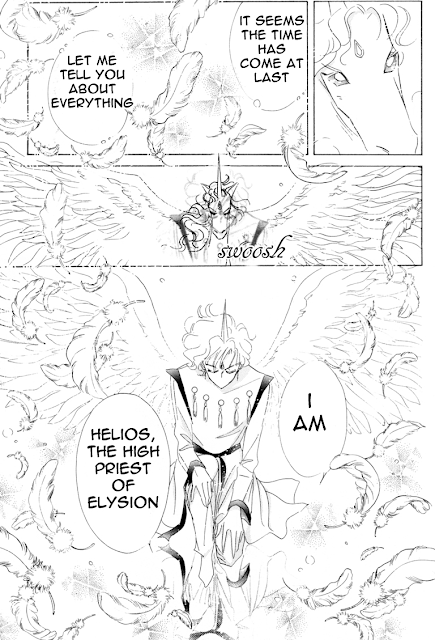
Continuing from the last act, the Lunar Senshi and Sailor Jupiter run to the side of Mamoru, extremely ill, and Helios, damaged from protecting him from the lemure. Mamoru coughs up the truth alongside his blood. Chibi-Moon asks Helios if this is part of the enemy's plan. To answer Helios takes on his humanoid form again, introducing himself properly as High Priest of Elysion.

As images of the planet are drawn in front of Helios to compliment the surreal tone, unclear if it's a physical illusion Helios is making or purely an effect Naoko is drawing for the reader's benefit, Helios explains his purpose. He explains that Elysion is a Holy Land resting deep within the Earth, acting like the Heart of the planet and that as the High Priest of Elysion it is his duty to protect the Earth along with it.


One of the things people cite as one of the draws of the Dream Arc is it is a visual showcase, showing along with the Stars Arc Naoko's development as an artist, particularly because the Dream Arc's tone allows her to regularly represent ideas with otherworldly imagery drawn alongside the literal events that are transpiring, allowing the artwork to shift easily between the literal and the symbolic allowing Naoko to do what she loves to do visually; draw striking images. I'm not especially good at analyzing visuals for quality, but I know that the final two arcs are usually considered the high point of the series visually.

Helios tells Mamoru he's Mamoru's guardian priest, addressing Mamoru as the prince of this planet. Mamoru is surprised at how Helios knows of his past life, and Helios confirms that he knows of Endymion, his prince, even if Mamoru knows nothing about him. He explains that his body and Mamoru's bodies are linked with the Earth and Elysion, that their bodies have been resonating together. He then uses some kind of x-ray beam from his horn that shows a black rose growing in Mamoru's chest, explaining that the black rose is the curse Nehelenia placed upon Elysian, affecting all four of them.


It's a very elegant shojo-y image while also being quite dark. 

Helios continues to exposit that the form they see now is just his astral projection, that his real body was imprisoned in Elysium and turned into a Pegasus by the curse. Chibi-Moon asks who did this. Helios finally tells our Heroes what they're up against. Helios tells them of the Kingdom of Nightmares residing within the New Moon, led by the Queen Nehelenia, sealed away long ago in the darkness of the new Moon. I really like this backstory as it's very fairy tale sounding yet has that cosmic Sailor Moon element.


In the darkness Nehelenia stirred, casting a dark curse on the Earth, infecting its heart, Elysion, and causing the dark rose to blossom in Helios and Mamoru as was shown earlier. Helios using the holy power of Elysion was able to for a time hold the curse at bay, but was overtaken but the nightmare which lay Elysion to ruin. 

With Helios' power gone, the Earth was laid open for invasion and the Dead Moon Circus emerged from the New Moon. But it is more complex then that, for the Dead Moon Circus is trying to encircle them, invading them from within and without, attacking the surface with their ship, and nightmares sieging Elysian, trapping them all. Once the nightmares reach the surface the world will die.


Helios mentions they have a single saving grace, that the Dead Moon Circus didn't realize the Heir to the Silver Millennium had been reborn upon the Earth, and implores Super Sailor Moon to save the world. Usagi gets all resolute and says she will of course save the Earth and Mamoru and defeat the enemy. However, Helios drops the other bad news...that even if they destroy Nehelenia, her curse will not subside. Instead, Helios says that the person he was truly looking for was the "chosen maiden", the one who can break the seal on the Golden Crystal which can restore the Earth. It does seem strange that another crystal could heal what the Silver Crystal itself could not but I will have my own explanation for that when we come to it. It also provides an extra wrinkle to the plot to give it the cosmic "search and find" mystery element most Sailor Moon arcs have rather than just have it be the too simple "beat the bad guy and everything goes back to normal.

Helios describes the chosen maiden again, one protected by moonlight, a soldier and a princess with beautiful dreams, the chosen maiden of the crystal can break the Golden Crystal, a description that can apply to both Usagi and Chibiusa. Helios is pained and begins to fade away as he loses the strength to maintain his astral projection, asking the Lunar Senshi to find the Golden Crystal and use it with the Silver Crystal to banish the nightmares from the Earth.

Mamoru continues to cough and double over from pain, and tells Usagi to stay away from me, that he doesn't want the curse to spread to her. Admittingly, I don't know why he thinks this curse can spread, but I imagine he was just being cautious and it does set up this awesome moment that comes next. Usagi tells him "I'm staying with you, just as you feel the planet's pain, your pain is my pain. No matter what happens, I will find a way to make you better" before embracing him wholly declaring in no uncertain terms that she WILL stay with him, that she will protect him and this world.

Every time I read this sequence I am filled with the impression of just how strongly these two love each other and how courageous Usagi is being for Mamoru. Usagi is a sensitive scared girl by disposition but it doesn't matter how scary the situation is, it doesn't matter if Mamoru's pain is a deathly infectious disease, she embraces him wholly, because his pain will always be her pain, because she wants to share everything he has and is with her. You can see in how she holds him to the fullness of her body that she is symbolically accepting him in his entirety, even his pain and suffering willing to bear it for him. This to me is such a strong beautiful expression of love. 

After that scene concludes with Chibiusa reiterating what was just said it cuts to the Guardian Senshi...discussing what was just said in the scene prior. The Guardians admit they don't have any strategy with Ami, Rei, and Makoto wishing the Outer Senshi were here, commenting about how the Outer Senshi made them stronger and how thinking about them in their time of crisis allowed the Senshi to reach their super state. Minako pretends to go along with this but it's revealed after that it's exasperating her insecurity as a leader, especially since she is the only one who still can't transform, something she's kept hidden from the others.


One of the things I like about Minako's chapters is they consistently mix up the plot structure that the others repeat, befitting Minako's chaotic and even cartoony energy. Minako was Naoko's favorite of the Guardian Senshi and you can really tell with how much unique plotlines she gets in the manga. Here for instance we don't get a contrast between a temporal dream and a deeper dream beneath that like we do for the other Guardians, we get Minako already focusing on her deeper dream but feeling like she can't reach it.

Artemis tries to encourage Minako telling her he's sure she will transform soon, just like the others did. Minako seems unconvinced and goes to take a bath. Artemis catches a glimpse of her bathing form and comments that Minako has grown incredibly beautiful lately, like the goddess Venus, though Minako herself isn't feeling it which is humorously reflected in the art.


This acts as a microcosm of the conflict. Minako has greatness inside her but can't see it, can't realize it.

After a brief gag where Diana comments that Artemis is looking at Minako like a boyfriend does a girlfriend and Luna bites Artemis for peeking on her in the bath, we cut to the Amazoness Quartet, who are doing circus things like swinging from trapeze or balancing on balls, commenting on one of the Guardian Senshi seemingly being unable to reach her Super Form. They comment on getting bored and two more Dead Moon Circus Members, Xenotime and Zeolite show up, and promise their "big sisters" the Quartet that they'll get rid of the Senshi.


You know I can really see why even though the anime adaptation of this arc despite being much longer and ridiculously full of filler, still didn't include these two because they are the most pointless villains in the entire arc. It's not like they have cool powers either, as you'll see...they just throw knives.

We cut back to the Guardian Senshi who are investigating the Dead Moon Circus. People are more irritable than normal and fighting all around them, which they don't know is from the intense heat, or from or supernatural interference. Rei brought Michiru's mirror using it to sense the strange disturbance and Ami comments that she's scanned the area and found there's a strange aura that is acting like a barrier around the region, attributing the discovery to a program Setsuna gave her, Minako visually twitching in annoyance. Makoto hears a helicopter which reminds her of Haruka and comments it'd be easier to scan the area from atop a helicopter like Haruka's.

Minako gets fed up, commenting that makes five times they've mentioned them...getting defensive and angry, thinking they all view her as undependable for a leader. Ami tries to console her and Rei comments she's acting strange which Minako has probably heard a lot as she runs off. Though of course, being Minako, she has to make a pun as she does so.


One of the great things about Minako is that she can do nutty stuff like this where it's somehow both comedic AND serious at the same time and the two to complement each other. Minako making a strange pun as she runs away makes the scene more comedic, but it somehow doesn't take away any of the serious impact and if anything exaggerates it by an expression of her personality.

Minako runs away, crying to herself that she's a failure as a leader. Then in...a bit of a whiplash, Xenotime from before in very slight disguise comes up to her and pretends to be a talent agent, who wants to scout her out to be an idol. We immediately cut back to Minako with the Senshi as they're all shocked she was scouted out by a talent agent, the drama of the prior interaction apparently completely lost on them. Everyone is shocked...


...except for Rei


Rei is used to this nonsense from Mina.

Ami notes that this seems really suspicious especially as it's a "Dead Moon Entertainment" production from a "Mr. Xeolite" according to her card, but as she's explaining it Minako is literally already halfway out the door. Minako in her own thoughts however reveals she knows it's a Dead Moon trap and is going specifically to prove herself as a leader and take it on by herself commenting  that she's Sailor Venus and she fights "for both fun and duty!"

She reaches the idol auditions which apparently called for swimsuits. Minako comments on how hot and humid it is. Seeing how many girls showed up for the idol audition Minako wonders if she can save all these people herself but worries that if she calls the others to help her, they'll find out she can't transform and decides that she's her mind up on it.


The audition starts and Zeolite calls out to them that that it's a story audition, that they are heroes in a jungle and have to get through the jungle and save the kids on the tower....I thought this was an idol audition, not an actress audition? Zeolite mentions the reward is 5,000,000 yen, though Minako obviously cares more about the childrens' safety. The girls run off with their fighting each other releasing energy with Jun-Jun collecting the energy, turning their dream (to be an idol) into a nightmare. Minako tries to calm them down, to no avail.

Giant rocks are rolled in the way of everyone and Jupiter shows up smashing them with her bare hands. The other Guardians get angry at Minako for not calling for help from them. Minako tries to transform, but to the shock of the others she can't, and in embarrassment, Minako runs away, devoted to stopping this herself.


Minako runs through the jungle commenting on the multiplying lemure sucking up everyone's energy, getting angry at how these girls just wanted to follow their dream and how she's gonna tear the Dead Moon Circus apart, climbing the tower. Meanwhile Xenotime and Zeolite are throwing knives at the Super Guardian Senshi and actually pressure them, telling them if they fight back they can't ensure the safety of their untransformed friend. Lemure attack the not fighting back Guardian Senshi.

Minako reaches the top of the tower, however the captured children turn out to just be disguised lemure. She's attacked by VesVes and one of the knife-throwing brothers, who pins her down. VesVes uses the lemure to brainwash Minako, but Artemis jumps in her face, scratching her to snap her out of it. VesVes, annoyed at this, opens the hatch below them, which causes what I think is  supposed to be a cartoon-style "temporary don't fall until you look down" gag


before Minako can fall Artemis catches onto her, somehow supporting her full weight on his little kitty arms. However PallaPalla arrives and summons another giant stone like before to come down so it will crush Artemis. The act ends on a cliffhanger as Minako yells for Artemis.


As I mentioned Minako's character chapters are always a bit different to the other Guardians in plot structure, seemingly in part because Naoko likes Minako most but also probably because Minako's chapters are last so Naoko wants to subvert the formula she had established. There's a little bit this act about Minako's two dreams, but the conflict isn't really about conflict between them so much as it is about Minako's insecurities as a leader.

On the positive side, I will say it's a fairly understandable and sympathetic motivation for Minako. Especially with how the last three chapters has had the other Guardians look to the Outer Senshi for their inspirations, as opposed to her their leader. Combined with her inability to transform and it's very understandable that Minako would be feeling insecure. Minako's antics and the reactions the others have towards them are generally funny as well.

I will say however this plot isn't resolved very well. It'd be one thing if it left on a cliffhanger and it was returned too, but without spoilers, this subplot isn't resolved in a way that really connects to Minako so much as it does another character. Because it's also focused moreso on Minako's relationship to the other Senshi, as their leader, it doesn't really explore Minako as a character in herself the way the other Guardian Senshi chapters do. There's a little of that with Minako declaring herself a Senshi who fights for fun and duty, but that isn't really an expounded on idea, or her getting angry that the Dead Moon Circus are exploiting childrens beautiful dreams for their energy but that's a motivation that could equally apply to any of the Senshi or really any heroically inclined character. Plus Xenotime and Zeolite are some of the most boring villains in the entire series.

Back on the positives though, I adore the sequence with Usagi refusing to leave Mamoru's side despite his sickness. I may had had problems with the whole "Mamoru hiding his sickness" in previous chapters but I think this resolution is a beautiful display of Usagi and Mamoru's love and a highlight of the Dream arc in general. I also thought that the lead up to it, while just exposition was very elegant and at least conceptually cool, even if I'm not sure what the deeper meaning is, if there is one. I've wondered if the idea of the Dead Moon Circus attacking from without and within is a reference to the idea of the two dreams, but that doesn't seem to connect based on depiction. 

It's strange to me possibly the most serious, dramatic sequence basically explaining the stakes of the arc are the prelude to Minako's silly antics this act, but on some level I think that's just Minako as a character, for whom silliness and seriousness, fun and responsibility, congeal and become hard to tell as distinct. Overall I think the act's pretty good; it had one great scene and the rest was pretty good and a nice mixture of serious and funny, even if not as deep as I'd like. Next time however, is an act oft considered the best act in the Dream Arc.