Sunday, April 16, 2023

Bishojo Senshi Sailor Moon Act 50 Review


The Stars Arc begins with Usagi and Mamoru in a passionate embrace kissing under a starry sky. As they do a shooting star passes by them. Mamoru brings Usagi closer to him and asks if she made a wish. While Usagi acts playfully defensive, she says that her wish was to always be by his side. Mamoru, smiling, asks if she would like to "return home" with her with the two watching a shooting star as they leave. 


This is definitely not the more childish Usagi from the Dream Arc. Usagi here is seen passionately embracing and making out with her boyfriend, returning home with with all the implications that holds, and now speaks of her wish to always be by his side, a reference to the realization of her true dream to protect the world at Mamoru's side in the Dream Arc as opposed to the childish dream she initially thought she had of just being taken care of. 

We begin the masterful atmosphere setting of the Stars Arc. Obviously there are direct references to stars both in the visual imagery and in the dialogue. Stars have had many symbolic associations but are most often associated as a class of object, as distinct from the Sun or any other star specifically, with the idea of eternity. The stars are, from the human perspective, seemingly unchanging lights in the darkness that with their dance across the Heavens, set the standard for time we use. This arc will deal heavily with the idea of the eternal and temporal and so the stars are the perfect image to use, and one I personally connect too with well. The tone of this can be read in several ways. I love how this scene was so atmospherically set that you can read it in several lights. You can read it as romantic, as the dialogue suggests with the dim lights over the second panel and Mamoru's individual panel over the scene an allusion to the romance of the privacy and intimacy of being alone with one's lover. Yet the dim lights can be read as a ominous, a metafictional foreshadowing of the fate of our lovers, especially with how Mamoru alone is in darkness. This act means something different to one who is reading this for the first time, and one who has read it already. It also means something different to the one who has read the entire arc, especially the final act and panel of the arc, with Usagi being shown specifically in light, with her embrace being shown as alight across a backdrop of stars, with her wish of being always by his side, which connect to the themes of the arc and the imagery used on the last page of the manga.

The Outer Senshi watch the shooting stars from their abode, commenting that it seems there are meteor shows every day, foreshadowing more directly the plot. We cut to a picture of a galaxy, indicating the vast cosmic distance the following image is meant to be from. A woman with long flowing hair and a long flowing dress looks into a crystal ball watching Usagi and Mamoru's embrace at the climax of the last arc, commenting on the beauty of the Silver and Golden Crystals. She proclaims that soon their glittering brilliance shall belong to her, fitting for her who stands victorious above the galaxy, that very galaxy reflecting in her eye speaking to her cosmic ambitions. 


Thus we are introduced to Galaxia. Galaxia is only around for 10 acts of a 60 act manga, yet is my favorite villain across fiction. I'll get more into why as I get into this arc but broadly the three reasons I like a villain are them being threatening (the degree they push the protagonist), entertaining (the amount they steal the show when they are on screen), and compelling (if they feel believable, to what extent I can understand their heart.) Galaxia isn't just good at all three, isn't just great, she is among the best villains in each of the three for me. This introduction, mysterious as it is, shows Galaxia's elegance and cosmic ambitions through the imagery and her words which somehow are of ultimate ambitions yet feel understated and restrained in a way that so perfectly fits her character. 

We cut to Usagi in her bedroom, awakening uncharacteristically early, and uncharacteristically serious compared to her usual "WAAHHHHHHHHH I'M LATE" routine. Perhaps just a sign of her newfound maturity as a high school girl. Yet Usagi finds to her surprise that she's crying without understanding why. A dark feeling has entered her heart. This has been seen before back in the Infinity Arc, when she started crying without knowing why because she subconsciously picked up on the sorrow of the Outer Senshi. But what is she feeling this time?

Chibiusa meets Hotaru to go to school, the two being all cutesy together. The two gossip about Kyuusuke and Momo getting together. Usagi comments that the two sure are close, being all cranky from the earlier feeling she had when she woke up. She comments on the two of them holding hands and Hotaru asks "Don't you and Mamoru hold hands." Usagi, feeling a bit upset about something involving Mamoru we'll find out later in the act basically just walks through their hand-holding


As mentioned, Usagi is just feeling down for ulterior reasons but once again.... very "subtle" way of alluding to Chibiusa and Hotaru's relationship Naoko, literally comparing them to Usagi and Mamoru.

Usagi meets up with the Guardian Senshi and we cut to Haruka and Michiru cutely bicycling together to school with Haruka complaining about getting up early. with Mugen Academy gone they have to attend...normal school. The horror. Michiru happily greets her fans greeting her. Haruka side-eyes her and comments she seems to be having fun and Michiru starts talking about how much fun it will be living out their youths. Meanwhile, in another cute scene, Setsuna is acting as the nurse for the Elementary School that Chibiusa and Hotaru go to, showing her maternal side. All the other kids get jealous of Hotaru for having a cool, beautiful mom.


I don't really have much to add to these scenes, they're just super cute and funny. I do think it's nice seeing these new other sides to Michiru and Setsuna, Michiru liking attention and having a romanticized view of youthful life and Setsuna enjoying taking care of children and having a fondness for cute things, as they two have had less focus then the other Outers. This is especially true of Michiru since Setsuna did have her own subplot, if short, in the Black Moon Clan arc. 

Back with the plot, we cut to Usagi in class with a cute bunny pencil when Minako throws a paper ball note at her. Minako asks if she wants to go to the CD store after school, but Usagi sends a cute note in return saying sorry, she can't, she's got something important to attend. After school Minako gets the low-down from the other Senshi. Mamoru's going away to study in America, and the crybaby princess is taking it hard, acting like she'll never see him again even though she can teleport. Minako complains she wanted to watch the Three Lights video she got on reserve making Michiru giggle. To my slight disappointment no one comments on the fact that every time a new idol group shows up they inevitably turn out to be mind-controlling monsters in disguise. 

Haruka asks and Minako explains that they're a popular new idol group with the cute girlish Yaten, the mature adult Taiki, and the cool guy Seiya. They're already popular with both Minako and Makoto being fans.


Michiru gives a bit of an elegant laugh and comments about "those boys." Minako notices and excitedly asks if she's a fan. Michiru coyly tells her that they're having their first live show in Shbiuya at the "Fantastic International Music Festival." Minako asks how she knows something even the fan club doesn't know and Michiru reveals she will be playing there as well, shocking Minako. A bunch of girls show up revealing Haruka to be the leader of the track and field club to be training these girls, all of whom are of course going all lovey-dovey over the attractive Haruka. 

This segues into a description of all the girls clubs with Michiru in the Swimming and Music clubs, Makoto in the Gardening and Cooking clubs, Ami in the computer club, and Minako in the volleyball club. All of which should be self-explanatory. Ami complains that she wanted to be in the computer club badly but it's full of boys who only play video games, she's the only girl there. Meanwhile, Minako with stars in her eyes says she's gonna get tickets from Michiru and they can all go see the Three Lights.


Makoto comments that Minako seems to be at peace. Minako responds that they worked really hard for this peace, they should enjoy being high-schoolers. Setsuna far away comments that this peace may not be long-lived however, ending the funtime shenanigans, cute as they were, and returning us to the drama.

We cut to Usagi and Mamoru at their airport. It's THIS scene. Mamoru tells Usagi he'll be there for a year, maybe a little longer. Usagi says that since Mamoru achieved his dream winning a scholarship to Harvard, she should be happier. Usagi says she told herself she'd see him off with a smile, and though she starts crying, she keeps smiling. The lovers embrace, Mamoru telling her to write him lots of letters. Usagi tells him that she'll write him a lot of letters and call him often.

Usagi asks him to return to her soon. Mamoru promises her that he will return but before he goes he pulls out a present. Usagi opens it to....find a ring...


It's a promise ring, a ring symbolizing his promise to return to her side, for the two to finally be together forever. I cry every time I see this scene in the original manga and in every time it's adapted. I just love these two together so much. The sheer level of support they give each other, the way they truly mean everything to each other, and how they can never seem to stay away from each other. This is a moment that means so much given how much they've had to fight to be together. They thought it was fate, it was the will of the gods to keep them apart. They've died and been reincarnated, they've had horrific monstrosities time and again try and keep them apart, yet it's their love that has always empowered them to continue on. The last arc used childish elements to relate its subtext of growing up, and indeed each of the first four arcs in their own ways were about themes related to adolescence from finding your own identity apart from one's history, about taking responsibility, about understanding what you are and are not willing to sacrifice, and about realizing the deeper dreams that undergird childish material dreams. This new act has shown the Senshi in a new stage of development truly as young adults, and it shines through in Mamoru's implicit pre-proposal here. 

The two lovers kiss


Then Galaxia kills Mamoru


Absolutely brilliant moment. It works on so many levels. First the obvious. It's a MASSIVE shock to the unexpecting reader, and even I who have read this manga many times feel a jolt from the suddenness. There's a general pattern you see in these kind of series. The Heroes go through the various minions or traps or challenges the big bad sets until they reach the big bad. Perhaps they and the Big Bad will meet a few times during it, but this kind of stuff just doesn't happen normally. What do people talk about when they talk about surprising deaths in fiction? I can think of no death more surprising I've ever seen than having the Big Bad surprise teleport in and kill the second most important character in the story in the first chapter of an arc. This act is telling the reader not to expect Galaxia to be another Beryl, Demande, Tomoe, or Zirconia. She's not going to be just sending out her minions to attack the Senshi one at a time (though she may do that as well.) She's going to take initiative. It's telling them that this arc is not like the others, the things that were important to this point like Usagi's love can die any moment. It's a moment that fills the series with sudden momentum and throws the reader into confusion and uncertainty. 

It also does the same to Usagi. This moment will underscore Usagi's personal conflict this arc, the seeming temporality of all things she trusts and relies on. It throws her from her safe comfortable orderly Solar System into the chaotic uncertain greater Universe. As sudden as this moment is, the prior part of the arc foreshadows this moment and its connection with the themes of the arc. It's been a recurring feeling so far that the Senshi have reached a new stage of maturity but with that comes that sensation; the feeling that all the things of your childhood are themselves a temporal stage of development and that safe comfortable world of yours will fade away leaving you in the seemingly infinite, dangerous and uncertain universe to find your way. Both of Usagi and Mamoru's interactions so far have been about the idea of permanency, that they will always be together. But can anything truly be eternal in the material universe? That theme of eternality and temporarily will be the recurrent theme of the arc and it introduces it by challenging the thing that seemed most trustworthy and eternal in the series so far; the union of Usagi and Mamoru. And what an introduction to our villainess! I love Galaxia for a lot of reasons and the very same thing that makes this moment so impactful are how it builds up Galaxia as our new villainess. She comes in and immediately, before we know her minions or goal or even her NAME, completely disrupts the set of assumptions the series is built on. The Sailor Senshi of destruction lives up to her title destroying the thing Usagi trusted in most, and with it her sense of invulnerability and stability. What other villain in the first chapter of a new story arc starts the story by just suddenly killing the second most important character in the entire series without it even being built up the entire chapter? This is what makes Galaxia so threatening and entertaining, the way she seems an unstoppable and unpredictable force, the way she breaks narrative conventions just as she might a planet, the way she breaks the reader's sense of confidence. I could go about this scene but I need to proceed at any time.

Usagi faints from the traumatic experience but is caught by Seiya of the Three Lights, who says they're already too late. The Three Lights escort Usagi's unconscious body away to the shouts of a bunch of fangirls. Usagi awakens in their car, smelling the fragrance of Osmanthus or Sweet Olives. In a daze she asks to be let out and walks away, with Yaten humorously saying "she could have at least said 'thank you' " only to be cut off by Seiya.


So Usagi's going to have trauma induced amnesia for a bit over Galaxia killing Mamoru. This doesn't really bother me as it wouldn't have truly changed the plot that much if it didn't happen, it doesn't cause any plot induced stupity, but I get that this might be frustrating narratively for some readers. I think it serves an important narrative function of representing the brutal part of reality Usagi has trouble facing, but obviously just because something can be thematically justified doesn't mean it's not narratively frustrating. I find for people that don't like the Stars Arc that's broadly the reason why. That the level of thematic depth doesn't excuse what they view as narratively frustrating decisions. I don't feel that way, but I think that's why some people don't like this arc in a nutshell.

The next day Usagi wakes up still in a bit of a daze with it deliberately mirroring the way she woke up the last day, to visually show that yesterday seemed like a dream, that it's all vague. Usagi goes to school and immediately Minako gets in her face asking if she gave Mamoru a hot goodbye kiss. Makoto notices the ring on her finger with Ami, Makoto, and Minako freaking out at what that means. Usagi, still glassy-eyed responds that Mamoru gave her this ring, got on his plane, and landed safety in America unable to face what happened.


This is how you make a scene somehow both a cute and funny scene, and also really sad. You give the scene completely different meanings to two different characters. The Guardians wanting to know the spicy details of Usagi and Mamoru's relationships and freaking out about Usagi's promise ring are relatable and funny and cute. Yet at the same time, Usagi is in an entirely different mental world as them, having seen the devastation of the Guardian of Destruction already. You can sympathize and understand either, and so the scene can serve as both at once.

We cut to Chibiusa recalling the entire Dream Arc saying she needs to go report all that happened to mama, meaning she needs to go back to the 30th Century. Diana adorably agrees stating she's "eager to help report on Small Lady's progress" which of course makes me imagine Diana giving a tiny but very formal, very serious report to the Queen. Haruka, Michiru, and Setsuna encourage her in this but Hotaru, in one of the most innocently cute things she says in the entire series says "you're going back home? That's no fun." She really is a child whose friend is going home for the day. Chibiusa tells Hotaru she'll be back soon...once again the problem of time travel....she could literally go and come back a second after she left.

In a...rather quick bit, Chibiusa says her goodbyes and leaves for the 30th Century, possibly to emphasize the subjective sensation to Usagi of the world changing uncontrollably so quickly. The Guardians comment on how with both Mamoru and Chibiusa not here, Usagi's gonna be so lonely but Usagi forcefully says that Chibiusa will be back soon and Mamoru will come back.


If you know what happened to Usagi, her response here makes more sense. She's trying to insist that everything's alright, that they're not going to be gone when she needs their presence, that they're gonna back because she knows subconsciously Mamoru's not coming back. 

Later the Senshi are at the concert with Michiru playing violin and Haruka playing piano, impressing the Guardian Senshi. The Three Lights come out to perform wow-ing the Guardian Senshi, especially Minako. Afterwards, the Three Lights meet Haruka and Michiru in person. Taiki and Yaten get along well with Michiru, commenting they're fans of hers. However, Seiya comments to Haruka that she "moves like the wind" alluding to Haruka's secret identity and the two share a tense handshake where Haruka senses the energy of the stars around the Three Lights


Of course with all the level of subverting her normal dynamic, Naoko also re-uses one of her old favorites, the "mysterious new allies" trope she loves to use every arc. And as always there's a level of mistrust between the two groups that Usagi must mediate between. Here they will always be a difference, but not to be seen for a bit.

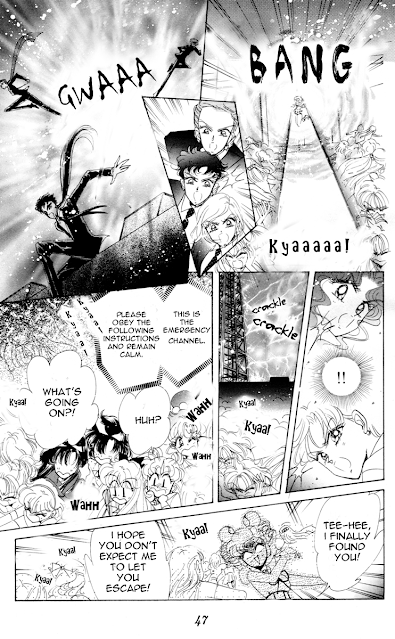
Meanwhile, a woman in a mouse-looking costume and shades is watching the Three Lights with interest. She comments that she finally found them, holders of Sailor Crystals, the ultimate Star Seeds. Feeling the energy of 10 other Sailor Crystals here as well she gets very excited, proclaiming Galaxia-sama will be very pleased and that she, Sailor Iron Mouse, will get them. Iron Mouse then shoots an energy blast at the stage where the Starlights just barely dodge, causing massive panic 


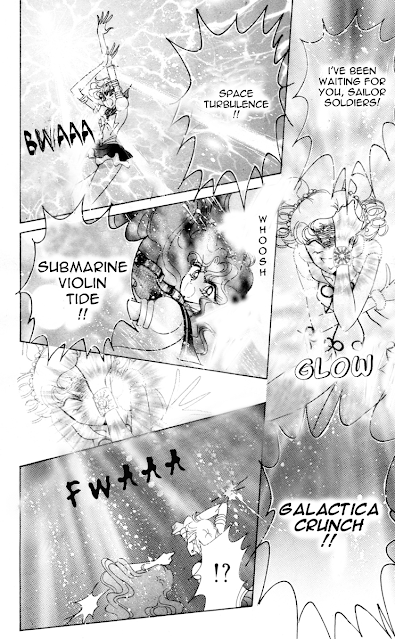
The Sailor Senshi transform to battle this new enemy, with Jupiter blocking an attack from Iron Mouse and Mars and Venus blocking off the door to keep civilians from being endangered. Uranus and Neptune attempt to attack Iron Mouse with their new attacks but she raises her braclets and calls out "Galactica Crush" seemingly nullifying the attacks. 

However, she's hit by a surprise third attack from a new assailant, blowing her up, briefly reminding Usagi of Mamoru. The Senshi look in surprise to see three new Sailor Senshi but dressed entirely differently from them.

The three fly away without saying anything, ending the act.


Act 50 is a great act, setting the tone for the level of quality for the Stars Arc. The obvious comparison are with the other arc-starting acts; Acts 1, 15, 27, and 39. 

Act 1 was an act that was incredibly iconic and rose into archetypal greatness with Usagi's henshin, yet had to spend a lot of time developing a mundane situation to get there and focusing on a lot of elements that wouldn't be important for most of the story. Act 50 also has a lot of mundane elements, yet these are not just much more entertaining because its with the cast of characters we've known the whole series as well as Naoko's evolution as a writer. Its mundane elements are far more integrated into the supernatural plot as opposed to just providing a contrast with things like Usagi and Mamoru's love scene foreshadowing or leading directly into Galaxia taking Mamoru's star seed or the Senshi's maturity reflecting one of the themes of the arc, the temporality of things. Yet this act also rises into archetypal greatness and if it was read as much 1, could have a similar level of iconic-ness, specifically the airport scene of Usagi and Mamoru.

Act 15 was an act that was full of life and mystery with the mysterious Black Moon Clan and Chibiusa's arrival, that set up the Black Moon Clan arc almost in totality in the plot elements introducing most of the Black Moon Clan at once while also having scenes of the Guardian Senshi in peacetime. However it was a bit thematically light, not really expressing what the themes of the Black Moon Clan Arc would be and maybe felt a bit cramped. Act 50 is as full of mystery, introducing the only member of Shadow Galactica that truly matters this arc, Galaxia herself, in a way that is full of intrigue, introduces the new allies in a way full of mystery, and also shows all of the Senshi in peacetime in a way even more effective then Act 15, as while in Act 15 the Guardians brush off Usagi's concerns about Chibiusa, here they don't even know what Usagi is going through. It does this without ever feeling cramped, able to send many pages just on Usagi and Mamoru sharing a romantic scene as set-up, and introducing the major theme of the arc in a way that is both unintrusive but evocative.

Act 27 was an act that introduced the arc being tonally more mature and full of intrigue, setting up the atmosphere as Act 15 did the characters, and introduced three of the most popular characters in Sailor Moon; Haruka, Michiru, and Hotaru. However the act also struggles to integrate the old cast and new cast naturally. I will say Act 50 isn't amazing at integrating the old and new cast, but it's at least comparable if not superior with having Galaxia kill Mamoru being a demonstration of how Galaxia breaks the established order of the series. It also expresses that this arc will be tonally mature and sets up intrigue around the characters, but whereas Act 27's maturity was a more slow paced maturity, a creeping darkness, Act 50 slams you in the face telling you to hold on because nothing will be the same. It not only sets up the atmosphere, it sets up a more immediately exciting atmosphere full of momentum. 

Act 39 was an act that was full of ideas and had to express some relatively esoteric images and ideas, feelings of dreaminess, and did so fairly well but in turn was rather unfocused being a relatively long act with a bunch of disconnected ideas and no clear emphasis. Act 50 also expresses the relatively obscure theme of the arc, but it does so more naturalistically and in a far more focused manner. While Act 50 and Act 39 have scenes that communicate ideas, Act 39's were disorganized while Act 50's were all unique character dynamics somewhat not seen before and built to the big set pieces. 

Act 50 does all this while still having its own identity. Act 50 is Naoko's writing at its more pure and efficient while also somehow subverting the formula she had become known for. Its thoroughly entertaining the whole way through with fun little details everywhere, yet also builds to a fantastic midpoint, which is a highlight scene of the entire series. Even without being the longest act it has several scenes that ring fantastic in my memory; especially the two scenes with Usagi and Mamoru. It sets up the arc perfectly, giving its theme and central villain perfectly while also giving it moment, and at the same time is engaging in itself. Its only weaknesses, some things being not 100% logically consistent within themselves like the inconsistency of Chibiusa's time travel or Usagi not being able to just teleport and see Mamoru whenever she wants is a weakness of the series in general and is worse most of the time. Some people might not like Usagi temporarily getting amnesia from trauma, but I don't mind it as a narrative device as it thematically fits the arc so well.

What amazes me about this act similar as Act 1 for the series as a whole, is that this is the norm for the Stars Arc. It's an Arc that the best of any arc would be the norm for this arc. Act 50 isn't an especially good Stars Act, this is just how good this Arc is. Yet it's still a fantastic act I love. I had to stop myself from just continuing to talk about some of the things this act and it always invigorates me for the Stars Arc. 

Sunday, April 9, 2023

Sailor Moon Dream Arc Review and Ranking

The Dream Arc is technically speaking my least-liked arc of Sailor Moon, though that's not really saying much. I love every arc of Sailor Moon and as I've mentioned before I like the middle three arcs of Sailor Moon roughly equally. I still greatly enjoy this arc. If I was to express why it's my least favorite it's broadly just that it doesn't reach the heights of the Second Arc, or especially the First Arc, nor is it as consistent as the Third Arc. Though in its defense I would say it is probably more consistent than the first two arcs and its heights are around as good as the Third Arc's. 

I recognize that this is probably an unpopular opinion as it stands. Possibly due to the release of Sailor Moon Crystal's adaptation of the Dream Arc, the best and most faithful season of Crystal to date, recent polls have had the Dream Arc being legitimately the most popular arc of the Sailor Moon manga. This really surprises me. Better than Black Moon and Infinity, perhaps. Better than Dark Kingdom though? Better than STARS? I can tell you when I was first getting into the fandom in my childhood, the Dream Arc was not a popular arc of the manga. Maybe it was connected to the then more recent 90s anime adaptation SuperS which is the most disliked seasons of the 90s anime but broadly the sentiment was that the Infinity Arc was the cool mature arc with the complex moral conundrum introducing three of the four cool Outer Senshi that were immediately immensely popular and the Dream Arc in contrast is one of the simplest and most childish of the moral conflict, if it even is one at all, and that it introduced no characters that people loved the way the first three arcs had. Sure Helios had his fans, especially among young girls, but to try and compare him or the Quartet to the characters the first three arcs introduced seemed wrong. The new characters and the new plot just seemed to be childish and lacked depth and "coolness." And in the 90s everything was about being cool and mature. However, cultures change and the pendulum has swung back on these concepts. Dream is now revered and Infinity I see criticized. With the change in public opinion, I did try to re-evaluate Dream and see if I was missing something that might radically change my understanding of the arc.  

The major theme of this arc is sort of explained in the name. The Dream Arc's themes is dreams, both literal but more often metaphorical the dreams we have for things we desire, and specifically, it's about the distinction between first-order dreams of love, things we want because they are good in themselves vs the usual material dreams we go around chasing as tools to get the former. When we forget the purpose of the latter and make them superordinate to the former, we are putting the cart before the horse, worshipping the created instead of the creators. This is shown in the dreams of each of the Senshi. Ami's deeper dream is to express her love, her emotional side she shunted when her artistic father abandoned her and her mother, but she mistook her second order dream of getting smarter for her true dream and could not develop until she reconnected with her younger self. The Outer Senshis' deeper dream was to finally live and fight alongside their beloved princess that filled them with hope from the across the Solar System, yet they mistook their second order dream of fulfilling their duties and responsibilities as their true dream and could not develop until they were moved from a legalistic view of their duties to one born of love. Sailor Moon's true dream was to protect the world alongside the ones she loved, but mistook her second order dream of peacefully living without responsibilities and being taken care of as her true dream and had to develop by realizing that the real Mamoru, the one she fell in love with, the one whose eyes had the same blue glow of that World brimming with hope and possibility and she always got stronger for, didn't want her to just remain static how she was, but wanted her to grow and improve. Examples continue to abound. The whole arc is revealed in the last act to having been taken place in a single waking dream the world was trapped in by Nehelenia in the moment of the eclipse. This is a recurrent image in the arc and a relatable one, the idea that in our daily life, we find ourselves becoming trapped in waking dreams, lulled by our perceptions, that we must be awoken from to progress. This connects directly with Saturn awakening the Quartet.

Like all the arcs the Dream Arc also contains the two central themes of the entire series; the ennobling power of love and the pain of solitude. In the Dream Arc this is usually expressed in the form of the duality of the two dreams. Almost all the Senshi express pain at their isolation from their material dreams be it Ami worried the others only value her intellect and don't her emotionally, Rei feeling isolated from her peers from her lack of a desire for a relationship, Chibiusa feeling insufficient in her perceived inability to compete with her mother, and so on. Conversely, their true dreams are always depicted as both bringing them closer to others and making them stronger usually being immediately accompanied by their Henshin into their Super Form, a form defined as being born of the Unity of the Sailor Senshis' hearts. In this the arc presents technically an idealized axiom, though in my opinion one barely more idealistic than reality; that deeper dreams will connect us to others, and conversely making material dreams primary will isolate us from each other. While this isn't always true in reality, there are some instances of people who truly have anti-social deeper dreams, such is exclusively rare. For the most part I relate to and find the Dream Arc's expression of the psychological reality of conflicting dreams very compelling. 

I don't think it's a fair critique of the Dream Arc to say that it is less deep than prior arcs broadly. While it's obviously much more black and white in its moral conflict than the Infinity Arc, its depth has been transferred from the realm of ethics to the realm of psychology containing some of the best character studies of Ami, Mamoru and to a lesser extent Usagi, Rei, Chibiusa, and the Outer Senshi. This arc has some other clear positives. More then any other arc I would say this arc connects well to other arcs, making constant allusions to the past arcs; the entire sequence of Nehelenia in the Silver Millennium, referencing the Black Lady plotline in the Black Moon Clan arc, the continuation of the Outer Senshi plot and internal conflict from the Mugen Arc as well as alluding to the Pharaoh 90 conflict in Act 44, a downright reiteration of the themes of the Black Moon Clan arc with Chibiusa's character, and a recontextualization of the numerous times Mamoru has given Usagi strength in prior arc climaxes. Similarly it foreshadows the next act to a degree no other act does. Act 44 has some of the crispest, most beautiful imagery and high-level poetic allusions in the entire series. The dreamlike atmosphere that this arc cultivates leads it to switch around in focus, which means that often even in the lesser acts of the arc there was often a really good sequence somewhere in.

However the inverse was also true. Even in the best acts this arc it would just switch to a sequence that felt arbitrary or outright contradictory. A sequence like the Pegasus flight sequence would appear in an otherwise lackluster act, yet on the other hand Act 44 still had bits that randomly didn't make sense like none of the other children in Michiru's violin class doing the obvious thing and reporting that the scary goth girl keeps making a ghost pegasus appearing. This arc may have connected to other arcs better then any other arc, but that meant at times it could feel a little dependent on them. So much of the final acts are about the Silver Millennium and to a lesser extent Crystal Tokyo rather then any Dream Arc introduced concept. The arc does explore returning characters admirably, but in contrast its new characters include the Quartet, characters meant to be the new Senshi that lack strong individuation, and a cast of villains more so supported only for strange powers and appearances rather than any interesting dynamic.

Oddly enough I think I like the Dream Arc a lot more because it's not the final arc. As a final arc Dream would feel like the series had begun to be dependent on its past ideas. As it stands now however the Dream Arc stands as a bit of a strange installment of the series that foreshadows the downright meta way the series would go with the final arc. If the Infinity Arc is characterized by Naoko's ambition, the Dream Arc on the other hand is characterized by self-reflection. It's Naoko using the dreamlike plot element to reflect on her own characters and the plot elements she had already introduced and to foreshadow what she had planned for them. In that sense you could say the Dreamlike atmosphere of the Arc is a plot device to allow Naoko to write at her more free self; writing towards reaching an emotional beat or a symbolic point rather than cohering to something making literal physical sense. 

That probably makes it sound more abstract than it is. The Dream Arc is not a super avant-garde work of abstract art. It's Naoko's reflection on her work and like many a self-reflective piece it incorporates elements of childhood including childhood whimsy and fantasy. In that, the Dream's arc potential and limitations; its strengths and weaknesses are seen. Much as a dream is speculated to be a way for the brain to organize the strangeness of the world to prepare one for the day ahead, the Dream Arc is an organization of all that has come before in Sailor Moon to prepare the series for its greatest endeavor, the climactic act. And like a dream, I find the Dream Arc confusing yet interesting, filled with strange unexplained elements and seemingly random diversions, yet also a deep meaning that enriches the soul and sheds precious light on the rest. 


Arc Ranking:

11: Act 45: They brought back my girl Saturn only to immediately write her out of the story again! It's not that this itself is particularly damning but the act itself doesn't have much in the way of positives to make up for its ending which seemed designed purely to make what was going on easier to write at the expense of interesting story possibilities and finally giving Senshi outside Usagi a chance to really shine in the main arc plot. That's the problem with the act in general which is skims over all the interesting parts. The Quartet start to awaken and immediately get sealed away. The Outers return and they and the Guardians don't have that many interactions. Especially given how much that was built up over the first half of the Dream Arc, it's disappointing. I love every act of Sailor Moon mind you, and this one has some nice characterization of Usagi and Hotaru, and Hotaru's fight with the Quartet is pretty cool if only because it shows Saturn really holding back and trying to show mercy on them, an ironic contrast from her depiction as the Messiah of Ruin last arc. That said, easily the weakest act in the arc.

10: Act 39: Act 39 is not bad, but it is unfocused. This is especially noticeable as it's the first act of the arc where focus is most needed as the act is meant to introduce the themes and ideas of the arc. A whole bunch of random things happen this act, presumably because Naoko wasn't sure yet where she wanted to expand the arc and so on reread it comes across as pointless such as Usagi and Chibiusa randomly bringing their Moon Kaleidoscopes to life, something not referenced anywhere else in the entire series. On the other hand while unfocused it does introduce at least some of the important elements of the arc and has more good points then Act 45. The sequence of Chibiusa flying over the city on Helios back is iconic to the series for a reason, Usagi and Mamoru's parental care over here is cute as always. 

9: Act 47:  Act 47 is a pretty fun act. It's mostly just a long fight scene between Nehelenia and Zirconia vs the Senshi but the other Senshi actually get to do more then they usually get to with Ami using her visor, the Senshi wounding Zirconia and making her run away, and Jupiter breaking Nehelenia's face with her fist, which is a real highlight of the arc to me. It's not an especially deep act and it has the weird "Helios is dead" melodrama that doesn't make any sense, but it's a fun read. It's definitely a lot more focused then Act 39.

8: Act 42: Jupiter's Dream Act is pretty decent, if kinda vanilla. I went back and forth on Act 47 vs Act 42 a lot, as both felt like fairly good reads for SM but nothing super special. Jupiter's was a decent vanilla character exploration of Makoto while Act 47 is a decent action sequence act of the Senshi fighting Nehelenia. However when I looked at the details of Act 47 I found several iffy parts. Act 42 on the other hand really shines in the details with cute bits like Chibiusa imagining the different Guardian Senshi giving her love advice, Nehelenia and Zirconia reversing the Magic Mirror scene from the Snow White fairy tale, or Makoto having a secret wish to be beautiful like Michiru. I don't think any part of Act 42 is as good as Jupiter punching Nehelenia in the fact from Act 47, but it's overall much more solid and even that part arguably detracted from Nehelenia's menace. 

7: Act 41: Rei's Dream Act is sort of opposite of Jupiter's Dream Act in my mind and there two are pretty much equal in my mind. Rei's Dream Act is very ambitious and parts of it I think are great. However similar to Act 39 to a lesser extent, it's a little unfocused, the parts not congealing as elegantly as the act prior to it. I really enjoy the humorous scene where Minako tries to convince Rei to get a husband to do all the work for her and I enjoy the differences between Mercury Dream and Mars dream where we see Rei doesn't lack confidence in herself the way Ami does, but her nightmare is one of betraying her own convictions. It also has Chibiusa and Helios' first kiss, if you're into that ship. Overall it's a good act and it does explore Rei's character but you really need to read it several times to get the full impact of it and it does not express itself to the fullest potential. 

6: Act 43: I like this act pretty well. Minako's exploration is good, it's just eternally unfinished because it's not concluded in this act and then in a later act it's made about Artemis instead. I love Usagi's declaration that Mamoru's pain is her pain and she will always be by his side, I like Minako and Artemis' friendship. The only real problem isn't so much its own fault as it is that it's unfinished and its plot isn't really resolved in future acts. Similarly it sets up the connection between Mamoru, Helios, Elysian and Earth which will cause the bizarre melodrama later about Helios not being able to be dead despite everyone treating that like a possibility. The villains this act are also some of the worst in the series history. I don't know on this one, it's an act with high highs but relatively low lows so it makes sense it's in the middle. 

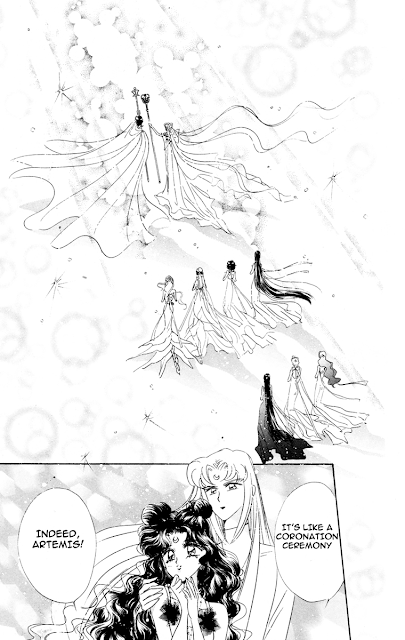
5: Act 49: The concluding act of the Dream Arc is a pretty sweet, nice conclusion to the arc that does wrap up everything important in the act and recontextualize it with a literal-izing of the arc's theme with the entire thing having taken place in a nightmare that presented the world from moving forward in time. The act can feel a bit repetitive, repeating elements from the last act (all the Sailor Senshi giving their power to Sailor Moon) as well as the Black Moon Clan Arc (Chibi-Moon wanting to be a full Senshi and step out of her mother's shadow.) However, the act never fails to excite me with its preparation of the reader for the Stars Arc as well as the poetic cosmic imagery with Queen Serenity telling Princess Serenity about the star in our hearts, or the King and Queen destroying the Dead Moon creating the light of their coronation. 

4: Act 46: I love the first two-thirds of this act though the last third is...not bad but not as good as the former. The sequence of Usagi's material dream is really good exploration of Usagi as a character in relation to the arc's themes and ties in seamlessly with her helping Mamoru to awaken his own Golden Crystal as the two realize they hold their same dream. The act explains the mechanics of the climaxes of the prior arcs without taking away from the magic, the romance of it, which is not an easy task. This is an act I love for its romance between Usagi and Mamoru as well as its expansion of the lore. The last third is fine, but it is just sorta more regular fighting with Zirconia. However even if I ignored that, I don't think it would break into the top three of the arc, which to me are in their own tier for the arc. 

3: Act 40: Act 40 is the best exploration of any of the Guardian Senshi in the main series, though some parts of Sailor V can compare.  Act 40 is really the act that sets the standard and the structure for the first half of the Dream Arc and which the sub-arc won't match until the end. It's psychologically complex yet realistic. Symbolic, evocative, and informative the act is everything one could want from a Character Exploration act. Act 40 is a real highlight for the Dream Arc and it's only not higher due to not really connecting to the main plot very much except in symbolism. 

2: Act 48: Act 48 is the climax of the Dream Arc and is generally great! Much of it is taken up by Nehelenia expressing her backstory, but whereas in many series and even elsewhere in Sailor Moon this could have felt overbearing and halting the pace, here it serves to tie the arc very well with the past and future arcs and doesn't overstay its welcome. Plus it's just a really cool sequence. Then there's the actual climax to the actual fight with Nehelenia with Nehelenia stealing the Silver Crystal, and Mamoru calling it back to Usagi's side through their love, a shining moment for him that's actually kinda set up by the mechanics so far. The art's my favorite in the Dream Arc at just the right level of abstractness with beautiful imagery everywhere. This act is pure fanservice with a lot of elements the fans constantly express wanting to see such as Queen Serenity/The Silver Millennium, the Senshi in their Princess Dresses, the Mooncats in their Humanoid Form, Mamoru contributing to Usagi, and more. However, there's one act this arc that's even more beloved and with good reason.

1: Act 44: The exact midpoint of the Dream Arc, with everything prior feeling like it built up from this moment, and everything after feeling like it came from this moment.  Act 44 is the Outer Senshi Dream act. The Outer Senshi were phenomenally popular characters at the time and Naoko made sure to write the continuation of their arc with the gravitas and style that they deserved. The act was the obvious highlight of the arc for me; emotionally gripping, symbolically potent, fun and relatable yet cosmic and alien at the same time in the way only Sailor Moon can truly be. Hotaru's sequence of coming to awaken again and lead the other Outers is my favorite sequence in the Dream Arc without question. The theme of the Dream Arc is never more compelling then this act which downright elevates the themes through allusions to some of the greatest thinkers in history. Act 44 is truly a fantastic act. 


Sub-Arc Ranking:

2: The Elysion/Nehelenia Sub-Arc (Acts 45-49): Despite basically being a large fight scene as a sub-arc, the sub-arc's pretty good overall. The final two-parter, acts 48 and 49 make for a really good climax to the arc that connects it to both past and future, while also culminating the themes of the arc. Act 46 has the really good sequence of Usagi and Mamoru in Elysion and Act 47 is fun enough in a fight scene-type of way even if it lacks in depth. That said there was a lot of details and random sequences that didn't work nearly as well sprinkled throughout; Chibiusa thinking Helios was dead when she knows he can't be, Chibi-Moon, Saturn, and the Quartet being written out of the story, the Senshi having to power up Moon twice in a row, Zirconia seemingly killing Usagi and Mamoru as the cliffhanger of two adjacent acts. 

1: The Senshi Dream/Quartet Sub-Arc (Acts 39-44): This sub-arc also had a lot of random details and sequences as well but they tended to feel more a bit arbitrary or unfocused then actually inconsistent such as the Senshis' weapons randomly coming to life, The Guardian Senshi being brainwashed for like a page in Acts 43-44, repetitions constantly of the villains talking about their plot, etc. The only really negative one was Mamoru's stubborn refusal to talk about what was wrong. Acts 40 and 44 were both fantastic acts that would be good acts in any other arc, and most of the other acts were pretty solid, being probably the best exploration of the Guardian Senshi in general of the series. There's also a lot of cute or funny details scattered about. 


Next time I start the reason I began this project; the Stars Arc. The Stars Arc in every version gets very strong reactions. I've seen people say that Sailor Moon should have ended after the Infinity Arc and that Stars is the worst. I've also seen people who don't even like Sailor Moon say that the Stars Arc is some of the best writing in the Shojo genre. Perhaps to be expected for a work that breaks down the series the way Stars does. As for me, the Stars Arc is my favorite story in fiction.

Bishojo Senshi Sailor Moon Act 49 Review


The Final Act of the Dream Arc.

Eternal Sailor Moon summons her new wand, the Eternal Tiare and calls for power from all their guardian planets to join together, coming together in her Tiare. Didn't this already happen at the end of last act?

This time differs however in that Mamoru also awakens the power of his Golden Crystal and send it to Eternal sailor Moon, with the narrative paying special focus to Chibiusa and Mamoru, meant to be resolving character moments for this arc.


granted, I don't know how this is any different for Chibiusa since again, she did this exact thing at the end of last act, but for Mamoru at least this does make sense since he started this arc not believing in his own power and now he's contributing arguably the biggest power to help Eternal Sailor Moon.

Eternal Sailor Moon attacks Nehelenia with her new attack "Starlight Honeymoon Therapy Kiss" which somehow hits Nehelenia from another dimension and Nehelenia spends three pages dying where she gives her dying speech as she reverts to just an ugly Zirconia, proclaiming she wanted to be the true lunar queen, that she is the eternally beautifully Nehelenia and most surprising of all that...she wanted Mamoru's hand in marriage?


So I understand the symbolism Naoko was probably going for here, but this just doesn't make sense objectively. Nehelenia's curse was destroying the Earth and killing Mamoru. Zirconia, who is part of her as shown here has tried to kill Mamoru several times, and Nehelenia was arguably going to kill him back when he and Usagi were in Elysian the first time, when she got angry about them shining their crystals at her. If her goal was to claim Mamoru as her beloved ala Beryl, it doesn't make sense that she would be doing all these things that would have killed him.

I understand where Naoko might have been going symbolically. The point of the arc is people forgetting their true dreams in exchange for material dreams, and as said by Nehelenia the darkness calls for the light and vice versa. I could understand the idea of she wanted the love of the Prince, that was her true dream, and she mistook the material dream of becoming the true Lunar Queen, a tool to achieve her true dream, as the more important one. That's the theme of the arc. But it doesn't make sense to have her be so aware of her dream here and at the same time be doing things that would actively kill him. Best case scenario, it's very convenient timing that she happened to remember her true dream right when it was narratively convenient at the last moment before the heroes killed her and not very well explained. Worst case scenario is Naoko just wanted to make her dream husbando seem hotter by saying "yeah even these eldritch abominations want him." .. honestly the worst case scenario might be somehow better than the best case scenario here.

With the death of Nehelenia, it's revealed that the entire time they were trapped in the moment of the eclipse as seen in Hotaru's game earlier in Act 44 when the moment of the eclipse didn't stop, and the eclipse finally ends with everyone on Earth waking up


This arguably can be used to explain some of the surreal elements of the arc including the weird temporal distortions and was likely what Setsuna originally sensed given she's connected to spacetime. 

Eternal Sailor Moon notes that the long nightmare is over, and flashbacks to her childhood in the Silver Millennium. The young Princess Serenity runs up to her mother crying as Venus told her a scary story of a horrible black monster living in the dream that eats up crybabies. She asks if that's true. Queen Serenity in response gives her a little speech I adore. Each of carries within our hearts a star. Light and Darkness are always side by side but if you let the darkness know you're afraid of it, it will swallow you up. To overcome the darkness of the mind, you must always let the star inside you shine brightly.


I don't know if Queen Serenity understood the truth about Star Seeds and was cleverly explaining the concept in a way a young child may be able to understand or if she is wise enough that she intuited a part of the fundamental nature of reality and is explaining exactly what she knows. Either way, this is at once a beautiful expression of the central theme of the series; the ennobling power of love, an expression of her maternal wisdom and love telling Usagi what she emotionally needs to hear to fight her own fears, and also hyping the audience for the Stars Arc. I get irrationally happy every time I get to this part because it's a great part that also makes me think the Stars Arc is imminent. It helps that Queen Serenity is a rarely used character, used for impact and that it's really drawn beautifully.
Back in the present, Eternal Chibi-Moon rushes off to Helios, only to find his humanoid body laying comatose on the ground. She pleads with him to open his eyes and gives the sleeping Helios a kiss, awakening him.


If we were going to  have the dark fey from Sleeping Beauty, we were obviously going to have to have someone be awoken by a kiss from their true love. As mentioned the drama of Helios being dead doesn't work for the reason Chibiusa herself explained last act, but emotionally speaking it's right for this to happen.

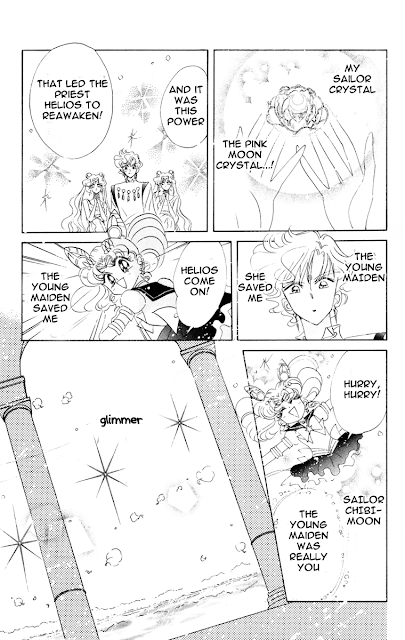
Helios opens his eyes and sees the lady that gave him prophecy earlier superimposed upon Chibiusa, revealing it was her that gave him his revelation earlier. He asks why she's crying and she puts her hand to her lips, and she says she's crying from joy that he's awoken. It's all very sweet. However then Diana tells Chibiusa that her crystal transformed into the Pink Moon Crystal and that's what awoke Helios.


So that latter part just doesn't work for me at all. Helios and Chibiusa's relationship is very sweet and everything about the maiden Helios searching for really being Chibiusa is good. However Chibiusa already made the Silver Crystal into her crystal in the second arc, the conflict and the resolution she had in this arc was a repeat of the Second Arc. It was awakening the Golden Crystal that broke the curse of Nehelenia that allowed Helios to be revived, not anything Chibi-Moon did. And for that matter what did Chibiusa do this act that made the crystal hers? In the Second Arc, it was the death of Sailor Pluto and symbolically her coming to realize that she had responsibilities herself, that she wasn't a failure of a daughter but the young princess who would somehow have to rule over the kingdom. Sure falling in love and kissing are elements of maturation but they're not unique to Chibi-Moon. This very scene of Chibiusa awakening Helios with a kiss is the inverse of the first arc where after the battle with Metaria, Mamoru awoke Usagi with a kiss. If anything this part is a demonstration again of how she is similar to her mother, rather then her own person. This part isn't unique to Chibiusa or to this arc. 

Helios follows Eternal Chibi-Moon out into Elysian only to find to his shock that it's been fully restored and he thanks Eternal Sailor Moon for awakening the Golden Crystal. He gives his prince a staff to carry the Golden Crystal upon, and just as Usagi channeled the spirit of Neo-Queen Serenity in the Second and Third arcs, Usagi and Mamoru channel the spirits of their future selves.


I think it's really cool the way Naoko has foreshadowed this moment by showing Usagi channel Neo-Queen Serenity's spirit at least three times since she awoke the Silver Crystal.

King Endymion and Neo-Queen Serenity rather casually destroy the Dead Moon, causing an immense light in the sky which is proclaimed to be the light of their coronation. 


This will be important later. 

The Sailor Senshi change into their princess dresses, save for Chibi-Moon and Saturn. It seems the implication is because the others are old enough, they are to be formally dressed for the royal occasion while Chibi-Moon and Saturn are still developing and don't need to be. Or Naoko just wanted to draw them in their princess dresses again. Now that Endymion has awoken his crystal, he is Prince of the Earth, just as Serenity awoke the Silver Crystal in the first and became Princess of the Moon and the two can be royally wed, uniting the houses of Moon and Earth.

Saturn goes before Neo-Queen Serenity and kneels, presenting the four Amazon Stones. At Saturn's request, Neo-Queen Serenity unseals the Amazoness Quartet who, Nehelenia's spell being broken, transform into four Senshi of the Asteroid Belt, the Amazon Senshi.


The Quartet secretly being Senshi explains the earlier part of the series where Sailor Saturn was telling them they needed to "awaken", the same language used for a Sailor Senshi. 

Sailor Ceres says that the Amazon Senshi were sleeping in the Amazon when Nehelenia noticed their sleeping power and somehow used the curse to make them puppets of the Dead Moon Circus. The Amazon Senshi says they will re-enter into their slumber as they wait for the future, telling Chibi-Moon that someday they will fight beside her and protect her,Chibi-Moon realizing that they serve the same role for Chibi-Moon that the Guardian Senshi do for Sailor Moon. Saturn thanks them and tells them that they will protect the princess until then.

The Amazon Senshi depart, and Chibi-Moon watching them go says that there will come a time she will stand as a fully fledged Soldier, and they will be beside her.


This is a pretty effective plot twist that I think is fairly well foreshadowed with the paralleling of the Quartet and the Guardian Senshi, and Saturn's refusal to fight them instead trying to get them to "awaken." While, as I've said, I think it's kinda repeating the Second Arc's theme, I do think Chibi-Moon's sentiment is sweet here. On some level I wish Chibi-Moon could have spoken more to her Senshi here, though I understand that would have lessened the impact of Chibi-Moon' dramatically and looking into the distance and expressing the desire to see them again someday.

Helios tells them it's time to return to the surface and summons his pegasus to take them there causing Chibiusa to gasp and proclaim he's like a knight on a white steed.


And like any good Naoko moment, this raises way more questions than it answers. Even though she was probably just trying to write fanservice for a young female audience.

Back on the surface, the Senshi say their goodbye to Helios. Helios says he will continue to pray for them from Elysian, putting special emphasis on Mamoru, the prince. Chibiusa all cutely stands in front of Helios with her hands on the edge of her skirt nervously as the two say goodbye. Helios tells her that he awaits the day they meet again with all his heart, and Chibiusa excitedly tells him that she will see him again, when she's grown into a real young woman. As Helios leaves, Chibiusa thinks to herself that Helios is her prince. She turns to see the Senshi enjoying the cutesy romantic affections of the young girl and encouraging her.


It's a really adorable little scene, and one that I admit, I find kinda relatable with the Senshis' reactions. The teasing affectionate encouragement of a young lady in her romantic ventures by her friends and peers. 

The act ends with a little linking between this arc and the next. Mamoru comments to Usagi that despite the battle being over, his heart still beats so warmly in his chest, like a little star is born in his chest, wondering it's the Golden Crystal he feels. Usagi paraphrases what Queen Serenity told her long ago. She tells Mamoru that each and every one of us has a star in our hearts, and the warmth you feel in your heart is proof that your star is shining brightly.

Looking at her loved ones around her, Usagi thinks to herself that to make her dreams come true, she will fight to protect the people important to her. Looking into the sky at the bright star she begs the star in her heart to keep shining and giving her strength. And if you know what's coming, you know why that's fitting and why she'll need it.


Everytime I read it, I get so excited for the Stars Arc. It carries a hint of that writing in it metaphorical expression of the feeling of meaning expressed in cosmic imagery, the star of our hearts burning brightly. 


As the epilogue act for the Dream Arc, Act 49 doesn't have to keep up the stakes of the large fight against Nehelenia that's gone on for the last several acts and can moreso focus on writing things that Naoko wanted to put in just to expand the lore, foreshadow the next arc, or just because she thought it would be cute. Broadly I think it does a good job at this, though as I've mentioned there's a few points where Naoko does as she is wont to do, sacrificing a measure of in-universe logical consistency or explanations for something to make better emotional or symbolic sense to the reader. 

Examples of this abound. Naoko repeats elements like the Guardian Senshi powering Eternal Sailor Moon from last act or Chibiusa going through some aspects of her Black Moon Clan arc development because she wants to create the emotional effect associated with the unity of the Senshi and Mamoru's development or appeal to the sense of the development of Chibiusa from childhood. She has Chibiusa worry and cry over Helios and awaken him with a kiss though Chibiusa explicitly knows Helios is alive, repeating an element from the Dark Kingdom arc in doing so, because she wants to invoke classic Fairy Tale symbolism. She has Helios take the Senshi to the surface on a flying white horse even though to this point Helios was that horse because it's wish fulfillment. As a problem, this is much better then the opposite problem. Creating emotionally moving, meaningful writing for the audience that doesn't make sense in itself is a lot better than writing something that is technically coherent and consistent but lacks spirit and meaning. However, it is an area I would say could be improved.

The highlights of this act, of which there are numerous are great. Very fitting for an act where time finally progresses literally, probably the best thing about the act is the feeling of progression, the excitement it gives to the readers for what's coming next. Some of this may be because I know what's coming next but that is definitely the feeling the act strives to make in the reader. Chibiusa's development is filled with declarations of how she will focus on growing into a young woman, how will she meet her prince and her Senshi again in the future. King Endymion and Neo-Queen Serenity's joint coronation not only will literally be an event recalled next arc but is an event celebrating the transition into a new royal phase, and the act ends with Usagi declaration symbolically looking into the future. The act gives the readers a sense of development just as the curse of Nehelenia holding everyone static, symbolically connected with the way the characters all fell into a static place fixated on their material dreams only to be freed by realizing their true dreams. Just as the characters break past their stasis and face the futures, so too do the readers get that sensation with the continual calls to the future.

The stellar imagery is also on-point in this act. I adore both Queen Serenity's explanation of the stars within our hearts and the callback Usagi makes later expressing it to Mamoru. It's a beautiful seamless connection between the themes of the Dream and Stars arcs, simple enough that both symbolically (a potential reader) and literally (Princess Serenity) a child being told a story can understand it, yet with a hidden depth that moves me reading it even now as an adult. It's concrete enough to be applicable to daily life, but abstract enough that it can be applied to numerous ideas. Is the star of our heart love? Meaning? Our true dreams? It's deliberately not any one of those as it would make the idea too specific, instead being exactly as abstracted as need be to be potent imagery. 

Broadly speaking Act 49's purpose is to serve as an epilogue for the Dream Arc and to prepare the reader for the Stars arc and I think it does it admirably enough. I would perhaps have liked Naoko to stick to her own rules and world-building more; not have Nehelenia's true dream so blatantly contradict her actions and have Chibiusa's character arc more notably diverge from her mother's so she can feel more distinct as a person for instance. However, the act provides very cute and moving content and imagery and provides the series with some momentum heading into the final arc.