Sunday, June 4, 2023

Bishojo Senshi Sailor Moon Act 57 Review


The story resumes with Kakyuu desperately trying to get to the blue flames encompassing the Starlights' bodies while Sailor Moon holds her back for her own good. The bodies of the Starlights disappear and Kakyuu tearfully mourns them. Yet Usagi recalls Yaten's words that their Star Seeds are eternal and uses that to comfort Princess Kakyuu by saying if they get the Star Seeds the Starlights can be returned to life.


It's a pretty sweet scene showing in a way Yaten herself reassuring Kakyuu since Yaten gave Usagi that knowledge specifically. More pragmatically I believe Takeuchi-Sensei was trying to lower the amount of characters that are around so she doesn't have to be concerned what they're all doing at any particular point. With the Amazon Senshi coming that would be kind of a lot to deal with in not a lot of page space. 

Eternal Sailor Moon, Sailor Chibi-Chibi Moon, and Princess Kakyuu fly off to the Galaxia castle. Then in a move that makes total sense when you know her master plan but is also one of the most hilariously petty things I've ever seen a villain do, Galaxia starts teleporting her castle away right before Sailor Moon reaches it over and over just to annoy Sailor Moon.


I could wax on about Galaxia being some kind of unreachable ideal or the parallel to the Silver Crystal's title as the Maboroshi no Ginzhuisho or what have you but honestly I just think this is really funny in how petty a way Galaxia is using to annoy Usagi. Sailor Moon thinks to herself that it can't be unreachable because Galaxia wants to fight her, she can FEEL it. She thinks to Galaxia "where are you Galaxia, where are the Star Seeds?"

Galaxia is indeed watching them from afar, enjoying annoying Sailor Moon when Chi and Phi show up, apologizing for the failures of Lethe and Mnesmonye, giving their Sailor Crystals to Galaxia. They comment at their tremendous power, at how they seem to almost still be breathing, saying that while Crystals without their body or mind normally only produce minimal power, thanks to Galaxia they can release the great power hidden with the Sailor Crystals, basically explaining why the Animamates could use the power of Sailor Crystals that aren't theirs. 

Galaxia states that with her Saffer Crystal, the ultimate force of destruction and the Silver Crystal, the ultimate force of rebirth, she will be invincible and control the galaxy...no...the universe. Galaxia speaks to her heart pounding with excitement and transforms for battle.


This is something I hadn't noticed until relatively recently but Galaxia's transformation brooch resembles Usagi's in arc 1, another visual demonstration of Galaxia being the Anti-Usagi. Sailor Galaxia prepares to meet Usagi saying they shall form a new history for the galaxy in their clash. Galaxia meets with Chaos and tells him it's almost time with Chaos speaking, saying it's almost time to form a new universe. 

Meanwhile back with Sailor Moon, she and her companions find themselves traveling through a strange fog, ending up in a graveyard where a strange butterfly themed Senshi stands before them, surrounded by butterflies. A funeral procession goes by and the mysterious Senshi says to our heroes "The butterflies are the dying embers of the stars, the funeral procession of butterflies flows forever through the galaxy." I think this is mostly just mood-setting but it's super atmospheric to me, the sense of finality and cosmic mystery going on, the sense that events rush past without our control. 

Kakyuu in shock finds the graves for the Starlights already made. The mysterious Senshi says it seems more flames have come to be extinguished, wondering what color butterflies will come from them. Moon and company sees their own graves being dug and the Senshi reveals herself as a Sailor Animamate Heavy Metal Papillion, the hunter of souls attacking them by binding them with vines. She says that to be burned at the stake is the logical tragic end for the ill-fated Messiah.


Heavy Metal Papillion is one of the most obscure villains in the series, only showing up for a few pages but Takeuchi-Sensei really uses the entire time to make her as dramatic and atmospheric as possible. Of course the real reason she included this scene is to reintroduce some specific characters into the plot.

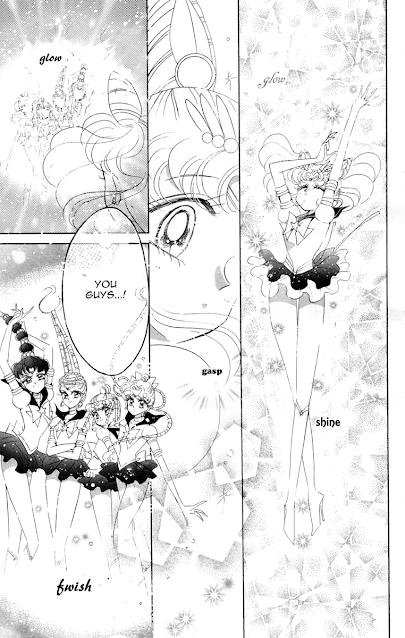
Though the Senshi are bound up Chibi-Chibi, in a conceptually really cool move uses the shine of her eye to send a signal back towards Earth. Instantly the Amazon Senshi and Chibi-Moon arrive, freeing Sailor Moon, Kakyuu, and Chibi-Chibi then killing Heavy Metal Papillion with a team attack.


I think Chibi-Chibi Moon uses the gleam of her eye as a distress signal to be a conceptually cool idea for how a cosmically powerful character might send a signal when tied down. Usually it'd be something like telepathy which is fine but not especially original. It's also important for Chibi-Moon's development that she and her team saves Sailor Moon from an enemy.

Sailor Moon and Chibi-Moon greet each other with Chibi-Moon quickly explaining what's been happening to the 30th Century, with everyone beginning to fade away save their Crystals and Sailor Moon explaining their Crystals were taken by Galaxia. Sailor Moon thinks back to Galaxia asking her if she really believes her future will come to be and redoubles her determination.


Sailor Moon and Sailor Chibi-Moon embrace for comfort. The Amazon Senshi mention that they were on Earth when a powerful ray of light shone to them, calling them to Sagittarius Zero Star. Chibi-Moon assumes it was Sailor Moon that brought them to the Galaxy Cauldron but Sailor Moon says she doesn't have that kind of power. They ask Kakyuu but Kakyuu also says she doesn't have that kind of power. They wonder how it could have possibly happened while little Chibi-Chibi Moon holds onto Usagi's leg.

Sailor Ceres notices the little Senshi and wonders if it's her, though is doubtful given her small size and timid demeanor. Sailor Moon explains that she's Sailor Chibi-Chibi much to Chibi-Moon's indignation. Sailor Moon comments that Chibi-Chibi crossed spacetime like Chibi-Moon and wonders if she's Chibi-Moon's little sister causing much shock on Chibi-Moon's part. The Amazon Senshi comment on the idea, noting they heart the queen only had one child.....this is another case of the characters not thinking logically with time travel causing a weird logic error. If Neo-Queen Serenity had another child past the time you were from, you wouldn't know about her yet but she would still be able to travel back in time. 

Sailor Moon wonders then if she's Chibi-Moon's child making Chibi-Moon have an even bigger shocked reaction, and wonder who her husband is. Chibi-Moon intuits Chibi-Chibi, whoever she is, is not her daughter, while Sailor Moon comments that Chibi-Chibi doesn't speak much but, regardless of who she is, has helped them many times and is a definite ally of theirs. 


In an amusing bit Chibi-Moon comments on the small girls whose power can reach Earth from the center of the Galaxy, an immeasurable power like Eternal Sailor Moon's, which is contrasted visually by Chibi-Chibi hiding her face behind Sailor Moon's legs. 

The fog clears and Galaxia's palace appears before the Senshi. However they are stopped by the "Star Gardeners" Sailor Chi and Sailor Phi, who welcome them to the Star Garden. Kakyuu demands the Starlights' Crystals but Galaxia's generals indicate to one of the clusters of crystals they've formed. Phi mentions that it seems more Sailor Crystals have come to join the Zero Star, which is a pretty cool example of Phi and Chi dehumanizing them as an expression of being enemies being used to further reflected Galaxia's philosophy. They're not people, their mundane identities mean nothing, they're simply more Sailor Crystals to be added to the clusters they've found. 

Princess Kakyuu prepares to get the Starlights Crystal by transforming into her own Sailor Form, Sailor Kakyuu


Why she didn't transform before now is not clear, though as Sailor Senshi outside Sailor Moon don't have infinite power, you could say that because she didn't need to be one to fly to Sagittarius Zero she was conserving her power for when she needed it. It's pretty cool that Kakyuu is a canonical, in fact the ONLY canonical example of a Sailor Senshi of a star rather than a planet or other smaller celestial body. She is the Sailor Senshi of the Kinmoku Star.

Sailor Kakyuu calls down extra power from the Starlights, either literally, given their crystals are right there, or emotionally it's not clear. Kakyuu uses her attack "Starlight Royal Straight Flash" throwing a series of cards at the Starlights Crystals to retrieve them however while Chi and Phi are unable to stop them, they teleport away regardless, presumably from Galaxia still watching and trolling them. 

Sailor Phi attempts to attack Sailor Kakyuu with her attack called "Galactica Plants Blizzard" but Sailor Kakyuu counters with her own attack, generating a flower storm around her called "Kinmoku Fusion Tempest." Sailor Moon prepares her Starlight Honeymoon Therapy Kiss attack to help when Sailor Kakyuu tells her that their bracelets are the source of their power. Sailor Moon finishes the attack destroying Sailor Phi but Sailor Chi teleports behind Sailor Kakyuu, stabbing her through with Chi's weapon. The Amazon Senshi counterattack Sailor Chi while Eternal Sailor Moon holds the dying Kakyuu. She professes her dying wish for a world of peace without fighting but says in a speech that will inspire Sailor Moon near the climax that even if there is fighting, she wouldn't mind so long as they are all reborn together again


Over the course of the Sailor Moon franchise if Usagi is a representation of the power of love, Kakyuu is a representation of the power of hope, being a character defined by her hope for a peaceful galaxy and the representation of the Starlights hope. These words will help inspire the climax of the series later and retroactively have more meaning, in Kakyuu's expression that she would be willing to be reborn into a world with conflict if it means being reborn with everyone else.

Sailor Moon expresses that she will be reborn, that they are Sailor Senshi and through their Sailor Crystals they will be reborn again and again, an expression of the eternal part of them. I like how they clasp their hands in this part, which is what Usagi said as an example of how through our physical bodies we make each other stronger and show each other love. Kakyuu perishes, her final words is saying that the Sailor Crystals are their hope. 

Sailor Chi watches this display and tells Sailor Moon that all this senseless death would cease if she would give Galaxia the Silver Crystal, that for the sake of the universe she should just surrender. This is the fundamental misunderstanding that Galaxia and her minions have of Sailor Moon and her allies, they see these deaths as just failures and therefore meaningless. But Sailor Moon and friends know that these deaths have meaning and that their love persists beyond the person's deaths, once again setting up the climax. Sailor Moon tells Sailor Chi that no matter how many lives are lost, this war won't end. Sailor Moon rises from her kneeling position and as she does the spirit of Kakyuu lingers in her memories,  the textbook indicating her as the symbol of hope, and she is filled with greater power as she one shots Sailor Chi declaring her faith in the purpose of the Sailor Crystals.


However in the distance, eight lights shine, the lights of eight Sailor Senshi to test Sailor Moon's hope, her resolve.

Princess Kakyuu's star seed flies away into the bracelet-clad arm of one of Galaxia's Senshi. Sailor Moon's next opponents are...


the Sol System Senshi.


Act 57 is a really good act however it's kind of difficult to talk about why because it's not so much that it's really good at any one thing in particular, but moreso it does a bit of everything. In contrast to the prior arc which was as almost as self-contained as any act in Sailor Moon could be, this act seems to connect with everything but itself. Indeed if I had any critique it's that the act in itself feels somewhat unfocused and like it doesn't have any particular throughline for it specifically.

This isn't a major plot act per se, it's still got an episodic story. Yet it does have significant plot developments with the death of Kakyuu and the return of Chibi-Moon and her Senshi, as well as the ending. These are some pretty substantial plot developments culminating Chibi-Moon's personal character arc, the ending of the act leading into the major events of the next act, and Kakyuu representing hope and her final words foreshadowing the climax of the overall story. However while all of these are sufficient or good: the ending builds suspense and excitement, Chibi-Moon's return is functional, and Kakyuu's death thematically resonant, NONE of them are the focus of the act. All of them are given a few pages to do.

Conversely this is not like last act where it's primarily an act a self-sufficient story of defeating one of Galaxia's defenders. There's two separate fight scenes this act; the first one with a new villainess, Heavy Metal Papillion, and the latter with Sailor Chi and Sailor Phi, Galaxia's two generals we've seen since the start. The former has good buildup and for a character with only a few pages has a lot of good atmosphere with trippy esoteric lines about death and the universe complimenting graveyard imagery, along with the Chibi-Chibi summoning the Chibi-Moon and company who save Sailor Moon. The latter obviously has been building over the arc and the culmination of Kakyuu's arc. However once again neither of these are really the focus of this act in particular, and are moreso dedicated to tying up some loose ends that the act had established prior and/or introducing elements which will be important later.

When you take these two things together the act is full of really good parts but is not quite as good as the sum of its parts due to a lack of narrative focus. You can kind of feel Takeuchi-hurrying to get all the plot elements she wants into place. But that's not to say it's bad, it's handled relatively gracefully or at least creatively with bizarre plot elements like reestablishing the mystery of Chibi-Chibi's power, bringing Chibi-Moon and the Amazon Senshi back into the story, and creating a resolution to the fight scene Sailor Moon is in with one action. 

There are some other disconnected bits of this act I think are good. This isn't meant to be a funny act but it does have Chibiusa's exasperation at Chibi-Chibi and the unintentional comedic of Galaxia's petty trolling of Usagi which I think is pretty hilarious. For a Stars Act it's not got the most philosophical musings or cosmic imagery but it has some with Kakyuu's final speech and Heavy Metal Papillion's introduction. It's relatively speaking not an act as focused on the central villain or conflict of Galaxia and her ideological battle with Usagi or the conflict between Gnosticism vs Nihilism, but it has some of that with Usagi remembering Galaxia asking her if she is sure the future she imagines will come to pass, Sailor Chi telling Usagi that it would be better for her to just surrender to end the senseless death, Galaxia transforming in preparation for her fight with Usagi using a brooch that mirrors Usagi's own in Arc 1 etc.

This is an act that I think is overall a good example of Sailor Moon. It's got a little bit of everything. It could stand to be a bit more focused or to be better organized but as it stands I think it's a pretty good act from overall having a lot of appeals to it. 

Sunday, May 28, 2023

Bishojo Senshi Sailor Moon Act 56 Review


Sailor Moon and company fly at the edge of the Solar System. Kakyuu gestures to the center of the galaxy, a giant light where many stars are densely packed saying that it is Sagittarius Alpha Star, with Sagittarius Zero Star being at its center. This is a reference to Sagittarius A, a supermassive black hole at the center of the Milky Way that all stars in the galaxy orbit around. The contrast between Alpha Star, the greatest and most supreme of stars, and Zero Star, a star of nothingness is also another reference to the two villains of Galaxia and Chaos.

Princess Kakyuu states all star seeds come from the center of the galaxy, it is the place where stars are born.


Sailor Star Fighter asks that if that's where the Shadow Galactica has made their base, then is Galaxia planning on controlling the growth and decay of the galaxy's stars. Kakyuu agrees that is most likely Galaxia's intent, and while they're not wrong technically, neither of them are thinking big enough. The Senshi grasp hands to fly to the center of the galaxy, with Kakyuu saying there's no guanrentee they'll get there safely. Sailor Star Healer says they're prepared regardless, knowing they were going into the middle of enemy territory. 

In literally one panel Sailor Moon and companies fly to the center of the galaxy...making their concerns of being intercepted seem oddly unfounded. However Galaxia is not trying to truly stop them from getting to her, she is planning on Eternal Sailor Moon reaching her. They reach the gate to Zero Star, finding themselves in a strange magical desert. A ferryman rows a boat across the desert, who identifies herself as Lethe, the ferryman of the "river of sand."


Seems Legit.

This is one of those cases where I think Takeuchi-sensei was a lot more focused on the symbolic side than the literal events. Deserts are one of the most commonly recurring visual motifs to represent barriers, challenge, or barrenness. Rivers and water in general are the opposite, representing life and potential. A mystical desert like this represents the barrenness of Galaxia's inner world, the way nothing persists in it, the same as Kakyuu's earlier statement that nothing lives under the domain of the Shadow Galactica. It being a river of sand is actually a really intriguing visual motif, representing the paradoxical union, a life made of barrenness and challenge, and reflects Galaxia's home world. That said if you're trying to follow the literal events this just comes out of nowhere and seems bizarre that they're flying through space and are just suddenly in a desert. There is also the more obvious reference that Lethe is the River of the Underworld in Greek Mythology and so the Senshi are here entering the "underworld", Galaxia's world of death opposite Usagi's world of life.

The Senshi board the ship because...I guess what else are they gonna do.....but as they go along the sand turns to water which swallows up the boat, sending Usagi into unconsciousness. Usagi awakens again in her civilian form, with a glazed look in her eyes. She asks where she is and how she got here. Lethe appears before and somehow manifests the Mooncats before her. But with the glazed eye in their eyes, Usagi doesn't recognize her.

Lethe says that if you take care of cats, you'll just be lonely when they die, you're better off by yourself. Usagi even in her dazed state disagrees, saying she gets lonely when she's alone and she thinks she wants to make a lot of friends. Lethe asks "Then what are your friends like?" However, Usagi can't remember. Lethe points to the ring on her finger, asking if she has a lover but Usagi can't remember, can't even remember who she is. 
 

Lethe tells Usagi that memories aren't worth much, even their bodies are just containers for the only thing of any real value, power. In demonstration of this cruel fact of reality, Lethe cruelly attacks the mooncats, getting at their Star Seeds. A painful scene but the symbolism is clear and strong here. Usagi has entered into Galaxia's world where this is the baseline assumption, this is the philosophy of Galaxia put plain and simple that Usagi is going to have to fight against. The body and mundane life is irrelevant, all that is important of someone is their eternal component.

In the far future, Small Lady feels a pain in her chest at Diana's pain in the past. She finds Luna and Artemis in pain, their bodies shimmering as if in and out of existence. Small Lady runs to her mother asking where Diana is. Neo-Queen Serenity responds that Diana felt a disturbance in the past and returned to help. 


Small Lady says that something has happened to Diana's body, she can feel it. Neo-Queen Serenity relents and shows her daughter what's going on. The bodies of the Senshi lay side by side, their bodies slowly fading away but their Crystals shining. The abnormalities in the past are threatening the future.

Small Lady, quite justified by this point, demands to go back to the past to help Sailor Moon. Neo-Queen Serenity tries to tell her it's too dangerous but Small Lady responds that it is her mission, that she can feel the pain of the others surging to her across time, that they call out to her. While Neo-Queen Serenity must stay here to guard the 30th Century, she will return in time to fulfill her mission. Small Lady transforms into Eternal Sailor Chibi-Moon, joined by the Four Eternal Amazon Senshi, Sailor Ceres, Sailor Pallas, Sailor Juno, and Sailor Vesta.


Neo-Queen Serenity relents, giving her daughter the Time Key and telling her that she will need to cross time, and the galaxy, making the latter sound more significant than the former. Strange as that may sound, time's dangers are circumvented by having a Time Key, while the dangers of the Shadow Galactica exist throughout the galaxy. 

Back in the present Usagi takes the dust in her hands in shock, asking Lethe how she can kill so easily and then in a super archetypal little exchange, Usagi says "Everyone is born to live" and Lethe responds "Living things are born to die."


In the temporal physical world we inhabit, both these facts are not only true but basically the flip-side of each other. It's a classic case of "is the glass half full or half empty." I don't think these statements can get more archetypal or universal, the meaning they hold is being expressed at the maximal amount precise.  Usagi is the heroine of the story, often associated with messianic and life-restoring themes, having brought everyone back to life on numerous occasions. Here she faces the ferryman to the underworld Senshi associated with death. As such there's a cool life and death symbolism reflected in their perspectives here. This also ties with the arc's greater themes. Transient things like individual lives are born in a sense to end someday, this is the fixation of Galaxia and those in her inner world, and it's true but it's not the full story, because as Usagi stated they are are also born to live, the very reason that they are born at all is to experience and go through life. 

Sailor Lethe attacks Usagi with her attack, who lays on the ground painfully asking why Lethe wants to kill her. Meanwhile, Mnemosyne watches but recoils at the sight, gripping the ground, clearly not wanting this to happen. Lethe tells Usagi she came here only to lose everything, as in the very point of Usagi coming here was to lose everything. Usagi knows that's not right, that she has loved ones to protect, but she can't recall anything about who they were to give her strength. Lethe says no one can beat her at the bottom of the river of oblivion and prepares to kill Usagi.  However Sailor Mnemosyne stops her sister, telling her that she's hurt Sailor Moon, just leave her to Galaxia. Hearing the words "Sailor Moon" restores Usagi's memories and she reawakens in the River of Oblivion.


Lethe gets angry that Sailor Moon somehow regained her memories in the River of Oblivion, while Sailor Moon rescues Chibi-Chibi. Mnemosyne telekinetically brings Sailor Moon and friends outside the water.

While Sailor Moon asks Chibi-Chibi if she's alright, Lethe asks Mnemosyne if Mnemosyne is betraying her. Mnemosyne, though less willful than her sister, replies that she doesn't want to hurt their fellow Sailor Senshi anymore. She gives Kakyuu water from the River of Memories, restoring Kakyuu's memories. 


Sailor Moon and Kakyuu address Lethe and Mnemosyne who introduce themselves. Lethe says that this it the outer moat of the Galactica Palace, with Lethe being the Guardian of the River of Oblivion and Mnemosyne being the Guardian of the River of Memory. Lethe tells Sailor Moon she can't let her take a step forward. Mnesmosyne tries to ask her to stop but Lethe just tells her to close her eyes, and asks her if she's forgotten their pact with Galaxia

This leads into a brief backstory for the sisters, that they were Senshi of a dual-planetary system, the two planets being small, dismal, and chaotic. War was constant. Galaxia arrived on the planets and her arrival wiped out all life save for them, Galaxia brought death and everlasting silence to the chaos. Galaxia told them that if she was victorious, they would find a peaceful place to live. However Kakyuu protests that they will never find peace or happiness under the Soldier of Destruction, that ruin and slaughter are all they'll ever find with her.


This backstory is great! You ever wonder why people follow these extreme fanatical movements, gnostic cults or the orders of a dictator. It's simplified, but this is why. Because chaos is fundamentally unlivable, and people will attach themselves to anything or anyone that can conquer the chaos, that gives their loved ones a world they can live in. Yes, Galaxia is a soldier of destruction who kills everyone, but even peacefully orderly death surrounding you is better than chaotic meaningless death surrounding you, because the former at least is comprehensible, it gives one a chance to rise from the circumstances. It is my opinion that the extreme gnostic impulse, and I speak from experience, comes from trying to bring order to the most chaotic of all things; the human heart. Likewise, externally people will align themselves to a dictator as a result of trying to bring order to chaos. Kakyuu's rebuttal is also well-founded. A peaceful happy world won't be made through destruction and warfare, the tools of a dictator like Galaxia. Galaxia this arc has been a physical threat, endangering Usagi's life, a mental threat as she breaks Usagi's mind and her plans seem almost unstoppable, a conceptual threat as she embodies the ideals and the ultimate enemy that Usagi must utilize her growth to face, and a narrative threat as she breaks the conventions that the genre and prior arcs have established. Yet here Galaxia is a spiritual threat, a corrupting force on the galaxy, turning Senshi against Senshi. Lethe and Mnemosyne are great character despite their briefness. Lethe is immediately compelling as a villain despite her dark actions because it's easy to understand and sympathize with her desire to protect her soft-hearted sister. If it was just Lethe wanting a peaceful world for herself, she'd seem understandable but indulgent and irresponsible. However, to do vile actions in the protection of one's family is a pretty classic motif for a villain to make it hard to hate them. I mean, what should Lethe have done, resist Galaxia to the end and let her sweet sister die? For what, her pride? 

Lethe responds to Kakyuu's statement by speaking to Sailor Moon in an accusatory fashion, asking if SHE will bring peace to them. Can she promise them a happy future, the way Galaxia at least says she will. Lethe angrily declares that Sailor Moon's power attracts conflict, that as long as she's there, the war will never end, and so in her eyes Sailor Moon is their enemy. She does this while standing protectively in front of Mnemosyne who in some of my favorite art of the series looks as Sailor Moon with a mixture of sadness and pity and anger, knowing Sailor Moon is supposed to be their enemy, and clearly on some level she is responsible for the conflict they bear, but also being soft-hearted and not wanting to hurt anyone. 


This is a favorite art of the series for me, the way their stances and faces say so much about them. Lethe says that no matter who wins, the future will be the same, she just wants to secure happiness for herself and her sister.

Sailor Moon responds that if Lethe truly believes it will end the war, that she will allow Lethe to kill her, much to the shock of everyone here. Sailor Moon says she came here to end the war herself, that she has the same mission and wish as them, that there is no more battle, that peace returns, no matter what future that entails for them personally. 


Personally, I don't think Sailor Moon was really telling Lethe to kill her there, but was saying the words she knew would best reach Lethe's heart because of their self-evident truth, but I know there's some contention there.

Lethe, unable to tell herself that someone willing to allow herself to be killed for their sake is their enemy and seeming to know already deep in her heart that killing Sailor Moon wouldn't end the war anyway, allows her to pass. However, Sailor Chi and Phi show up, denouncing Lethe and Mnesmonye for their weakness before taking their star seeds. The last act of the sisters is to hold each others hands as they disappear.


For basically only appearing in one act, Lethe and Mnemosnye are such good characters, I think. Their story is tragic, evocative, self-contained yet ties into the greater story and thoroughly engaging. 

Sailor Phi attacks them but Chibi-Chibi creates a barrier to protect them. However Phi does manage to take the star seeds of the Sailor Starlights, ending the act.


Act 56 is a much more active act than the past two, starting the second half of the Stars Arc. It's pretty notable that compared to the other Star Acts, it's pretty clearly the most self-contained of the acts in Stars. It's not filler, every SM act advances the plot at least some. This act has Sailor Moon and company traveling to Sagittarius Zero Star and the death of the Starlights which is fairly important to the Stars Arc plot. That said it's definitely the act that feels more disconnected to the rest of the arc. Like as someone whose reread this manga a lot, I see all the thematic connections this act has to rest of the arc, and it's place in the overarching narrative, though for a first time reader I can imagine the events of the act might seem less unified with the rest of the arc.

Talking about the internal story of the act first I think Lethe and Mnemosyne make for a good pair of antagonists, some of the most compelling in the series history and decently threatening. Their story is interesting and tragic and makes for a good test both physically and emotionally for Usagi. I do think that Sailor Moon regaining her memories from hearing the words "Sailor Moon" could be seen as a little deus ex machina-y. I would perhaps have preferred something that referred back to the first half of the act, such as the thought emerging in Usagi's mind that "I can't keep avoiding the pain" referencing she's already "lost" her memories and regained them in the arc. With that said I think the story is pretty good on its own. I like that Lethe and Mnemosyne's rivers form the "moat" around Galaxia's palace, as well as conceptually the ideas of the "river of sand" or the interaction between the embodiment of life, Usagi, and the ferryman of death, Lethe, exemplified by their brief exchange that things are born to live, and things are born to die. The exchange is an archetypal exchange as directly meaningful as asking if the cup is half full or half empty.

Where this act excels, as is the general case for Stars Acts, is in the symbolism which is what actually connects this act to the rest of the arc. While the act may seem kinda disconnected on a first read, if you've read the story many times, it actually serves a narrative purpose connecting the two halves of the arc. The first half of this arc is broadly Galaxia imposing herself on Usagi's world, the eternal pressing itself upon the temporal and breaking it, the affairs of the greater galaxy seeming inevitable and destructive to the relatively tiny local world of the Solar System. The second half of this arc in contrast is Usagi entering into Galaxia's world, reversing the usual structure of an SM climax, learning about this larger than life Soldier of Destruction who seems to control everything. The narrative purpose of this arc then is for Usagi to cross the threshold and see the effects of Galaxia's dominion over the Galaxy. 

In series where the hero has to infiltrate or bust a dangerous cult, there's always a scene where they first enter and the viewer is quickly exposed to several displays of atrocious acts meant to express to the viewer what's at stake, what the antagonist's effects on others really is. This act serves the same purpose, showing what Galaxia's effect on the galaxy is as a spiritually corrupting force that causes sympathetic Senshi to have to do horrible things to survive. To this point Usagi has encountered the effects of Galaxia's philosophy, but this the first act she has to encounter the worldview itself as she enters into Galaxia's world, exemplified by Lethe's statement that living things are born only to die. There idea of the eternal war and trying to bring peace to it is also an idea introduced which will become the driving idea for much of the second half of the arc. Finding peace is Lethe's goal, a time and space that would be safe for her soft-hearted sister. Kakyuu tells her that you won't find peace following a Soldier of Destruction, foreshadowing the revelations Galaxia herself will eventually realize, and Eternal Sailor Moon offers her life if it would stop the war, foreshadowing the question she will have to face at the end of the story; the choice between painful chaotic life and quiet peaceful death.

There are a few other points about the act of note. Chibi-Moon and her Amazon Senshi are going back to the past to help Sailor Moon which is a pretty good continuation of her arc in the Dream Arc. As mentioned the start's a bit weird with how they voice a concern only for it to be immediately disproved without any comment. Also Lethe killed the Mautians? I get that it was needed to show Lethe's expression of Galaxia's philosophy and representing the world Sailor Moon had entered but that seems really weird given the cats were on Earth at the time so...what?

Sunday, May 21, 2023

Bishojo Senshi Sailor Moon Act 55 Review


The act resumes where the last act ended, Galaxia's power blowing away the city while Usagi tries to withstand the force, thinking she's not to face Galaxia, an enemy beyond all others she's faced. She tries to telepathically contact the Outer Senshi, telling them to respond as she needs their help.

Galaxia however reads Usagi's intent and telepathically shows Usagi images of the Outer Senshi dying. Usagi remains resolute and thinks to herself as she reaches for the Holy Grail that she summoned in front of her that she'll get everyones' crystals back, and that united they will will be able to save everyone. Galaxia just floats through Usagi's barrier though telepathically asking if she really believes that.


Galaxia is my favorite villain and this is one of the reasons. When creating Galaxia, Takeuchi-Sensei was thinking about Usagi, one of the most iconic manga characters to ever be created and someone who has by far dominated the story so far with her narrative and ideals, and wanted to create a rival, an anti-Usagi who could break that sense of certainty that Usagi, the readers, and the narrative had built around Usagi's story and this is almost literally represented in Galaxia's words and actions here. She simply ignores the barrier Usagi built up around herself, she destroys the city around Usagi, the locality that represents Usagi's mundane life suddenly and out of nowhere, she questions whether Usagi even really believes that this will be just like every other time.

Usagi tries to protest that this is always what happens, that they always unite and protect the future but Galaxia scoffs at the notion, asking her if she's sure that future will happen. Galaxia destroys the Holy Grail, symbol of the unity between the Senshi. A surge of energy happens as Galaxia says that now Usagi's planet will be no more and Usagi collapses from the strain. However before Galaxia blows up the planet, Chibi-Chibi grows her angel wings again and creates a shine that actually recreates the Holy Grail and the city.


This is the first time in the narrative Galaxia's plan has actually not come to fruition, even if the basic thrust of what she was aiming at was achieved by tormenting Usagi more. I love how Galaxia, just as she started this arc by killing the leading male and second most important character without any hassle asks Usagi if her stereotypical idea of how things will go will happen. Galaxia, the Soldier of Destruction, just as she wipes away the city destroys the narrative certainty. Of course, on some level, the reader thinks that there will be some kind of happy ending, but the degree is left uncertain by how much Galaxia destroys the standard narrative established in the last four arcs, represented by her messing with the future. Maybe there will be a happy ending, but the sacrifices and losses could really be anything. 

The Starlights show up trying to figure out what happened but Chibi-Chibi just calmly says things are alright, without any worry at all, building to her secret identity. The Starlights are shocked that Usagi survived an assault against Galaxia, despite not even transforming and restoring the city in the process, commenting that this is the legendary power of the Silver Crystal.

We cut to Galaxia in a flashback, drinking alone at a bar on an alien planet, listening in on a conversation, or rather a man ranting. He proclaims  that there is a birthplace of the stars, strong stars and weak stars, light and power, that if someone had it they would own the universe and be like a god, not live "like that." Having gotten the information she was looking for Galaxia proclaims to him that "trash is still trash until its death" and leaves both the bar and the planet. Looking down upon it she speaks to herself saying "whenever I go, all I see is trash" and well...


Galaxia is a soldier of destruction indeed.

Galaxia suggests that this is the fate of both this planet and her home planet, implying she destroyed it as well, the ultimate example of Galaxia's disdain for temporalities, declaring she is the one chosen by God, the one given such power. Insane as this might sound and though I don't have the godlike ego or genocidal tendencies...I can relate to Galaxia here. More than that I relate to her more than almost any other villain in fiction, maybe more than any other villain period. On the Gnostic to Nihilistic Spectrum, my tendency is dramatically towards the Gnostic. Sure I don't destroy entire worlds but I know immediately what Galaxia means when it seems like the world is empty. When I watch fictional series, I don't feel very much for most of them. You go through chapter after chapter, episode after episode, for scant bits of meaning, but so much just seems...arbitrary. This character or that event happens because the writer felt like it I guess and there's no deeper reason. I don't....feel it. And this isn't something I feel only towards others. I don't talk about it much but when I write anything, I feel...almost a contempt for most of my sentences. Every sentence I feel needs to justify its existence, so many of them I just think to myself "That doesn't go very deep, that doesn't give enough meaning." Even in real life, so many moments of our lives pass by without conveying any deeper meaning and people just seem okay with that in a way I don't understand. I can find meaning in them, just as I can read meaning into stories or deliberately try to extract what's meaningful in them, but I have to work for it most of the time. I always want most things to be more efficient in meaning, to take less time and effort, and give more meaning. Indeed what I love about Sailor Moon IS that it's so meaning-dense. It communicates so much in so little time, and even there you'll see if you go back on these reviews I give praise to the acts that communicate meaning and criticize when the times when things feel empty, even if I rationally know that no human author could possibly make a long-form story so meaning-dense as I'd like. I don't exalt in the chaotic destruction many seem too, I feel no drive to mess up orderly and working systems...yet I do enjoy a form of destruction of my own, I enjoy mentally burning away all the fat and excess, cutting down on the excess and arbitrary and the... meaningless. I wanna see how meaning-efficient a series can be, yet even as I mentally do that, part of me knows for some reason that's the part of series others connect too. Things that feel shallow to me are the interest of others. This impulse within me taken to its logical extreme is Galaxia who destroys whole worlds...because they're not meaningful to her, because they're trash without value for her. This is part of Galaxia's character arc that makes her one of the most compelling villains, heck one of the most compelling CHARACTERS I've ever read. I know the emptiness that drives her, the quest to find the meaningful and eternal that will fill the emptiness. And the conclusion of her character arc moves me just thinking of it now.

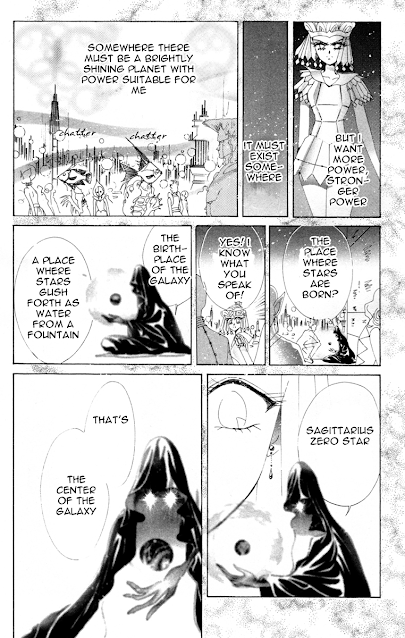
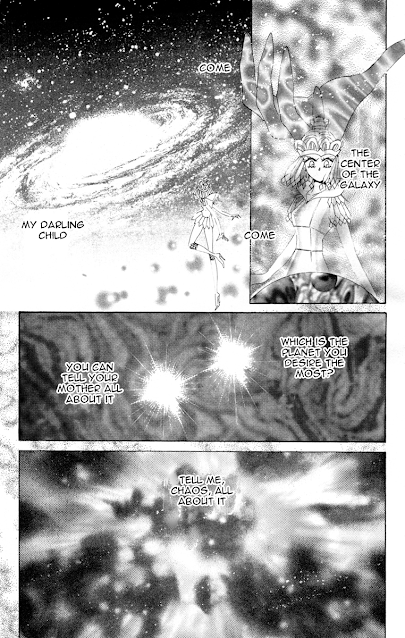
Galaxia in the flashback goes searching for an even greater power, a shining star worthy of her, looking for that mythical place in the universe where who does she run into, but Wiseman from the Black Moon Clan Arc. Knowing how to manipulate power-mad tyrants, Wiseman tells her of the place where stars are born, rushing forth like water from a fountain, Sagittarius Zero Star. Wiseman guide Galaxia to the center of the Milky Way where she meets a strange amorphous entity known as Chaos, who proclaims itself her mother.


Wiseman being here was a pretty cool reveal I think, and it probably makes sense time-wise. Technically Phantom appear until Crystal Tokyo so Wiseman shouldn't have been born yet, but he's also a time traveler and there's a reveal near the end of the arc which adds an extra way this could make sense. Galaxia's traveling around the universe is pretty cool especially since we see some really non-humanoid looking aliens with fish heads and Chaos itself is introduced. Little is seen about Chaos here but it's clearly going to be a bit plot point for the arc. 

Galaxia awakens from her dreaming of her past in her civilian form calling it a "tedious dream of when she looked for where she belonged." She mentions Sailor Moon shall come here soon, just as Chaos called her here to see the true, deliberately paralleling the two which will become relevant later as well as expressing that she became enlightened of something here. Galaxia beckons Sailor Moon to hurry here, saying the Earth is not even worthy of Sailor Moon alone, let alone a battle between the two, once again showing both her extreme larger-than-life personality and her disdain for temporalities-like worlds.


This is really cool although in ways that will make more sense after you learn the truth of what Galaxia is trying to do. Broadly though Galaxia after meeting Chaos had a mission, a goal, and her words mean more in their light.

Tin Nyanko returns, begging for forgiveness and one more change. However, Galaxia says that trash can never become stars, a reference to her dream flashback and to her believe that the only thing that matters about something is the eternal part of that thing, that the temporal part that changes is meaningless. She causes Tin Nyanko's bracelet to release and Tin Nyanko turns to dust, as Galaxia changed her body. The symbolism here is a bit more direct. Galaxia considers her minions temporal and like sand shifting in the wind, and so they become. 

We cut to a dream sequence of Usagi where she is beside a great shining star, hearing the sound of rushing water. Yet even hear she is not safe, for Galaxia attacks her, telling her that this is Sagittarius Zero Star, the Galaxy Cauldron, and dragging her down into it.


It's not really clear how Galaxia is doing this, even though she clearly is doing this as Usagi is being given plot information here. However, the reason why she's doing this is clear. She's tormenting Usagi even in her dreams, making it so she can't feel safe even in her dreams and trying to draw her to come to Sagittarius Zero Star. 

Usagi awakens again at Chibi-Chibi's prompting with the Starlights and Kakyuu nearby. Usagi thinks she thought she was being dragged down into that Dark Abyss, which is possibly a poetic reference to Hell or the Underworld. Usagi feels Chibi-Chibi's warm hands, commenting that Chibi-Chibi saved her, gave her strength through her warm hands, contrasted against the cold Abyss. Usagi wonders at the mysterious little angel sent from the future sent to save her, and at her allies protecting her while she's awake. Following up her feelings last act of losing herself to her eternal identity of Sailor Moon, bearer of the Silver Crystal, that her presence is what's causing her loved ones to be killed, Usagi thinks to herself that her friends are dying for her because she is the Guardian with the Silver Crystal...and then Usagi says something that is a massive moment in her own character arc and the themes of this arc in particular. 

Depending on the translation she says "no matter what, I'm still me" or "I just have to accept it. Every me is me." following by saying that because of that fact there are some things only she can do. Addressing the Starlights she says that they are more than their Sailor Crystals, but their bodies too. It is by seeing each other, by talking to each other, by joining their hands together, that their power grows. That it's only with their bodies can they combine their strength, that's what a Sailor Senshi is.


This is such a fantastic moment, I don't even know how to start talking about it. This is the character development for Usagi that foreshadows the climax of her battle with Galaxia and even here it shows the truly antithetical position for Galaxia. Usagi believes that these temporalities we live in are important because they are how we come to know each other, that the eternal component of our being come to understand each other through the temporary and transient parts of ourselves, and that's so...true. While I will get more into this in Act 59, the eternal manifests itself through the temporal so it can. Great metaphysical universal truths from gravity to fairness are experienced by the mind in the transient and humble sensations of mundane life from dropping a plate accidentally to seeing continually unlucky and feeling sorrow for them. These seemingly small meaningless and arbitrary sufferings of the universe and even its arbitrary joys are a communication between the inner eternal universes of our souls to with the eternal realities of the outer universe. What Usagi is saying here that their power as Sailor Senshi, as shown through their higher forms which are literally their hearts coming together as one, is formed of the bond their selves, their hearts, their Sailor Crystals form but THROUGH their bodies, their physical selves, that these silly mundane lives they lead are what connect them to each other and let them become stronger, that this transient world of temporalities, painful though it may be, allows the change that the Eternal Sailor Crystal alone would not. When most people, myself included, talk about great works of fiction we might say it makes other works look bad in comparison. But the Stars Arc of Sailor Moon is the only great work I know to do the reverse. It makes me love every single other work of fiction more because it helps me see them for what they really are: an attempt from one heart to express and communicate with mine, a physical manifestation through which I might see the eternal reality of another heart or the truths of the universe we share.

Usagi gets a chill thinking about Galaxia's words, though refuses to believe that her friends are lost forever, speaking to Galaxia in her heart saying she will return things to normal but in classic empathetic Usagi fashion trying to understand Galaxia's motive and why she is doing what she is doing. After that is a cute scene where Usagi gets up early the next day and Ikuko questions why, with Usagi asking if she can keep Artemis and Diana as pets, knowing they need a home temporarily without the others. Usagi explains that Artemis and Diana are Luna's husband and daughter, and says, with a sad expression that Minako can't look over Artemis at the moment. 


All the while Usagi thinks back to Kakyuu telling her that the damage to their foreheads aren't healing, and they may never talk again. The cats meow pitifully. The scene I believe is meant to show the growth in Usagi's composure and be emotionally evocative in how Usagi has to say these calm words knowing the reality.

Ikuko agrees to take care of Artemis and Diana as well as Luna, relieving Usagi. Usagi, having to hold back all her emotions tells her mother that she's leaving with Ikuko tearing up telling Kenji that it feels like Usagi's not coming back, the cats in similar despair.


That's some...ominous foreshadowing. Usagi goes off to war.

Usagi along with Kakyuu, the Starlights and Chibi-Chibi have a few exchanges, with Yaten surprised on Chibi-Chibi speaking normally now, the four planning to go to the ouskirts of the Solar System to meet up with the Outer Senshi. In a cute little exchange Seiya asks Usagi to give Seiya her hand, to let Seiya guide her. Usagi refuses, saying she doesn't want to be a burden and will keep up with them, but Seiya responds that she's a princess and a princess grows stronger when she gets protected. It's a cute little exchange. 

The Senshi grow Angel Wings to fly through the Heavens, as they take off for the Outer System. However when they arrive at the Outer Senshis' castles, they find them abandoned, only static playing on their screens. Usagi panics and rushes between them. When they get to Charon Castle orbiting Pluto however...


Sailor Moon learns from the visual recorder that Galaxia has already killed them. I know it would have super broken up the flow of the plot and probably wouldn't have been good for the overall symbolism and what they represent...but some part of me really wishes that Saturn and Galaxia had actually fought instead of Hotaru having her Star Seed taken in civilian form. Saturn vs Galaxia would have been the most hype thing ever.

Sailor Moon holds her face in her hands in anguish, saying if Galaxia wants Sailor Moon's crystal, she should just come after her, asking in despair why she is doing this to everyone. Sailor Moon declares that she will never forgive Galaxia, and addresses Kakyuu demanding to be brought to Sagittarius Zero Star. Kakyuu asks in shock how Sailor Moon knows of Zero Star. Sailor Moon says Galaxia told her of it, before addressing Galaxia directly saying to her that she's coming to get her. Meanwhile, transposed over this image in a really cool visual display, Galaxia senses Sailor Moon's intent across the Galaxy, telling Sailor Moon to hurry to her so she can destroy everything she loves one by one, till Sailor Moon is all alone. The two greatest lights of the universe are fixed against each other, their battlefield is set and the time of their battle approaches, concluding the first sub-arc of Stars.


The act concludes with a brief mysterious twin pair of girls, Lethe and Mnemosnye seeing an immense light approach them, the distant light of the Silver Crystal. Mnemosnye tells her twin she's scared and Lethe reassures her that she will protect her and their future, and won't let anyone step past them, obviously foreshadowing the next act.


Act 55 is fairly similar to Act 54 in its strengths. As such, I can hypothetically understand how someone might not be especially fond of it, given how much of it thematic self-reflection and dialogue and not actually much plot advancement, but on the other hand COME ON it's SUCH good thematic development. I think it's absolutely fantastic for my own part and it even advances the plot more than the last act. Parts of this act leave me truly at a loss for words because it's so...its strengths are so immediately evident to me yet also so deep in its themes and developments.

Act 55 concludes the first half of the Stars Arc. It culminates in the dichotomy of two subplots; Usagi's development and learning about Galaxia, comparing and contrasting them, forming the recurrent dichotomy of the first half that reaches its apex within this act, preparing for their clash. 

Galaxia is introduced as this mysterious character characterized by her larger-than-life nature, beginning the arc by declaring herself queen over the galaxy and proving herself so inevitable and alien to Usagi's world that she kills Mamoru, the leading male, during a romantic moment, halfway through the first Stars act. Over the course of this arc, Galaxia has seemed an unstoppable inevitable force, more than a person. Every time Usagi thinks she's won or is safe, NOPE Galaxia is here to take everything she thought was real from her. We see Galaxia only cares for the Eternal and the Universal, wondering why the Sailor Senshi cling to their mundane lives coming to the culmination this act as we see Galaxia's thoughts for the first time, her dismissal for the temporal nature of things with her declaration that trash will always be trash, her care only for the eternal, as well as the scope of her character. She is paradoxically the ultimate, the eternity, the top of the Senshi hierarchy that shapes the Galaxy's politics with her will, yet it's this various fixation that makes her compelling. 

Galaxia's destruction of the internal world of Usagi's security and expectations is continued into this act, to the point of being expressed vocalized as Galaxia asks Usagi if she is really certain that her future will come to being. Similarly, narratively, most of these arcs have a second half where the various villain group invade the planet directly. The Dark Kingdom freed Metaria who attacked the planet openly. The Black Moon Clan with Black Lady at their side attacked the future Crystal Tokyo directly. With the arrival of Pharaoh 90 and the awakening of Mistress 9, the Daimon attacked Earth to turn it into their homeworld, Zirconia eventually engaging the Sailor Senshi in open conflict when Usagi and Mamoru were weakened. However, these were the culmination of their arcs. Attacking the planet directly isn't Galaxia's plan or the point of this arc, so casual that Galaxia does so suddenly to start an act without even transforming and mocks the idea of the Earth being a worthy battlefield. Now the battle for Earth, for Usagi's inner world is only the prelude, the arc beginning where most arcs end. Now Usagi will have to invade Galaxia's world, come to understand this strange new enemy of hers, a seeming final equal and opposite to her, if she wants to win foreshadowed in her twice this act wondering about Galaxia's true nature, what kind of person she is. Now instead of having to protect her own planet, for the first time in the series, the second half of an arc will be Usagi entering into the world of an enemy, the great and most absolute inner world of the setting, Galaxia's world. the world of Sagittarius Zero Star. It's an immediately engaging subversion of the established structure that works on on many levels, mostly to show Galaxia's unique nature in the series history, how she focus only on the great and supreme things in the universe, how she is truly an equal to Usagi, whose inner world is equal in importance to the arc to Usagi's, how Usagi will have to come to understand Galaxia to prevail, foreshadowed with Usagi wondering multiple times who Galaxia is, and the way Galaxia parallels herself to Usagi with both being summoned to Sagittarius Zero Star, and is trying to make Usagi alone the way Galaxia herself is.

If Galaxia is the ultimate subversion of the series, breaking its narrative conventions, Usagi's arc over this first half, culminating within this act, is entrenched in the series' history. Literally this first half of the arc has been about Usagi coming to terms with Galaxia and preparing her will to battle against the greatest threat in the universe. But metaphorically it's about Usagi coming to terms with the transient nature of the things she trusts in and believes in. Usagi is introduced to us as an immature, irresponsible girl who nonetheless becomes stronger for the ones she loves. Over the course of the series, she has developed into a mature and responsible young woman, and a champion of love and justice, through the exact same principle. It showed Usagi's transformation in Act 1, and then showed that act on a far grander scope across the arcs, becoming a better, nobler, and more capable woman through her love for others. However, the first act of this arc where Galaxia killed Mamoru in front of her at the same time killed her sense of security and trust in the world she knew, the expectations she had that she and her friends would always triumph and defend everyone. 

For the first several acts she's unable to face this reality at all, completely disassociating from it. However, over the course of the arc, she has to grow to face this reality, embodied in Galaxia. Last act, Usagi wishes that their bodies would go on for eternity, her love embodied as angel wings which though they should let her fly through the Heavens, instead weigh her down, her greatest weapon, her love that ennobled her made into her curse by Galaxia. Yet this act she makes the emotional breakthrough with her proclamation "every me is me" neither prioritizing her material life as Usagi or her heavenly life as Sailor Moon, and asserting the diametric opposite of Galaxia's philosophy, that these fragile temporal material lives we lead to give them strength, and that itself is what a Sailor Senshi is. In doing so, she as Eternal Sailor Moon regains the use of her angel wings to fly through the Heavens, which is what allows her to fly to Galaxia's world. It is in recognizing her power to grow stronger as a Senshi that she literally, emotionally, and metaphorically regains the ability to confront Galaxia directly. 

I adore how each of the themes of the first four arcs can all be seen in this act as this act shows Usagi's development as a person and a Senshi to the point of being able to fact the ultimate reality embodied in Galaxia. In the first arc Usagi came to realize that her identities could co-exist within her at the same time, shown when she declares herself Princess Serenity and Sailor Moon against Metaria and when she chooses to live as Usagi Tsukino on Earth instead of as new Lunar Queen. That's seen with Usagi's declaration that she is still herself, that their bodies are an important part of them giving her conviction in her ideals. In the second arc, Usagi had to learn proper responsibility, taking on the ultimate maternal responsibility, a willingness to sacrifice herself for her daughter, and the responsibility of ruling over the entire world in the future but not taking the responsibility for Demande's actions unto herself. Similarly this act, Usagi thinks of how Galaxia is killing everyone she loves to get to her, a part that's clearly in her mind since last act showed her flashing back to Saphir making that same assertion. Yet instead of falling to despair again, Usagi refuses to take responsibility for Galaxia's actions and instead uses this to motivate it, to take the responsibility on her shoulders to stop it saying "There's always a friend risking their life to protect me. Even if it's because I'm the Soldier with Silver Moon Crystal...My being this way is exactly why there are things only I can do." The third arc taught Usagi the importance of looking beyond the surface layer of a person to their soul allowing her to see that the mysterious "boy" Haruka so alien to her was another Sailor Senshi with the same heart as her. Usagi ends this act looking at Galaxia no longer as some inevitable force, but as a person, a person whom Usagi wonders at the intent off. This makes her someone Usagi can fight, and will be important for her later in the arc. The fourth arc taught Usagi the difference between the surface level and deeper dreams, shown when she breaks free of an indulgent dream where Mamoru serves her every whim to share the same dream with him, a dream of the two in true partnership, working together to protect the world as symbol of their love. While Usagi's material dream is for the safety and security of her friends, that they might never die symbolized in her statement last act that "I wish these bodies would last forever," while Galaxia might have shattered the waking dream Usagi inhabited where they were all fine and wouldn't die, Usagi had a deeper dream, a dream of protecting this world surrounded by the ones she loves, a deeper dream that maintains her and empowers her in the time of toil, and as loving true dreams unites her with her friends regardless. Usagi has gone from a scared crybaby, half as good as any of the other Senshi to the light of the universe, a soldier who this very act faces down the strongest Senshi temporarily whose very visage paralyzes other Senshi and it feels so incredibly EARNED. This act subtly showcases Usagi's growth as though the entire series has built up to this moment of Usagi going off to battle her ultimate opponent with all the development she had.

This act is fantastic because it juxtaposes the series' two best characters in my opinion: Usagi and Galaxia, developing both, connecting to both past and future in its showcase of the development of Usagi and foreshadowing what she will need to beat Galaxia, highlighting the difference of their hearts, one who rejects the flawed temporal worlds we inhabit, and one who loves them, a conflict which if I'm honest, is one I experience regularly. 

That's not even getting into all the cool little details about this arc! The part where Chibi-Chibi fends off Galaxia, the first time the whole arc Galaxia has been stopped from doing something foreshadowing Chibi-Chibi's importance, Seiya and Usagi's cute little exchange about princesses being stronger when protected, Ikuko's comment about Usagi seeming like she will never come back building the tension and the finale where Usagi declares she is coming for Galaxia while Galaxia like a true supervillain grinning and inviting her to come for battle building the hype. I love this act and I could talk about it even more, it is the perfect thing to reflect on the greatness of the series so far and prepare the reader for the final sub-arc in Sailor Moon. 

Thursday, May 18, 2023

Mythology Scaling to Real World, Pros and Cons

I enjoy scaling Mythological Figures yet one of the eternal arguments that come up about it is the following:

"Yeah this character created a star, but they didn't think the stars were that big so it's not that impressive a feat."

I have to be honest, I'm a bit of two minds about this argument and can see arguments for and against it. This blog will basically be assessing this logic. Before I begin, however, powerscaling, though it might not seem it,  is really two related but distinct questions that each scaler needs to pick what they're asking:

"If these characters and their stories were real and they fought, who would win?"

and

"If these characters were written to fight, like in a crossover, who would win?"

These often have the same result, but have some different assumptions. If you're trying to answer the first question then when powerscaling a character you're asking "how strong would this character have to be, at minimum, to perform the feats they are attributed if these events actually happened?" and if you're trying to answer the second question then when powerscaling a question you're asking "how strong is this character intended to be depicted as." The two questions will have different perspectives on things like authorial intent, outliers, consistency, and diegetic vs non-diegetic interpretations of the text. 

When powerscaling, I'm trying to answer the first question. I don't usually think "how strong did the author intend this character to be" or "how strong are they usually depicted", my thoughts are "alright if this feat really happened, it would require about this level of power or speed to actually do." I don't necessarily think either way is superior or inferior, just that they are answering different questions. I'm going to try and talk about Mythology Scaling to the Real World using both questions.


Question A:

In Method A, what the author intended is seen as sort of irrelevant. As such if I was to talk about a feat for Zeus from the Theogony, how large Hesiod thought the universe was is kind of irrelevant. So that makes it nice and simple, right? Mythology Feats scale to the Real World equivalents?

Well, no, that's just where it begins. While this question treats the fictional setting as a "real" world for the purposes of the hypothetical, and therefore the author isn't being considered, details given about this world can be anything said in the text. If a fictional setting is meant to take place on a planet that is not Earth, then destroying the planet it takes place on can consequently be a different level of power than destroying the Earth.

This might seem like a different scenario however because these Mythologies purport to happen on the Real World and in fact, often seek to explain things about the real world. Therefore it seems especially clear here, though this would be my default assumption anyway, that the "universe" of the stories is identical to ours except where it is noted. This would be my default assumption anyway for any story.

There is an additional wrinkle, however.in the form of cosmological contradictions. Talking about "Mythological Zeus" or really "Mythological" anyone is always going to be a vague composite. What we call mythologies are really many stories by many writers who often have different cosmologies in mind and write different cosmologies. Yet at the same time, these stories ARE often meant to take place in the same "universe." They will very often directly reference each other, saying this person was the descendant of that person, or reference events from other mythical stories. The closest equivalent to how Mythologies are formed in terms of modern writing would be something like Western Superhero Comics with many writers over generations writing in a shared universe, except the DC Universe is 100 years old and has central editors to keep stories in line while Greek Mythology spans a length of time at least many times that length and encompasses everything from the pop culture of the day like plays, to the actual temple religion overseen by priests. These are writers distinct enough that Aristole refers to Anaximander as being "a long time ago" (~200 years difference) yet the full span is several times that.

And these writers did contradict. I remember being in one powerscaling debate about Zeus and my opponent refused to believe any of the Greek Gods could be above at max Star Level because one of the ancient Greeks estimated the size of the universe to be what we would today would known to be the size of a large star. However, the Greek philosophers and astronomers did not all agree with Anaximander along with others thinking the universe was infinite and with various primordial entities in the Greek Mythology having statements of being "boundless" or "endless" in the actual religious texts.

Broadly these contradictions have to be reconciled by whatever method a powerscaler usually uses to reconcile differences in cosmology by different writers. Other long-running verses with many authors have similar contradictions, it's just here the differences are on a wider scope due to a far greater timescape and lack of central editing authority. Broadly I treat mythological feats like I would any other feats, I treat it as equivalent to the real world unless I see a textual statement that the object of the feat is distinct, in which case I treat it how the verse specifies. If a mythological deity makes a star, I would call them star level normally. If the culture it comes from doesn't know what a star is, that doesn't really matter to me since I'm treating it as though the story is real for the purposes of the hypothetical. If philosophers of this culture have wrongful postulations that stars are holes in the sky as large as, say, a person, I wouldn't consider it important especially if there are conflicting views as I don't consider the mindset of the person writing the story important for the question at hand. If the religious text explicitly says that the stars are holes in the sky the size of people I would say the feat is the power level needed to make a person-sized hole in the sky. If it says numerous contradictory things about what the stars in the sky are, I will try to reconcile the maximum amount of information I can. 


Question B:

This is not my natural inclination, so I may not get the logic down for what people who ask this question would think on the matter. I am not as big a fan of answering this question as, being more narrative analysis-y than math and science-y, it's more ambiguous a lot of the time and more subjective.

Obviously if you take the Ancient Greeks or any society from Pre-Modern times they would not be thinking about their Deities manipulating stars and galaxies the way we would think about them, because they didn't know about these things. While the approximate size of the Earth has been known since about 240 BC when it was calced by Eratosthenes, the true size of the universe is obviously very counter-intuitive to the human mind, and things like manipulating the stars or the milky way are very obviously not intended by the ancient writers to be the sizes we know them as today, the very notion of such sizes would be even more baffling to them then they are to people today. Indeed many times Mythological Gods have feats of manipulating geographical features of the Earth; mountains, valleys, islands, and so forth, and this is meant to be very impressive which would obviously not be the case if they would also create stars as we know them today.

I do think there might still be an argument however to use real world sizes for at least a large amount of mythological feats as well. If we are considering Authorial Intent, most of the themes these feats are not included to specifically state the character is mountain level or star level. It's meant to impress upon the reader or listener the divine power of the gods. I highly doubt that if you went back to ancient Greece and somehow told the Priests of Apollo that the Sun is a sphere over 100 times the diameter of the whole of the Earth, that they would change their religious beliefs. Instead, I think they would respond something to the effect that this is the power of Lord Phoebus Apollo that his chariot flies through the Heavens regardless. The relevance of these feats in the minds of their authors isn't the specific power of the feats, but the great and awe-inspiring power of the Gods.  This is also why there are contradictions in power. Even ignoring the cosmic feats, it might seem a contradiction that Typhon, a monster on the power of Zeus could be trapped under Mt. Etna, yet Athena in the Gigantomachy hurled the island of Sicily in combat against the giant Enceladus, Athena being weaker than Typhon and Mt. Etna being a single volcano on Sicily. Yet both of these feats individually are meant to emphasize the divine power of the characters involved and are not concerned with the specifics of the the joules or kilograms involved.


Ultimately how the ancient Greek believers or any Pre-Modern people would have taken in the updated scientific knowledge of the universe we possess is unknowable. Broadly speaking for mythological feats I take the feats to be equal to the real-world feats unless the information is presented contrawise in the text itself, which is the same standard I take for any series.