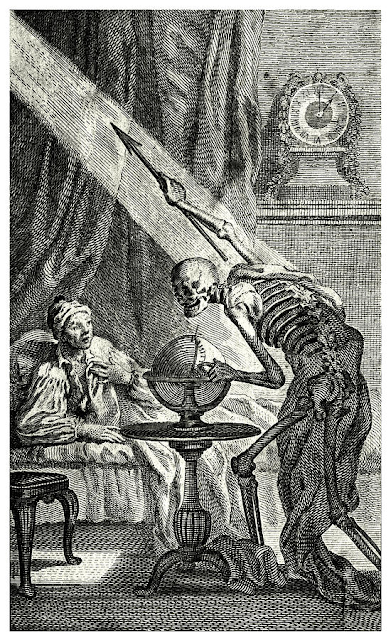
Darkseid, the New God Lord of Apokalips and most famous enemy of the Justice League
Trigon the Terrible, The Lord of Madness and most famous enemy of the Teen Titans
In terms of intra-universal matchups for DC Darkseid vs Trigon is one of the most talked about matchups, but even debated within the comics themselves by the characters

and with the Justice League: Apokalips film involving a climactic battle between the two reinvigorating the flames of discussion about this particular matchup.
It makes sense that these two would be matched up a lot as both are meant to be "ultimate evil" type figures, with both characters having statements of being evil itself or the most evil of beings on numerous instances, which makes some sense due to both of their connections to the Great Darkness.
As such I wanted to quickly give my thoughts on this matchup. For this I am using Pre-Infinite Frontier Darkseid as Post-IF Darkseid is one of the hands of the Great Darkness and I think that's a bit too much for this to be at all interesting.
So let's go over the two characters briefly:

In terms of power, Darkseid is a being from the Godsphere, the conceptual fourth world containing eight infinite "realms." One of these, Apokalips, is controlled entirely by Darkseid, with his power being able to switch Apokolips with the mortal world of Daxam despite the size difference

Darkseid has made the Spectre powerless before his almighty evil according to one promotional description

and beat down The Spectre's equal and dark opposite Eclipso

The Spectre is the Angel of God's Wrath whose power has numerous times affected all of Hell, even freezing it and one of the greatest demons of Hell Neron


Neron being so strong that he could easily defeat Lord Satanus in raw power, even when Satanus had the power of his sister Lady Blaze, and base Satanus being strong enough to warp all of Hell to his image


This shows that even on the conceptual plane, Darkseid has infinite power.
Darkseid however isn't known primarily as a physical threat, but as a mental threat, being one of DC's smartest beings being the a cosmic hypergenius even within the New Gods, a race of cosmic hypergeniuses. Darkseid has invented technology on multiple occasions that tap into the Source or its' dark half, the Anti-Life Equation, extremely fundamental and primordial energies in the DCU


and Darkseid regularly draws chess matches against Eclipso, one of the tactically trickiest minds of the DC villains

Darkseid, like all Major Godsphere entities has a wide host of abilities including pretty much all conventional haxes like manipulation of matter, energy, space, time, souls, and minds, as well as reality-warping, time travel, and so on. However, Darkseid has some abilities that are particularly notable even for high Godsphere Tier characters
Darkseid's most famous ability is his control of the Omega Effect of the Infinity Pit. This grants him several abilities including shooting his homing conceptual existence erasing omega beams which causes beings to cease to have ever been


These Omega Beams have been referred to as "Termination itself"

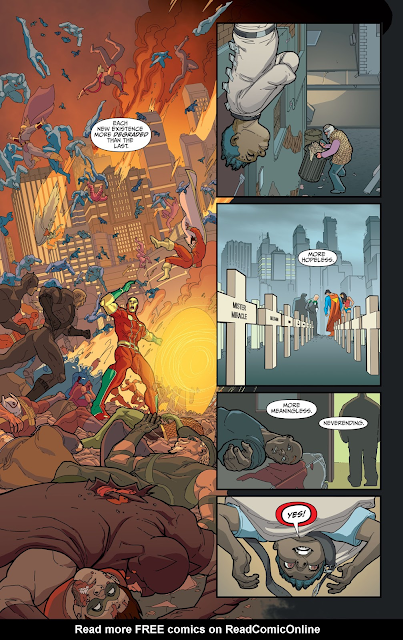
The Omega Effect can also allow Darkseid to sentence someone to the Omega Sanction, which traps the user in a series of infinite nightmare realities that get progressively worse and worse to break them of all hope

The Omega Effect also allows Darkseid to absorb the life and energy from other entities to amplify or replenish him. Even when highly weakened, Darkseid was able to do this to incredibly powerful sorcerers like Mordru before draining all of Mordru's world of Sorcerer's World


and let Darkseid defeat the similarly powerful deity Zeus by draining him of his lifeforce


Darkseid also has a form of conceptual manipulation having captured an aspect of Death, the Black Racer, and making it subservient to him, able to summon it at will and command it in his battle against the Anti-Monitor


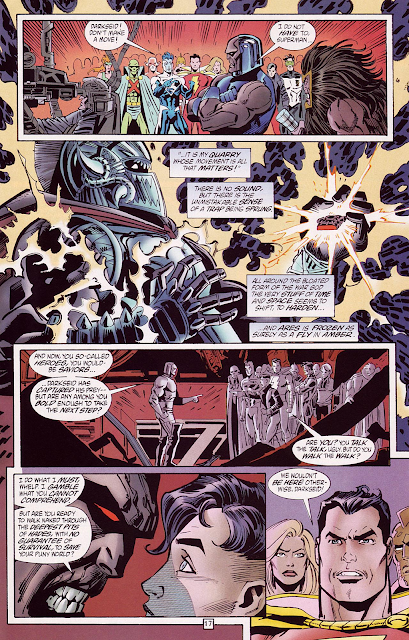
Darkseid was able to harden the spacetime around Ares after Ares gained the power of the Godwave, amplifying him to a power level far beyond Darkseid, freezing him in time
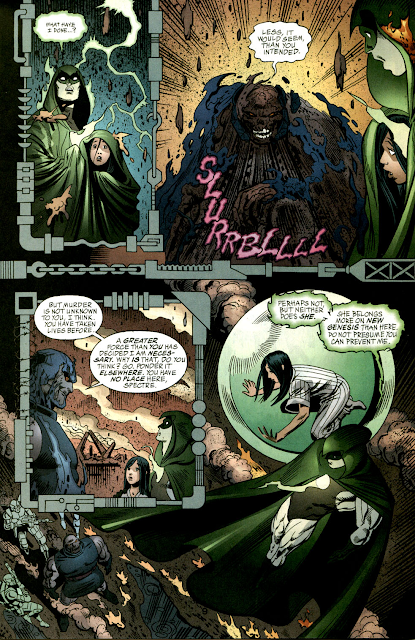
Finally because Darkseid a necessary component of existence, when the Spectre killed Darkseid with the Logoz, Darkseid simply... returned to life.

Darkseid obviously has many more abilities, but these are his most relevant against similarly powerful entities. Though his most powerful ability is definitely his ability to sit on your couch

In terms of weaknesses, Darkseid like all the New Gods is weak to Radion, which is essentially Kryptonite for the New Gods. However strong New Gods like Darkseid have at least some resistance to Radion.

Trigon is another being of the Godsphere, specifically he is one of the Demon Lords of Hell. As a Demon, Trigon's power varies somewhat depending on the souls he's consumed, though at his peak he is an extremely powerful entity.
Trigon entered the domain of the aforementioned Neron and threatened that he was making the Hell Lords look weak before threatening him directly. This threat was enough to make Neron, a demon who's all about manipulation and trickery, corrupting people through lies and deceit, to go on a direct offensive and stop with his usual means, showing he took the threat very seriously
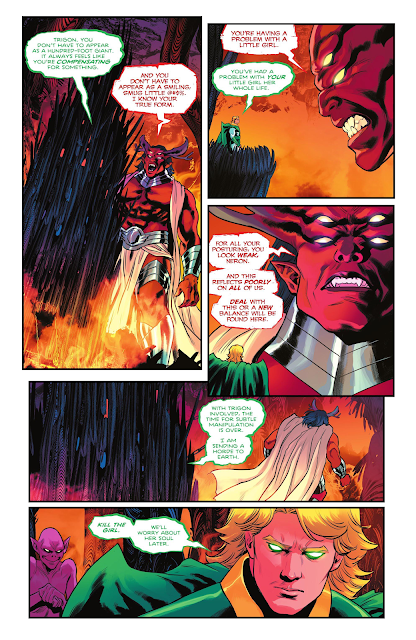
In the New 52 storyline Future's End, showing a possible future of the DC Universe, Trigon is shown leading a council of extremely powerful demonic or dark supernatural entities including Neron, Eclipso, and Blight


Neron and Eclipso I mentioned in the last section but Blight is different and potentially even stronger than they are. Blight is one of the Justice League Dark's strongest villains, and threatened to unite the physical and metaphysical realms

The Metaphysical Realm refers to the Godsphere, meaning depending on how this is interpreted, Blight may be able to manipulate the entirety of the Godsphere, as in the eight realms of Heaven, New Genesis, Skyland, Nightmare, Hell, Apokolips, Underworld, and Dream, as well as the intermediate spaces. You could say that uniting them just means manipulation of the entire physical realm and merging that with a part of the Godsphere. This arguably makes more sense scaling wise and as a plan, but is the opposite of what the actual issues with Blight imply with talk of it affecting all creation.
Finally there's an even bigger potential scaling for Trigon. In the Injustice Universe, Trigon is depicted as battling evenly with Mr. Mxyzptlk

This fight was not intended to be canon when it was written as Injustice was originally not meant to be set in the mainline DC continuity but retroactively became such when Injustice was revealed to be one of the Earths in the Multiverse. This causes a lot of logical problems and is inconsistent power-wise for Trigon but this fight technically happened in the multiverse. The most consistent way to scale this is to assume that Mxy was just playing around as he sometimes does, though it still causes some logical problems in terms of canonicity. If you do think Trigon scales to Mxyzptlk then he would be wildly powerful with any being from the Fifth World being able to fall upon and destroy the entire Fourth World/Godsphere just as Fourth World Entities can do to the Third World/Physical Multiverse. And Mxy's among the strongest.
Trigon's not especially known for his intelligence, though like all Hell Lords Trigon does have to keep up with the internal politics and scheming of Hell and sometimes makes bargains with mortals that he does not keep in order to trick them into doing things. In the New 52 Trigon orchestrates a fake battle with the Teen Titans to get Raven to be accepted as a member of the team quickly. The Genius Detective Tim Drake was there and knew something was wrong but couldn't figure out Trigon's plan

Tim Drake is considered the finest tactical mind that Batman has worked with by Batman himself and helped Barbera Gordon perform cybernetic surgery on Cyborg


Trigon is a major godsphere entity and so has reality-warping and through it most conventional forms of haxes including matter manipulation, energy manipulation, mind manipulation, space manipulation, time manipulation, time travel, and more. He has a few abilities that are particularly relevant for a fight against a similarly powerful being.
Trigon's most potent ability is his soul manipulation. Trigon consumed the souls of his entire dimension, 100 Billion souls to travel between dimensions

and this soul manipulation has been shown to even work the afterlives of planets

As the Afterlives in DC are conceptual in nature, this mean's Trigon's Soul Consumption is Conceptual in Nature and should work on other Godsphere entities
Trigon can absorb power from evil, with the New 52 Trigon being stated to have gained his level of power from absorbing power from the evil of universes


Beyond this, Trigon has a realm that is a physical extension of him and if he is destroyed, even in both body and soul, he will simply respawn in his realm

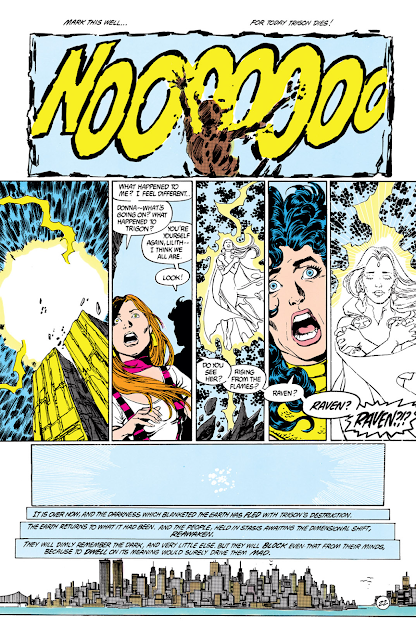

In the Injustice universe which once again doesn't really make sense to be canon but was made retroactive canon Trigon showed the ability to summon Scorpion from the Mortal Kombat Universe to the Injustice Universe, suggesting he can summon beings from outside the multiverse though not necessarily control them

There's more scaling and abilities for other versions of Trigon. The 2003 Animated Trigon has the ability to create dark clones of people and had precognition and the Teen Titans Go Trigon has toonforce and scaling above extreme cosmic powerhouses like Mxyzptlk and Unkindness Raven but it's weirdly implied that for whatever reason these are not the same being with Teen Titans Trigon and Teen Titans Go Trigon being expressly different entities. As such whether you think either actually applies to the mainline Trigon is up for debate (more realistically and more likely 2003 Animated version would be an Emanation of the real Trigon while the Teen Titans Go version would be some fifth World alternate version)
In terms of weaknesses, Trigon is ridiculously arrogant to the point that he is unafraid of and thought he could beat the Presence, literally the DCU version of God,. He also used to have difficulty traveling through the dimensions though he seems to have gained some way around that. Finally Trigon like all demons relies on the souls he has consumed and in his domain that give him power.
Overall while I don't think this is a stomp, I do believe this matchup would be fairly clear-cut. Trigon has an arguable advantage in raw power depending on your opinions in regards to scaling Blight and especially Mr. Mxyzptlk, However, this is really his only advantage and it doesn't actually help very much. Darkseid as a part of necessary existence comes back whenever he's killed, something Trigon's raw power doesn't get around. Even if Trigon became amped in power due to the sheer evil of Darkseid, he still doesn't get around this immortality. While Trigon has something similar, being able to regenerate from his realm, Darkseid can just destroy his realm, depowering Trigon and removing his regeneration, while Trigon can't destroy Darkseid's necessity to existence.
Darkseid also doesn't need to do this. His conceptual existence erasure, conceptual manipulation, and ability to summon the Black Racer to inflict conceptual death are all powers Trigon has no resistance to at least his Omega Beams but potentially all three tactics would bypass Trigon's regeneration. He could also freeze Trigon in time as he did to Godwave Ares. In fairness, Trigon does have some win conditions of his own. Most likely is his soul manipulation and consumption which, being conceptual in nature, should be able to work on Darkseid's conceptual soul-self. He also hypothetically could summon something to help, particularly Radion if Trigon knows Radion is the weakness of the New Gods.
However, the real clincher is the two's mental capacities and tactics. Darkseid is one of the smartest beings in the DCU, his plans only ever stopped mentally by the Justice League due to the presence of super-geniuses like Superman and sometimes not even then. Darkseid is also hyper-practical and focused as a fighter and if he thinks someone is genuinely a threat to him (something he is a good judge of) he usually starts with his omega beams and wastes no time. Conversely, the Teen Titans relatively speak lack supergenius characters to the same degree as the Justice League and regularly outwit Trigon, with Trigon also regularly messing around in combat and vastly overrating himself in terms of power. Darkseid is far more likely to hit Trigon with his omega beams first than Trigon is to hit Darkseid with his soul consumption first.
As a final point, depending on how big the gap you think Darkseid and Trigon is in power, Darkseid could just steal Trigon's power from him. If you think Trigon genuinely scales to Mxyztplk, than the power gap is probably too wide for Darkseid to reach Trigon's level through this method. If you don't however than even if Trigon is stronger (particularly through amping himself on Darkseid's evil), Darkseid should be able to even any power gap by draining Trigon's lifeforce for himself. So, overall I think Darkseid wins this fairly cleanly.
Outside the matchup I also want to quickly clear up what the difference between these two "ultimate evils" are conceptually and narratively. Darkseid is the god of evil, with ambitions to dominate all things. Darkseid often doesn't care about minor slights because they are beneath his notice. There was a new god of perversions called Sleeze on Apokolips that Darkseid eventually banished him for his pettiness and lack of scope. One can make deals with Darkseid and Darkseid will follow through with them, and Darkseid has helped to stop greater threats before. Darkseid's machinations are long-reaching and sinister. He represents evil as a grandiose force, dignified and subtle.
Trigon is not like this at all. Trigon makes deals about not shooting you in the back and then shoots you in the back anyway. Trigon will fly throughout a city killing random people for fun. Trigon destroys planets and galaxies for no reason but sadistic joy. When Raven went to Trigon's dimension a little girl called him a monster. Trigon prepares to kill her with intense pain only for Raven to take all the pain herself... only for Trigon to then incinerate her anyway. Trigon is a stereotypical Devil, a monster of cruelty and petty sadism. His plans are rarely longer than his impulsive drives to conquer and destroy. He represents evil in a more Dantean sense, savage and bestial and petty.
Darkseid's evil is cold, efficient, and somber. Trigon's is fiery, arbitrary and gleefully sadistic. Darkseid is "Who Taught You How to Hate" while Trigon is "When You're Evil." They are both meant to be "ultimate evils" narratively but Darkseid's emphasis is on the "ultimate" and Trigon's emphasis is on the "evil."