Thursday, June 10, 2021

How they compare: Tezcatlipoca (Aztec Mythology)

Before spacetime, after it, above it and below it was the Teotl, the all encompassing one Ometeotl encompassing all dualities. The male and female aspects of Ometeotl had 4 children; strongest of them was Tezcatlipoca. These beings of pure Teotl, the great energy permeating and making up the cosmos sought to make a world to rule over, however when the world was formed they bickered and squabbled who should rule over this world, their conflicts bringing about the destruction of four worlds before their current.

Of these the two who were in conflict most intensely were Quetzalcoatl and Tezcatlipoca. These two have struggled and come into conflict since time began. While Quetzalcoatl is arguably the nicer of the two to humanity, neither is truly good nor evil, as they two form a neccesary balance for the cosmos. Tezcatlipoca possesses himself many admirable qualities; such as being the punisher of any who would mistreat their slaves.


Tezcatlipoca is one of the Teotl, comprised of sacred energy existing before space and time, with any physical body he inhabits being merely a temporary form he has taken. The ways of the Teotl may seem strange to humanity as they are not in the strictest sence "distinct" from each other but are instead aspects of each other such that Quetzalcoatl is referred to as the White Tezcatlipoca and Tezcatlipoca is the Black Quetzalcoatl. Likewise to destroy a being of Teotl conventionally is impossible just as it is impossible to destory energy; one will instead simply shift their form from one to another. When Teotl were burned in flames, they simply became new Teotl.

In terms of power Tezcatlipoca should easily scale to star level. Even the very humble Teotl Nanahuatzin was able to become the new Sun when he threw himself into the flames. Tezcatlipoca may be even stronger as he is indentified as the Jaguar constellation comprised of 14 stars and is stronger then his brother Huitzilapochtli, identified as the weakest of the four children of Ometeotl killed 400 lesser Teotl turning them into 400 stars. There's also an argument that Tezcatlipoca is actually universal as he and all Teotl are at one with Ometeotl who is the all encompassing teotl of all existence, encompassing all dualities and the cosmos itself transcending spacetime, but this seems to me be moreso a case of Tezcatlipoca simply being an aspect of a greater entity in the same way that for instance every Darkseid Emanation is technically Darkseid, but one doesn't scale from the latter to the former.

In terms of speed, Tezcatlipoca should pretty easily scale to at least FTL as at the end of one of the worlds controlled by Quetzalcoatl it is said he turned into a giant jaguar and quickly ate almost every person, the few not consumed becoming monkeys. To quickly travel around the world eating most of the human populace is needless to state, quite FTL. It is also known that the Teotl can quickly travel the path created for them by Omeotl's male and female aspects, the milky way. To travel across the Milky Way in less then an hour would require a speed billions of times the speed of light. Regardless speed may not be very important to the Teotl, or at the very least the 4 Gods; Quetzalcoatl, Huitzilapochtli, Tlaloc, and Tezcatlipoca as they existed before spacetime.


Tezcatlipoca like all the Teotl shifted forms easily, most often taking the form of a large Jaguar. He was also viewed as lord of jaguars and could command them. Even in physical form however Teotl seem resistant to harm with the Teotl not being much weakened from having their hearts removed and Tezcatlipoca seemingly unbothered by using his leg as bait for the primordial sea monster Cipactli or bothered after when she ate it. He was viewed as lord of all things ethereal; the wind, the mist, the smoke, the night. He could become the night itself, and make wind (even hurricanes); mist or smoke come before him. In his form of the night he seems to have become a spiritual entitiy, identified as the spirit of the night, the lord of things which are nigh and is identified as he who changes things through conflict suggesting some level of control of battle.

Tezcatlipoca was considered a lord of fortune seeming to demonstrate some level of fate manipulation for he was the one who could grant one fortune and rulerships. For this he is known as Tlalticpaque, possessor of the sky and earth. He was able to stir forth both conflict and magic and so is the granter of sorcery and triumph in battle. 

Tezcatlipoca also wields an obsidian weapon and a smoking mirror, for which is most known. This mirror gives him knowledge of the future, of distant events, and of what lies in the minds of others. This is how he grants prophecy to his followers.

Tezcatlipoca's final weapon is his mind however. Tezcatlipoca is a trickster god known for being very cunning and manipulative. He eventually even defeated his rival Quetzalcoatl, if temporarily, via cunning. Tezcatlipoca inebriated Quetzalcoatl and manipulated him into incest with his sister, the chaste priestess Quetzalpetlatl. For this shame Quetzalcoatl left to the east for his quest of penance, and when he returns the two shall conflict again. This is likely even more impressive then it seems as Quetzalcoatl is the Teotl of knowledge and learning so to decieve him is likely a very good intelligence feat. 

In terms of weaknesses, Tezcatlipoca is never noted as having any particular weaknesses within the mythology, however there is a sort of natural consequence that being made of energy means hypothetically energy manipulation should allow one direct manipulation of his being. 


Name: Tezcatlipoca, many epithets
Origin: Aztec Mythology
Powers and Abilities: Made of holy energy, Shapeshifting (Can turn into a humanoid, a large jaguar, the night, and the spirit of darkness), superhuman endurance, exists outside spacetime, manipulation of wind, darkness, smoke, and mist. Can induce conflict and chaos. Can give visions of the future. Precognition, Clairvoyance, and Mind-Reading (with Mirror), possible fate manipulation, Creation and possibly Reality-Warping (aided in creating the world)
Weakness: Hypothetically energy manipulation
Destructive Capacity: At least star level, likely large stellar, possibly universal
Range: At least planet, likely inter-stellar
Speed: Likely MFTL (billions of times the speed of light)
Durability: At least star level, likely large stellar, possibly universal
Stamina: Infinite (outside of time)
Standard Equipment: Obsidian Weapon, Mirror
Intelligence: Genius manipulator (was able to decieve and manipulation Quetzalcoatl, the Teotl of learning and knowledge)

So how well would he do in other verses?


In DC, Tezcatlipoca would....basically fit right in as the Emanation of the Tezcatlipoca of the Sphere of the Gods, either in the Post-Crisis or New 52 period. While slower, particular for the former, it doesn't really matter due to him existing outside spacetime. Tezcatlipoca would do pretty well but not much greater then one would suspect, being about as strong as a Wonder Woman or Shazam villain. I know this because Wonder Woman literally fought Tezcatlipoca and stat and power wise it was basically identical to mythology Tezcatlipoca. 


In Marvel Comics, Tezcatlipoca would fit pretty well in on the lower herald range given even beginning Heralds can easily travel galactic distances and can reignite stars. While he would be around that level physically, a Herald is a really bad matchup for Tezcatlipoca as they have really good feats of energy manipulation and sensing, and he can't even use his mind-reading on them as their minds become part of the Power Cosmic.

If he was on Earth, he would do a lot better even against characters that hypothetically would be able to beat him. Tezcatlipoca's greatest ability is his ability to stir up strife and chaos, both literally with powers and via manipulation and deception and in any universe that isn't super idealistic, he would be a much larger stealth threat. It would be perfectly possible if he was in Marvel to be revealed as the one granting Ulysses his visions causing Civil War II.


In Saint Seiya Tezcatlipoca would be stronger then people first awakening the Seventh Sense who can destroy stars and low tier seventh sense users like the witch Hecate who traveled at millions of times c, though this is a hard limit for him as the Gold Saints and similar tier entities would absolutely destroy. 

He would actually have a fairly interesting fight with most SS characters first awakening seventh sense, as they have the power of miracles which can probably kill him but he's likely too durable for it to easily work and he's more versatile then them. It's also very likely he could take a manipulator role and give visions or induce chaos to try and create a chaos like the Sanctuary Arc.


In the Disney Hercules-verse Tezcatlipoca would be an immediate top tier. He has power similar or superior to Zeus himself who could rearrange many stars in the night sky and his speed is even superior as their speed was "only" millions c while Tezcatlipoca's is likely billions. It's also notable that the verse is full of characters that are seeming more easy to manipulate and don't have nearly as advanced hax. However if he tried to solo the verse directly Hercules and Zeus might be able to stop him as Hercules by end of movie is a "true hero" and would likely prove hard to manipulate as Quetzalcoatl was. Tezcatlipoca could probably do it, but it would take time. 

Meanwhile Zeus probably has the ability to seal him away as he did the titans. As Zeus used energy sealing it's likely this sealing would work like physical sealing to Tezcatlipoca, and given Zeus used it on numerous entities as strong as him it would likely work. Gods in the Hercules-verse are also resistance to fate manipulation as the Fates couldn't cut Hercules' thread after he attained godhood meaning Tezcatlipoca couldn't win with fate manipulation. Tezcalipoca would likely be a good fight for the verse.


In Greek Mythology Tezcatlipoca would have a very interesting place. He's stronger then most of the lesser Theoi who even though they can turn humans to stars are not as strong as turning 400 people into stars. That said he's massively weaker then most Olympians whose fights can distort boundless infinite sized primordial entities. He's also massively faster then anyone in the verse as most of Greek Myth lacks speed feats beyond massively hypersonic to relativistic making him a speedster for the top tiers. This gives him actually a very good analogy; he would have the same stats as Hermes.

Hermes is much stronger then lesser Theoi but weaker then the other Olympians but is a speedster that can give everyone in the world dreams and carry their souls down to the Underworld similar to Tezcatlipoca's feat of eating people across the world. In fact the more one thinks about it; Hermes vs Tezcatlipoca is honestly a really hype match.

Tezcatlipoca is not abstract like Hermes but he does have fate manipulation, one of the most broken powers in Greek Myth. Hermes was able to outwit the god Apollo, God of prophecy and learning similar to Tezcatlipoca's feat of outwitting Quetzalcoatl. The two fast trickster gods, lords of the wind, lord of jaguars vs lord of snakes (Hermes, was a god of snakes like....Quetzalcoatl coincedentially), this is a battle that would actually be really hype. 

Tuesday, June 8, 2021

Happy Pride Month: History of LGBT in Magical Girl Genre


Happy Pride month. To celebrate I decided to make a blog talking about the connection between LGBT fandom and the magical girl genre. 

Magical girls have long had a connection with the genre though over the course of it's 6 decades of existence, the genre's exact relationship to it has changed and grown, which is what this will be exploring; going over each "generation" or decade of the magical girl genre and how LGBT characters were depicted within.

This is mostly going to be about lesbian and female bisexual characters. This is because magical girl series tend to be primarily, or sometimes almost entirely female casts, and a notable portion of the male characters are love interests for the female characters; as such queer female characters are signifigantly more common, though if there is queer male or transgender characters of note to my knowledge I will be sure to mention in that section. 


60s Magical Girls/Really Early Magical Girl Series:
As might be expected, in the REALLY early magical girl series LGBT were never referenced as it was the 60s, early 70s for some. It's also of note that most of the time magical girls in this era were young children rather then the teenagers that magical girls would be associated with later, they simply didn't show any romantic or sexual tendency; it was squeaky clean a lot of the time. Most early magical girl series were a plot about a young girl coming from a magic world or having a magic item that either let them do whatever they wanted or let them transform into whoever they wanted.

It is interesting to note I think that, at least for the time, the magical girls did run the gamut of tomboyish to girly. While Sally from Sally the Witch would be considered almost entirely feminine by today's standards, by the late 60s standards she was considered quite tomboyish, even referenced in her theme song, due to her rebellious attitude, mild temper and her outspokenness, particularly in comparison to someone like Akko-chan from Himitsu no Akko-Chan. It is probably fair to say that even at the beginning of the genre, Magical Girls were interested in exploring femininity; such could be even said to part of the definition of the genre. 

The precusor to the genre was Princess Knight made by Tezuka in the 50s, the story of a young princess born with two hearts, the heart of a girl, and the heart of a boy. While not generaly considered a magical girl story, as Princess Sapphire doesn't use magical abilities, it is universally considered a precursor to the genre, and it's premise and plot being so immediatly rooted in gender exploration has been a large influence. Also of note is that Princess Knight is often considered a trans icon in the older anime community, due to the fact that it's story can be seen as paralleling the experience of transgender people, having a heart of one gender born into the body of the others.


70s Magical Girl Series:
During the course of the 70s, Magical Girls changed a lot, particularly with the release of more adult series like Majokko Megu-chan and Cutie Honey. The Magical Girl genre, possibly at least in part in reaction to the 60s girls, suddenly had lots of sexuality, and dark/adult content, and serious real world non-escapist type stories. During this period lesbianism/bisexuality was sometimes brought up but not in a particularly flattering light; more often used for titliation, as a marker of moral corruption, or used for comedy. 

In Cutie Honey for instance, which was not initially understood as belonging to the same genre as works like Sally and Akko-chan, pretty much every female character demonstrates same-sex attraction save ironically for the main character, and mostly for her. This was part of a seperate trend in magical girls; instead of cute little girls the magical girls were more often young women whose hotness was emphasized such as Honey's attractiveness to seemingly everyone. The villainesses attaction to her are characterized as predatory, her teachers' lesbian attraction is characterized primarily as abusive,and so on. 

Another 70s Magical Girl series, Majokko Megu-chan uses lesbianism not as a negative character trait or to establish the main character's attractiveness but for titiliation and comedic purpose. Meg and her rival Non engage in magical battle that tends to get quite heated which the perverted antagonist Rabi finds arousing, used as a joke. This is referenced in out of universe material as well with suggestive pictures presenting the two as a couple.


80s Magical Girls:
In the 80s, especially the mid-80s magical girls were primarily associated with studio Pierrot who attemped to essentially formualize the magical girl genre, and probably created the magical girl as an archetype. Much can be said, both good and bad, can be said about this period, and one of the things one can say about it for better or worse is it was a very safe period. Pierrot went back to the innocence of the 60s magical girls, and arguably went even further. As might be expected from such a description, the 80s magical girls lacked much reference of LGBT, even if the girls often had more of a romantic drive then their 60s counterparts. If anything the series were even more heterosexual then the early magical girl series, as they included heavily romantic subplots universally heterosexual as opposed to the more childish innocent slice of life as the 60s.

Outside of Japan however, things were not quite the same. In the United States She-Ra, retroactively believed to be an American Magical Girl series came out which along with it's brother series He-Man has a large queer fanbase and whose reboot included canonical LGBT characters. I must confess not to be able to comment much further as I am not as familiar with American Magical Girl history.


90s Magical Girls:
At the tail end of the 80s, beginning of the 90s, Pierrot's influence on the genre had waned as ironically shooting for safe is not a safe strategy over the long run. This brought about a revolution in the magical girl genre, a massive shift and a renaissance. The late 80s to early 90s transition in the magical girl genre is rivaled only by the shift from the late 00s to the early 10s. Most of the writers of magical girls in the 90s were women that had grown up watching magical girls in their childhood and wanted to write magical girl stories that were idiosyncratic, on whatever topic they found interesting, and with characters that they related to themselves or the people they knew.

As might be expected, with the sudden individualization of the genre and the return of adult themes (this time from a female perspective), LGBT characters not only returned to the genre, but under the guidance of perhaps more sympathetic writers in a more sympathetic time, writing to teen girls instead to the parents of little girls, they were actually given a more human sympathetic portrayal then before. I can not emphasize enough how huge a shift this was, and could go on and on expressing all the differences.

Obviously Sailor Moon came out at the start of the 90s and completely changed the game. A protagonist who demonstrated attraction to other girls, a pair of explicitly lesbian magical girls who were not treated as villainous or as jokes, but as wise older sister figures, a team of magical girls (which allowed for fandom shipping.) The anime primarily under the guidance of director Ikuhara who is quite interested in LGBT relationships added even more such as a greater degree of focus in the third arc to Sailors Uranus and Neptune, gay male relationships and characters that were coded as transgender. Sailor Uranus and Sailor Neptune in particular were absolutely insanely huge influences on the 90s queer anime community due to being not just a canonical queer anime pair, but one in one of the biggest anime franchises to have been seen to that date, treated as completely equal and noble and without a tragic end. 

On a similar note the all women mangaka group CLAMP made two magical girl series during this time, CLAMP being known as well for their love of LGBT characters having started by making homoerotic doujin of Saint Seiya and having made shipping fanart of Meg and Non from Majokko Megu-chan. The more famous of the two, Cardcaptor Sakura a magical girl that could rival Sailor Moon had Tomoyo, best friend of the protagonist Sakura, have lesbian feelings for her. The magical girl genre had this idea before with Na-chan and Honey in Cutie Honey, but now instead of being played for jokes, it was treated seriously and wholesome-ly. Likewise CCS has a homosexual male relationship between Sakura's brother and another boy.

There was another series very important to the development of LGBT apperearences in Magical Girl series. The aforementioned Ikuhara after he stopped working on the Sailor Moon anime directed the 1997 Revolutionary Girl Utena anime, an anime for whom the sheer amount of LGBT characters is so all-consuming that it's influence on the LGBT magical girl fandom was assured, even before taking into the fact that it was quite likely the first magical girl series for whom LGBT issues were the primary concern of the text as opposed to simply being a trait of some of the characters.


00s Magical Girls:
Compared to the massive shift from the 80s to the 90s, the magical girl transition between the 90s and the 00s was a lot less dramatic. While there were changes in the genre, they happened more gradually and not so intensely. There is really two periods here; the late 90s to early 00s forms it's own period, with the late 00s being it's own seperate period. The late 90s to early 00s of the MG genre is known for being generally more comedic takes on the genre compared to the more serious and often darker early 90s works. The late 00s is often considered a more dead area when the genre became less popular and the works started to become niche and limited to a few big name franchises or become more action-heavy fanservice series for boys.

For the most part magical girl series in the 00s were fairly similar to the 90s in terms of LGBT content. Shipping of magical girls on a team was still fairly common both in the works themselves and by their fandoms such as Mew Mint's attraction to Mew Zakuro. Two massive magical girl franchises began in this period both having an interesting contribution to the LGBT magical girl fandom.

Magical Girl Lyrical Nanoha's golden age was during this period though it continues past the 00s. One of the things Nanoha is most known for is that the protagonist Nanoha ends up in a lesbian relationship with magical girl Fate Testarossa, the two adopting and raising a child. This wasn't entirely unknown in the genre; Sailor Uranus and Sailor Neptune were a lesbian couple who at one point in Sailor Moon raise Hotaru Tomoe as their daughter, but what was different was both that this was the main protagonist Nanoha, and the fact that their relationship formed the emotional core of the franchise. In other words, while not a difference in kind, it was a difference in degree, moving it to the forefront, and even today being one of the most notable examples of a canonical lesbian pair in anime.

The other big franchise was Pretty Cure. Since it's inception with the relationship between Cure Black and Cure White being treated in some episodes almost as a romantic relationship, Pretty Cure has had a sizeable LGBT fandom, varying depending on the season in question. 


10s Magical Girls:
If any decade shift overtakes the shift from 80s to 90s it would definitely be from 00s to 10s; Madoka is the single biggest shakeup to the genre since Sailor Moon and Cardcaptor Sakura in the 90s, and the genre is reinvented and reinvigorized. 

Without the same level of distance behind us, it is harder to see in context the changes the 10s made to the Magical Girl genre, including in the regard of LGBT themes and characters but Madoka was absolutely massive to the Yuri fandom and is perhaps a reflection of the normalization of the lesbian relationships. It got to the point that Madoka won an award for best yuri title, despite technically not being a yuri title. It's possible that despite the antagonism, Madoka and Homura's relationship will be viewed as the 10s version of Haruka/Michiru and Nanoha/Fate. A signifigant difference may be that unlike Haruka and Michiru who are presented as older and wiser and generally more adult then other senshi, and Nanoha and Fate who got together when they grew up, Madoka seems to have begun magical girls having lesbian romances while still in the youthful stage of life, reflecting lesbianism as a norm, with fallible youthful characters as opposed to more idealized adult characters. In other words it is not just acceptance of LGBT people as entities with agency and humanity in their own right, but normalization of them as just like anyone else. 

It's also notable that this decade may have introduced to my knowledge the first transgender magical girl with Kiyoharu Suirenji from Mahou Shojo Site, depending on interpretation of some earlier characters like the Sailor Starlights. The difference between the 00s and the 10s seems to be one of normalization of LGBT characters and a greater diversity of type, showing LGBT people in a greater variety of perspectives.


Why is this relevant?
This doesn't seem to be as well understood in the west but a magical girl in some sense an idealized figure representing cultural norms and values in a somewhat similar vein as a superhero. Magical Girls are not just girls with magic powers, they are representations of idealized femininity, an exploration of feminine identity, and a celebration of the female locus of power. A Magical Girl carries with her the hopes and dreams of people, she is a figure of internal beauty and dignity, who does the right thing and represents what society holds dear. That is the difference between a girl with magic, any female character with supernatural powers, vs the magical girl; a distinctly feminine coming of age superhero story that enshrines femininity as something powerful and good.

The increased inclusion of LGBT figures in the genre carries with a validating sense of dignity, a recognition from society on the femininity and rightness of LGBT people. The move from ignorance to outcasting to ignoring to accepting and finally to embracing in society is reflected in their appearence in the magical girl genre. 

Wednesday, June 2, 2021

Good ideas in bad series

 There's a trend I've noticed that I think's really troublesome, and it's something that, in a more simple form, has saddened me since childhood. When something is bad, things connected to it are viewed as bad even when they didn't do anything wrong. 

A dramatic real life example; imagine I showed you a chair and then revealed to you this chair was owned and sat in almost every day by a serial killer, or by a genocidal tyrant. Maybe you're one of those "pure paragons of rationality" who will say "It's just a chair, that doesn't influence my view at all" and if so, I guess good for you. For most people, myself included, there's a sudden irrational feeling towards the object. I know the chair is fine, it has no real connection to anything the person who sat in it did, but at the very least it makes you now think of that person and as such is something you will feel more negatively towards.

This sometimes happens with fiction, and relatively speaking I think I'm alright at not doing this, and it's saddening to me how often I see it happen. When it happens with fiction what you see is that everything that happens inside a bad series, or even a controversial one is not allowed to be explored as people simply view everything associated with it as negative.

An example: There's a New 52 comic series called Red Hood and the Outlaws. The series, particularly the earier you go, was highly negatively recieved. I personally concured and didn't like it very much. Without going too much into it, it wasn't neccesarily the relatively large amount of fanservice but Starfire's early attitude of coldness and spitefulness that seemed to me so in contrast to what I enjoyed about the character. 

With that said, during this series Starfire reconciles with her sister Blackfire. This is a pretty big dramatic moment for the characters where Blackfire tearfully apologizes to Starfire for the torment she caused her and Starfire reveals that she had already forgiven her. This is, in my opinion, a really great moment. Now that's not me saying the series is good just from this one part, but it IS me saying this is an idea I think is worth exploring more but sadly a lot of people just aren't going to acknowledge because of where it's from.

I guess I'm making this blog to ask people to remember that the broken clock is right twice a day; and not to dismiss something just because of what it's connected too but isn't contributing too. A bad series can have a good idea same way a good series can make a mistake.   

Tuesday, June 1, 2021

Death Analysis: Wedding Peach


The Fighter Angel, savior of three worlds, the merciful girl with the temper, for your evil she will not forgive you! Wedding Peach is extremely displeased!

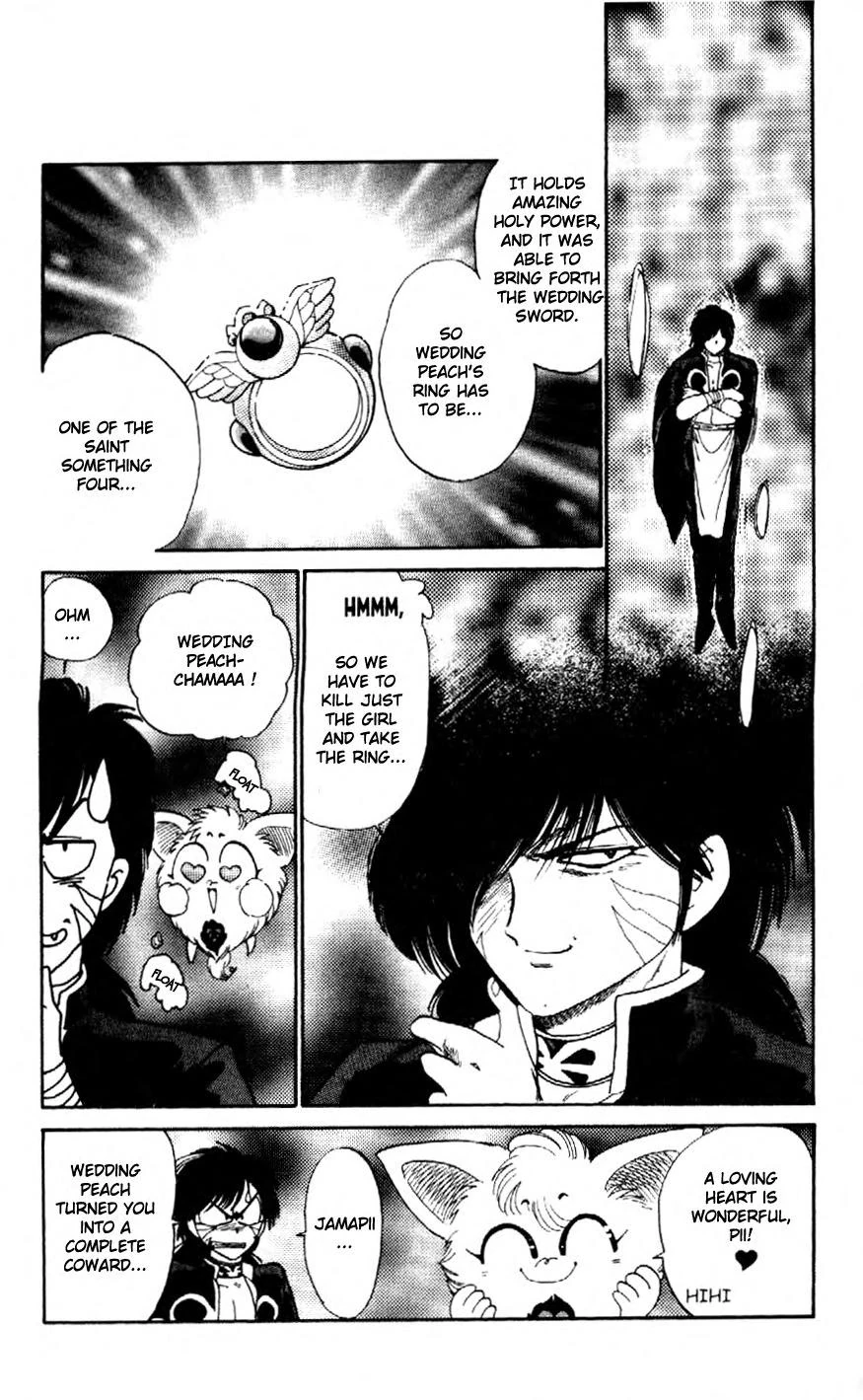
For unknown centuries the angels, spirits of love, and the devils, spirits of hatred, have engaged each other in spiritual warfare for the realms. The greatest power of the Angels were the Saint Four, 4 holy energies representing the blessings of the world. The Devil Queen Reine launched an assault on the Angel world to retrieve the Saint Four. In the confusion and chaos, the Saint Four dispersed into love energy and scatted down unto the Earth so the Devils could not use their power to bring evilness to all the worlds.

Over 100 years later the Angels and Devils are in a stalemate, and the human girl Momoko Hanasaki learns that she bears the blood of an angel and that she and the other Earth-born Angels have a divine mission to retrieve the Saint Four before they fall into the hands of the Devils. Her angel power awoken Momoko turns into the Magical Girl Wedding Peach and begins her mission.


Canonicity:

For Wedding Peach in particular there's a particularly strong argument that the anime adaptation is considered canon or secondary canon. The writers of both the manga and anime have stated that instead of one being primary it is a "media-mix project", both get ideas from each other that they incorporate and the manga made changes to adapt to the anime such as the change in design for the Super Angel outfits. 

For the sake of choice, I will be including anime feats but noting which feats are from the anime so you can choose to use or not use them at your leisure.


Spiritual Combat:

Most combat in Wedding Peach takes place on the spiritual plane of reality; Angels are representations of love and Devils are representations of hatred; their fight being a spiritual war for the human heart. The Devils are consistently called spirits and in the original state demons are without form or shape, unborn. Devils can take humanoid form either by inhabiting a host body or, as is stated in the anime devil can make flesh and blood for each other from their hatred (episode 47)

Devils have displayed the ability to manipulating and weaponizing higher forms of reality then the physical as well in the anime. One of the Devils put the "essence of fatness" into peoples' food (episode 10), the flame devils can infuse their lives themselves into the flames (episode 19) and Raindevila is stated to be the source of all evil (episode 50), suggesting that to withstand attacks from the Devils requires not just physical resistance but spiritual resistance, something also implied from the fact that Fighter Angels survived in area that disperses spirits and causes the world to become half-devil world.

Even on the spiritual plane it's been shown Angels and Devils can affect intangible things with Nocturne being able to shred a rainbow and the Angel Selece physically grabbing and carrying the souls of 3 other Angels to Earth.


Transformation:

The first ability Momoko learned; she has the ability to transform from her civilian form to her magical girl forms. She transforms into 4 forms as her abilities grow; her love angel form that was just an extention of her love energy, her fighter angel form that is is her prepared for battle, super love angel form when she recieved her one of the Saint Four, and her final form gained with the power of all the Saint Four. For the most part, this doesn't seem to actually change her abilities; it just boosts her stats from one level to another so I'll only be referring to form when talking about a feat she performed. In the anime Momoko could transform without even intending too if she needed to via the power of love (episode 1.)


Enhanced Strength and Durability-Love Angel:
After transforming Wedding Peach has supernaturally enhanced strength and durability. Even in her love Angel form Wedding Peach was able to hurt the Demon Pluie with a kick, although she also hurt him with a bite in civilian form. I think this might just be a mild level of toonforce in the verse as even normal humans will occassionally show comedic displays of strength. In terms of durability however her Love Angel form is probably not much weaker then her Fighter Angel form as she shielded Jama-P with her body from the attack of Pluie.


Fighter Angel:
As a fighter Angel Wedding Peach is prepared to do battle with strong demons! Relatively low end feats of power for a Fighter Angel include two of them clashing with Pluie destroying a large house, making an evil vortex disappear strong enough to suffocate people, and essentially tanking a fall from really high up. However the real feats of power come from withstanding the attacks of the Devils. Two of the Jama tribe of Demons, a weak tribe of demons were able to together create an Earthquake capable of damaging a large pillar in a building, a feat likely requiring a magnitude 5+ Earthquake, a feat of hundreds of tons of tnt to outright kilotons of TNT and in the anime, Devil Yukidaruma created a snow storm (episode 37.) 

Even greater then these feats are the dimension feats the Devils have. Nocturne created a thick darkness that seems to be some sort of dimension extending to the horizon calling it the living world of darkness her thoughts are intact and that it is where she resides within. The Fighter Angels were able to withstand numerous blows from her. Likewise the Demoness Arushion created and seemed to control her own dimension. Notably Arushion claims Momoko could wander forever in it. The anime has a bunch more dimension feats (episodes 12, 19, 32, and 40) with the most impressive one by far being the labyrinth dimension created by minor Devil Fusuma in episode 32, a labyrinth of other dimensions/worlds each stretching to the horizon and including numerous landscapes, one of which is explicitly based on Egypt and has the pyramids, and one of them containing a mountain at the horizon. To destroy a mountain is generally agreed to take on the upper end of the megaton range and to maintain a dimension with a mountain at the horizon would require at least gigatons let alone all the other dimensions or the possible country interpretation of the Egypt dimension. It's not only stated that in general Devils' powers are maintained by their presence (episode 2), it is directly stated that Fusuma maintains his labyrinth dimension (episode 32)

Whatever level the Fighter Angels are at be it the likely kiloton level of the manga, or the gigaton+ level of the anime, Wedding Peach scales in excess of it. She was able to take a lot of attacks from her brainwashed friends including Angel Lily slashing her throat and was able to pull both her and Pluie against the pull of Reine's vortex that was sucking everyone there in.


Super Love Angel:
With the power of a Saint Four, Wedding Peach's power jumps from being relatively strong for an angel or a devil, to being one of the top tiers of the verse; which shouldn't be a surprise for using a power that can control or destroy the worlds. In this form Wedding Peach was able to survive a clash of the waves of hatred and dark energy between Devil Viento and his father Uragano. Uragano was the Devil that battled Selece for the Saint Four whose attack sent them down to the human world, Selece being an incredibly powerful Angel, younger sister to the Queen of the Angels Aphrodite, and able to create and maintain a barrier around the entire Angel World for years against the Devils' assault in the place of her sister who usually does. Viento is an equal or near-equal to Uragano who believed he could kill Queen Reine with a surprise attack and betrayal, Queen Reine being someone who would require all 4 of the Saint Four to defeat. Having 1/4th the power of the Saint Four and being comparable to superior to Angels who can create planetary barriers would put Wedding Peach in the planetary range.

This is supported by the anime where the devils are stated a few times to want to destroy Angel world with the power of the Saint Four. There is also the powerful Devil Petora who is stated to be able to throw the human world into chaos or if he wants to even destroy the human world outright, the human world being Earth (episode 39.) Yet even he is inferior to the Rafaal Tribe of Devils, the elite tribe of Devils including Viento and Uragano, with the only Devil able to beat one being Queen Reine herself (episode 47) yet even in the anime Wedding Peach can equal and take hits from Viento (episode 43)

Stamina:


Speed:
Wedding Peach-verse has a lot of lightspeed shenanigans due to the Angels using light as a form of attack and the Devils use darkness as a form of attack, with the two often reacting to each others' attacks and even avoiding them. This level of speed is not just supported, but it arguably a lowball. The complete fodder tier Devil Jama-P was able to threaten all love on the Earth just by going to every couple indiviudally and attacking them. This is repeated and even Pluie responds to this plan without saying it's nonsensical or wouldn't work, just that Jama-P better not be purified this time. Direct numbers on this are obviously impossible but to quickly go around the world is obviously relativistic and to search it like that is almost certainly FTL. The Powerful Angel Selece was also able to fly to the human world without her memories, inter-planetary travel generally requiring signifigantly FTL speed to accomplish. Momoko and her mothers' love waves were also able to quickly reach each other carrying their thoughts and feelings when Momoko was on Earth and her mother was in Angel World, showing the speed of the Love Wave. This might be bigger as Angel World is also clearly not in our Solar System and the anime shows interstellar space between Human World and Angel World (episode 14) but as inter-dimensional travel is also involves it's probably impossible to quantify beyond that. 


Healing/Purification Magic:
Wedding Peach's real bread and butter, she emits waves of her pure love which heal the good and purify the corrupted via their sheer holiness.


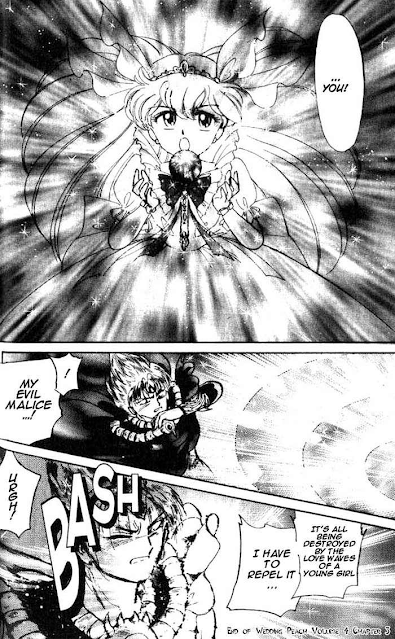
Wedding Peach's healing can work on a physical and a metaphysical level; able to heal Yousuke from the brink of death in civilian form, heal Jama-P's broken heart, and exorcise Devils possessing people. In a VS context, Wedding Peach has incredibly strong circumstantial hax against any evil character as she can nullify evil force, can destroy all evil energy, and nullify all malice. I don't just mean removed malice at that moment, she completely destroyed Ignious's evil feelings to the point the other Devils decided to kill him as he no longer had evil feelings in him. To defeat her then would either be to avoid/resist such power or to be able to defeat someone while holding no malice in one's heart against them. In the anime she was able to in her basic Fighter Angel form purify a stadium (episode 13) and undo laziness (episode 9) but all of this is nothing compared to her ultimate feat, a feat of insane hax, purification, and power even for the verse.

With the power of all 4 of the Saint Four, Wedding Peach reached her final form creating a love wave so strong that it encompassed Devil World, Human World, and Angel World, purifing all 3 and convering all Devil energy into Love Energy, completely transforming the 3 worlds and sending Reine Devilla into a deep sleep. To destroy a planet of diameter equal to 3 Earths would take an energy of 6e33 joules (about 1.4 Yottatons) and this would be a massive lowball since Wedding Peach didn't destroy them, she remade them all converting their energy and matter and she didn't just affect a planet 3 times Earth's diameter, her power reached to another world, Earth, and then to an even further world, Angel World farther away and with space between each. This also suggests each Saint Four would produce an energy of ~358.5 Zettatons, about 6.71 times the energy needed to destroy the Earth, which is consistent with the anime having a Devil capable of destroying the Earth be notably weaker then the Rafaal Tribe that are on the level of individual Saint Four, and with the Saint Four's other feats.


Defensive Magic:
Wedding Peach's magic, to complement her healing and restorative powers, also have several defensive usages. Wedding Peach's sheer aura can reflect attacks and can neutralize powers drawing from dark sources. She can also, if need be, absorb energy, although if she absorbs enough Devil energy she will die. Also in the anime Wedding Peach's friendship power with her friends became another barrier that reflected attacks (episode 19) which I suppose just makes it doubly hard to get around.


Attack Magic/Light Manipulation:
Wedding Peach can also weaponize her love energy into a weapon against the forces of darkness. Usually this takes the form of a blast of light that can pain, disorient, or blind the Devils. Even as just Fighter Angel Wedding Peach, her light was able to destroy the darkness of Nocturne and her henshin pierced through the fantasy world created by Arushion despite this dimension being one her Angel powers shouldn't have worked in. As a Super Love Angel, her love wave was able to extend even to Angel World, an inter-planetary, inter-dimensional distance.

Daisy and Lily's attacks showed the ability to spatially slice, cutting into another dimension, and it's likely Momoko has this ability as well, especially as Momoko showed this ability herself in the anime (episode 18.) Wedding Peach's prayer was also able to destroy an enemy's invisibility barrier in the anime (episode 16.)

Possible Teleportation:
Some angels can teleport. In the anime Wedding Peach teleported Yousuke away from danger (episode 16) and their love was able to transport their school back to the human world after it was BFR-ed (episode 38.) This it the only power or feat in the anime that directly contradicts the manga as in the manga Wedding Peach, Angel Lily, and Angel Daisy had to rely on others to teleport them and could not teleport themselves.

Possible Stealth Magic:
In the anime the friendship of the Love Angels somehow kept their civilian selves from being noticed by the Devils, as an explanation for why no one connects their civilian selves with their Angel selves (episode 8.)

Possible Enchantment
In the anime, the Love Angels working with love on a cloth, putting their soul into it, imbued it with the love wave enchanting it and making it impossible for the Devils to cut (episode 32.)


Equipment: 
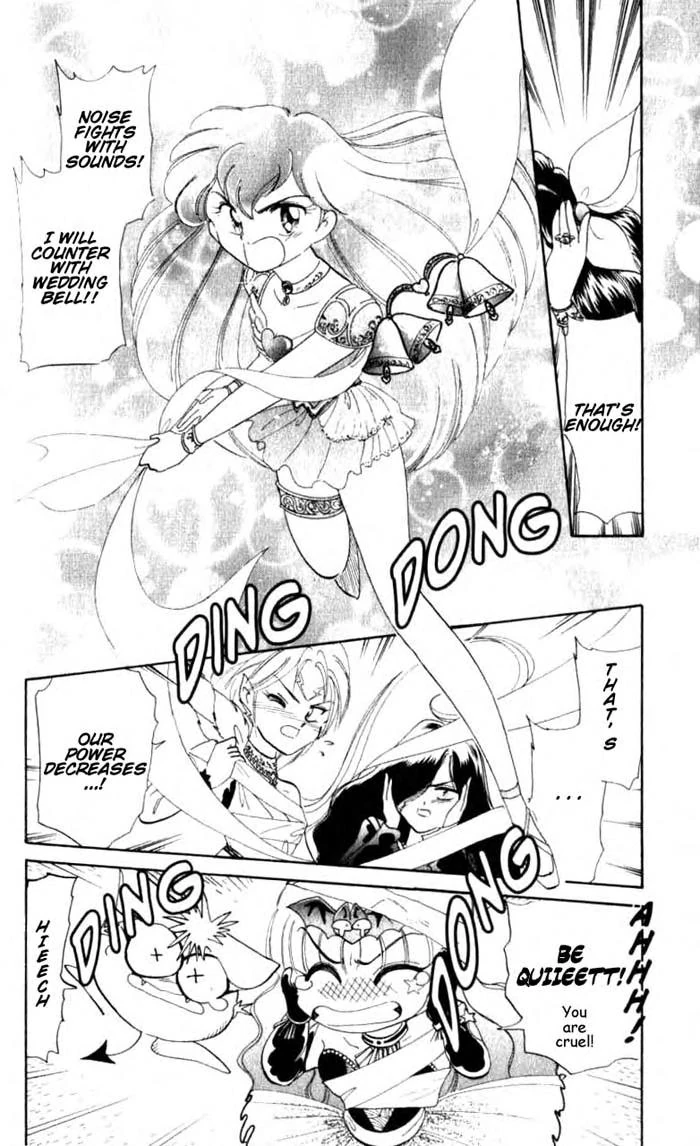
Wedding Peach uses various pieces of equipment to help in her battle with the Devils. Most of them are used as channels for henshin or attack techniques. Her transformation compact is what allows for her transformation and can also be used to speak to Aphrodite for advice. It's mirror is what she uses to reflect light for her attack, and can also be used to see inside someone's heart and can show what someone was like in the past. Her power allows her to manifest weapons needed for her attacks such that she can create her sword to perform a purifiying sword slice technique called "Wedding Peach Cut". When the Devil attacked with a malevolent noise attack, Wedding Peach was able to use her ribbons to create the sound of Wedding Bells which nullified the malevolent noise and which weakened the Devils' powers.

When she became a Super Love Angel she also got the Saint Crystal which allows her to perform the attack technique "Saint Crystal-Love for You", the aforementioned malice-nullifying attack and can nullify seals like Ignious's fire seal. In the anime this technique could be used to feel all someone's emotions and make them be reborn as a good person (episode 18), and also in the anime Wedding Peach could throw her tiara like a boomerang which cuts a devil's darkness (episode 20.)

Of course, the strongest piece of equipment Wedding Peach uses by far are the Saint Four.


Saint Four:
Once an Angel maiden married with the blessings of the whole world, such a concentration of holiness creating a power source beyond any others, providing Angel World the power of love. But such a concentration of power was also a vulnerability if stolen and misused; such was the nature of the Saint Four and the war between Angel and Devil. The Saint Four are the force that maintain all love in the world and should Queen Reine Devilla got her hands on them, the heart of love would disappear and all the words would be controlled by her.

The Saint Four have a will of their own and can act of their own accord. When the invading devils in the Angel World tried to destroy the Saint Four, they transformed and changed into love energy and scattered into the Human World as a flood of light before transforming back into objects. When the Saint Four transformed into love energy, they became a love wave massively eclipsing Angel World repelling all the Devils from the Angel World. The Saint 4 will naturally call out to be reunited. Wedding Peach has had once since the beginning, her mother's ring which gives her the power to transform into Super Love Angel Wedding Peach when her spirit awoke it, and in her final form can use the power of all 4. 

The anime mostly adds corroborating information about the Saint Four. Devil legend says that the Saint Four will destroy Devil World (episode 38) but they want the Saint Four to destroy Angel world (episode 6) before this happens. They also, even in a dormant state, project love energy from Earth to aid the Angels against the invasion of the Devils (episode 10.)


Psychic Abilities:
As part of being an Angel, one gains a higher state of awareness about the world manifesting as mild psychic abilities. Momoko has dreams which tell of the future, was able to sense Yousuke's suffering, and has demonstrated psychometry, feeling the emotions of those who have passed at their gravestones. She also sensed the evil emanating from a braclet, showng more psychometry. Most impressively, Wedding Peach can see and feel the memories of others. 

It's not clear how much the Angels' psychic abilities are in common but Wedding Peach likely has at least some degree of the psychic abilities Lily and Daisy have shown, espeicially if both have shown it. Lily and Daisy have felt a demonic presence, Angel Daisy was able to sense Nocturne despite her hiding in the darkness, and Angel Lily felt a bad premonition of what was coming. 

Notably, in the anime Lily was clearly the best psychic having more psychic feats then the other 2 by a good margin and also in the anime Angels can surpress their conciousnesses to avoid detection (episode 40.)


Possible Fourth Wall Interaction:
In the anime Momoko broke the fourth wall (episodes 6 and 12) and in the former even held the episode closing bubble open to protest that she totally didn't love Yousuke (who she's tsundere for.) 


Intelligence:
Momoko is not very smart in the conventional sense as she's kind of a ditz, but she has a tendency of avoiding being outwit and actually outwitting enemies just because she's a good judge of character and she has a tendency to act unpredictably due to her sometimes odd train of logic. In the anime she decieved Pluie for instance by swapping out her mother's ring with a toy ring that looked similar (episode 2.)


Weaknesses:
Momoko, as mentioned is kind of a ditz who is viewed as weird by her classmates and friends for her odd hobbies and explosive display of emotion. While she is extremely loving and merciful, she also surprisingly has quite the temper though it dies down quickly. On the other hand outside of her rage, she is supremely merciful being unwilling to stop trying to save a Devil who abducted her love, tried to kill her and her friends, and was trying to kill her literally at the same time as she was trying to save him even as everyone was telling her to stop trying to save him.

More potent then her psychological weaknesses are the weaknesses of her powers. If her heart is not stable and full of love she can't properly use the love wave and her big ultimate attack. Her heart being full of love is not usually a problem, but it being stable is something that almost never happens. She also has one more weakness that is either the biggest weakness or absolutely irrelevant depending on the matchup; her powers only work on evil people. Against someone good her offensive options are DRAMATICALLY lessened, basically forcing her to rely on her physical abilities, attack reflection, and possibly spatial slicing for offense. On the other hand, it doesn't come up much but this does make her completely immune to having her attacks reflected back at her since her attacks can't hurt her.


Personality: 
Momoko is a dreamy girl with her head in the clouds, idealistic and romantic. With her empathy that extends to even the Devils, it might seem she might be the worst soldier in the war against the Devils. But the reverse is true. Born of a human and an angel, Momoko is a child literally of the union of Heaven and Earth. As such, she is a fallible person who can sympathize and understand the weaknesses of the Devils yet has the Heavenly ability to forgive and show compassion.

In the long war between the Angels and the Devils, it was Momoko's ability to show empathy and compassion to even a Devil that began to redeem the Devils, finally winning the battle, and eventually allowed her to access the Saint Four. One can not beat the Devils by indulging in hatred, their substance, but instead in showing them love.

Wedding Peach's personality reminds me of the quote from Mark Twain "But who prays for Satan? Who in eighteen centuries has had the common humanity to pray for the one sinner who needed it most, our one friend and brother who most needed a friend yet had not a single one" In the spiritual war between love and hatred, Angel and Devil, Wedding Peach represents the maximum extension of love, love given to one you know will not reciprocate it in the hope that someday they may.


Summary:
+Transformation (Will possibly transform without intending too via the power of love)
+Building Level, possibly higher as Love Angel, Town Level, possibly Island Level as Fighter Angel, Planet Level as Super Love Angel, Large Planet Level Attack Potency with Final Form
+FTL Speed
+Healing (Can heal metaphysical things like a broken heart)
+Purification (Including Passive Purification, can heal up to a multi-planetary scale)
+Power Nullification/Emotional Purification (Can nullify dark powers and evil energy. Can fade away hatred and malice.)
+Attack Reflection
+Light Emanation
+Love Wave (Emanation of love energy, nullifying all darkness and hatred on up to a multi-planetary scale)
+Energy Manipulation (Can absorb energy and love wave can tramuste devil energy to love energy)
+Sleep Inducement (Her final love wave sent Queen Reine to deep sleep)
+Possible Rebirth Inducement (In the anime, Saint Crystal, Love for You caused an evil individual to be reborn as a good person)
+Telepathy (Has prophetic dreams and likely can sense energy. Has Psychometry. Can look into someone's heart and their memories, possibly can sense enemies and have premonitions)
+Possible Supernatural Stealth (In the anime Angels could surpress their conciousnesses, and the friendships of the Love Angels kept the Devils from detecting them in their civilian forms.)
+Possibly Teleportation and Spatial BFR/Slicing
+Possible Anti-Invisibility
+Possible Enchantment
+Possible Fourth Wall Interaction
+Can affect higher planes of being (Astral and Spiritual)
+Resistance to spiritual attacks and Sealing
+Supernatural level of Love
-If Momoko's heart is not stable, she can not use the full love wave
-Her magic does not harm good people
-Kind of a scatterbrained ditz, is completely merciful


Finding a good opponent for Wedding Peach is difficult because almost any thematic opponent is going to be a good person who most of her powers don't work on. This is the best matchup I've seen

Potential Opponent:


Eclipsa (Star versus the Forces of Evil): 

From what I can tell this fight would be pretty even physically and with magic in terms of potency and versatility. There's an interpretation of both characters that put them at like universal. Personally I think they're in the planetary range, as it stands I think this would be an interesting fight. Eclipsa is according to the narrative of Star verus is not an evil person, but does use dark powers meaning you'd have an interesting case where Momoko's powers wouldn't work on Eclipsa directly but would work on her powers. In terms of thematics Eclipsa fell in love with a monster, Momoko with a Devil, both are trying to show their socities that the others aren't neccesarily evil (although in Momoko's case the Devils are mostly evil and Angel World is mostly fair about it), and both are magical girls with familial baggage.


Next Time:


Thanks to my friend ThorGunderson1058 for this absolutely amazing next time trailer, I couldn't have asked for more and for thinking up the Wedding Peach vs Eclipsa matchup.