Wednesday, August 14, 2024

How I rank the other Stats

 Just made a blog for how I rate Power and Speed so wanted to make a followup blog on how I rate the other stats. What the lesser stats are is kind of contested but broadly I consider them:

-Range (Which can be broken down into sensory range and ability range)

-Intelligence (Which further breaks down in multiple categories)

-Combat Skill (Sometimes considered part of Intelligence)

-Other Relevant Skills (such as Stealth, Agility, etc.)

-Endurance (Which further breaks down into stamina, willpower, resilience etc.)


So to go over them:


Range:

Range is really simple, it's quite literally just a distance with the same values as something like attack potency. Usually, characters have separate sensory range and ability range, though if characters have abilities that work on anything they can perceive then the two can be one and the same. Sense Range can be higher so as a Knight who can see far greater distance than his sword can hit or lower such as someone who can teleport planetary distances but no special senses, though broadly to effectively attack a target one needs both to perceive where they are and to be able to reach them.

There's no obvious way to know what the starting range should be. Broadly I take the character who's ability range is higher and divide that by two. This I think is a fair balance between giving characters who's focus is on range like snipers and marksman the ability to use their range without starting characters at needlessly long range. 


Intelligence:

With intelligence, there's general overall intelligence and then there's intelligence in specific categories. In real life types of intelligence have correlation such that if you are smart in one area you are more likely to be smart in other areas with the strength of the correlation being how close the two areas are to each other. In fiction this obviously doesn't have to be the case. It's easy to imagine a supergenius scientist who has absolutely zero social intelligence. That said I do think the default assumption should be if a character is superhumanly intelligent in one area, they should be relative in other areas of intelligence unless the verse says otherwise due to the tendency of intelligence in one area to correlate with other areas. 

Intelligence for powerscaling tends to focus on three areas and I want to give credit to my friend ThorGundersen1058 who was the one who observed these three categories:

-Scientific Intelligence: The ability to manipulate the general world. 

-Social/Psychological Intelligence: The ability to manipulate other people. 

-Tactical Intelligence: Broadly the ability to effectively strategize and make decisions in dynamic or complex scenarios. 


To rate characters I think there are three broad categories: Subhuman, Human, and Superhuman that I subdivide into five or six categories each:


Subhuman:

-None: Characters genuinely lacks any reactivity to outside stimulus and acts more like a force of nature then a character. An example off the top of my head would be the Colour out of Space which is a malignant color from outer space that spreads and infects without reacting actively to outside stimulus.

-Reactivity: Characters can react to outside stimuli such as a Venus Flytrap which can react to bugs to consume them. The least intelligent animals like Jellyfish or Sponges would be here. Stereotypical zombies would probably be here.

 -Lower Sentience: Characters have intelligence equal to relatively unintelligent animals like Most Insects, Lizards, or Frogs. They have the ability to actually perceive the world and can make decisions based on that as opposed to instinctive reactions. 

-Upper Sentience: Characters have intelligence equal to normal animals such as Felines, Canines, Rodents, etc. All three types of intelligence start being seen here including usage of environment, pack behavior, and basic problem-solving. 

-Lower Sapience: Characters have intelligence equal to smarter animals like Parrots, Ravens, Apes, Octopi, or Elephants. These characters can show all three kinds of intelligence including tool use, using social structures, and/or employing complex problem-solving. Very young humans would likely be here as well.


Human:

-Upper Sapience/Below Average: Intelligence a standard deviation below normal human intelligence or more but still clearly human in intelligence or a relatively young human. This would also be the intelligence of races that are meant to be dumber than humans by a notable degree but are still clearlpy sapient and can communicate with them like stereotypical fantasy orcs or goblins. 

-Average: Intelligence is within the normal bounds for a human

-Above Average/Clever: Intelligence is a standard deviation above normal human intelligence.In Scientific Intelligence this is a character who is as smart as a normal person working in the scientific fields. In Social Intelligence this would be a character who is as smart as someone working in a field requiring social interaction like a salesman or diplomat. In Tactical Intelligence this would be someone who has to engage in broad problem solving and tactical thinking like a chess pro or a police chief. Someone who is Above Average overall is someone who has the intellectual capacity to perform any of these jobs if they tried.  

-Brilliant: Intelligence is two standard deviations above the average and their intelligence is very noticeable, which would be the top 2.5% of humans in the real world. This would be similar to the above except instead of a normal example of each profession, the character would be more akin to a highly qualified and impressive member of the above. 

-Genius/Realistic Genius: Intelligence is three standard deviations or more above the average, or the top 0.13% of humans in the real world, and would be equivalent to the smartest people in a region. Similar to the above, this would be people who are considered some of the best in a region in their field of intelligence or in overall intelligence. 

-Unrealistic Genius/Peak Human/Low Superhuman: Intelligence is five or more standard deviations above the average (1 in a Million) and would be equivalent to some of the smartest people in the world. Some feats of intelligence in the real world sound absolutely made up and what is and isn't peak human vs superhuman in intelligence is very unclear particularly when human intelligence can be easily exaggerated for fictional purposes, so this tier is used for this sort of broad level. 


Superhuman:

-Type 1 Intelligence: Type 1 Intelligences are characters who would be one of the smartest people in a Kardashev 1 Civilization (Planetary to Inter-Planetary.) In Scientific Intelligence these are characters that can create the technology one might expect of a Kardashev 1 Civilization. In Social Intelligence these are characters that are some of the best manipulators in a Type 1 Civilization or can manipulate a Planet to Multiple Planets of realistic humans. In Tactical Intelligence these are characters that are some of the best tacticians in a planetary to inter-planetary populace, or can match the best commanders of such in a tactical challenge. Someone with overall Type 1 Intelligence can hypothetically do all three and/or can process the raw information of an entire planet.

-Type 2 Intelligence: As above but instead with a Kardashev Type 2 (Stellar to Interstellar) Civilization and/or can process the information of a stellar body or system.

-Type 3 Intelligence: As above but instead with a Kardashev Type 3 (Galactic to Intergalactic) Civilization and/or can process the information of a galaxy.

-Type 4 Intelligence: As above but instead with a Kardashev Type 4 (Universal to Interuniversal) Civilization and/or can process the information of a universe. 

-Type 5 Intelligence: As above but instead with a Kardashev Type 5 (Multiversal) Civilization and/or can process infinite information. 


Whether it makes sense to talk about higher is questionable as at some part it's arguably not intelligence so much as a form of cosmic awareness. If knowledge of all things that will ever happen knowledge or precognition? If I was to go higher it would be something like

Metaphysically Infinite: Can process a higher "metaphysical" infinite amount of information.

Conceptually Infinite: Can process a conceptually infinite amount of information

Metaconceptually Infinite: The character's intelligence is treated as above "concepts" but still limited in some regard.

Absolute Intelligence: Character's intelligence is treated as being at one with the ultimate nature of being. 


Skill:

Skills obviously have a lot of overlap with intelligence but to me skills seem to be more specific and tend to be more physical as well as measured in a different way. The most commonly used Skill in Combat would obviously be Combat Skill, one's proficiency at fighting. While skills could be ranked in different ways, the way I categorized skill was deliberately designed to be applicable to any skill that might be used.


F Tier: Superhumanly Unskilled Tier: Characters that are poor at a skill to a degree beyond what humans could be. 

Low F Tier: Conceptually Unskilled: The Character is unskilled on a conceptual level. For Combat Skill this would be for instance a character who is the concept of losing battles.

Mid F Tier: Vastly Superhumanly Unskilled: The Character performs feats that are cartoonishly or cosmically bad at the skill. For combat skill this would be a character who somehow accidentally knocks out their own army. 

High F Tier: Mildly Superhumanly Unskilled: The Character performs feats that are superhumanly bad at the skill but not to a massively dramatic degree. A Character who fights like they're drunk would be an example.


D Tier: Unskilled Tier: The Tier of Normal Humans, Characters who are not proficient at the Skill in particular.

Low D Tier: Below Average: Characters who are below the average human at the skill but still within the general human range. For Combat Skill for instance, a character who's noticably clumsy would be here.

Mid D Tier: Average: The Skill Level of Average Humans.

High D Tier: Above Average: Equivalent to 1-10 Hours of Experience, these are for characters with some basic knowledge of the skill, a natural talent for the skill, or a lot of experience with a skill that is somewhat transferable. For instance, a Professional Athlete might not have any combat experience but would have a lot of experience knowing how to best maneuver his or her body. 


C Tier: Proficient Tier: The Tier of Humans who are Proficient at the Skill. 

Low C Tier: Equivalent to 10-100 Hours of Experience. Amateurs and Rookies at a skill on a professional level. Characters that can make some money at their skill but not a living. For Combat Skill, this would be soldiers who have gone through basic training or something like a militia town guard. 

Mid C Tier: Equivalent to 100-1,000 Hours of Experience. Professional Tier characters who can make a living from their skill. For Combat Skill, this would be professional warriors and soldiers.

High C Tier: Equivalent to 1,000-10,000 Hours of Experience. Elite Tier characters who are considered a tier above normal C Tier characters. For Combat Skill, this would be equivalent to special forces and elite warriors. 


B Tier: Master Tier: Characters that are masters at the skill and would be considered some of the best

Low B Tier: Equivalent to 10,000 Hours to 100,000 Hours of Experience. Characters who are considered masters of a skill and one of the best in a region. 

Mid B Tier: Equivalent to 100,000-1,000,000 Hours of Experience. Grandmasters of a skill who are considered some of the best in the world with a lifetime devoted to the skill. 

High B Tier: Unrealistic/Exaggerated Skill Tier. The feats of the greatest fighters who have lived sound like fiction and so it's not really clear what the boundary of skill for a human is. This would be the Skill of the best fighters in history or the skill of the best fighters in a Type 1 Civilization (Planetary to Interplanetary), which could have a similar population to the number of humans who have ever lived. While these people typically both have a lifetime of practice and huge natural talent, I also think this is where characters with Millions of Hours or Hundreds of Years of Experience even without natural talent would get to if they're an immortal or superhumanly long-aged character.


A Tier: Superhumanly Skilled Tier: Characters that are superhumanly good or are beyond the capacities modern day humans with our understanding of various skills could get too.

Low A Tier: Equivalent to Thousands of Years of Experience. Demonstrates Superhuman Feats of Skill (Examples: Physically beating someone multiple times as big, strong, and fast as you, defeating multiple opponents with your exact powers and abilities at once, etc.) The Best in a Type 2 (Stellar to Interstellar) Civilization. 

Mid A Tier: Equivalent to Millions of Years of Experience. Demonstrates Dramatically or Comically Superhuman Feats of Skill (Examples: Physically beating someone orders of magnitude stronger and faster than you, fighting an army with greater capabilities than you, etc.) The Best in a Type 3 (Galactic to Intergalactic) Civilization. 

High A Tier: Equivalent to Billions of Years of Experience or more. Demonstrates Cosmic Feats of Skill (Examples: Physically beating someone cosmically stronger and faster than you, defeating a planet of creatures with greater capabilities than you, etc.) The best in a Type 4 (Universal to Interuniversal) Civilization


S Tier: Transcendent/Infinitely Skilled Tier: Characters that are infinitely skilled

Low S Tier: Character is infinitely skilled. The most skilled in a Type 5 Civilization (Multiversal.) Can perform literally impossible feats via sheer skill (For Chess Skill for instance this would be something like checkmating with just a King and Knight which is impossible in Chess. For Combat Skill this would be characters that are basically so skilled at fighting it gives them abilities like non-physical interaction or flight even when that isn't something the powers would naturally or logically entail)

Mid S Tier: Character is metaphysically skilled. Character's skill can effect higher planes of reality that are more fundamental than the physical through sheer skill.

High S Tier: Character is conceptually skilled. This would include characters who are the literal concepts of things like warfare or martial arts and the like or characters that scale to them in skill. 


I deliberately tried to make this so it could apply to any skill, though some skills like stealth are usually moreso judged by other stats than the skill itself. Stealth for instance is very often measured by how good sensory range of other characters or objects that the stealth user was able to avoid. That said I think especially when you get higher up, it does look similar to combat skill in how it could be assessed. 


Endurance:

Probably the hardest stat here to quantify as it's several different stats: stamina, pain resistance, injury resistance, and willpower) that are all sort of correlated but different. These are rather hard to quantify, especially willpower, so the categories I would have for Endurance and for each individual category would be like

Subhuman: For characters who have endurance below that of a human

Low Human: For characters who have endurance on the lower end for a human

Average Human: For characters who have endurance around that of an average human

High Human: For characters who have endurance on the upper end for a human

Superhuman: For characters who have endurance that is beyond what a human could realistically have

Infinite: For characters whose endurance qualities are infinite. 

I think you could maybe divide superhuman into Low Superhuman and High Superhuman as feats like "fought for two days" feel like a different category than "fought for 1,000 years straight" but the border would be very vague. 


Strength?

Strength is weird in that the part of strength that's actually useful in a fight is the part that overlaps with attack potency and the other aspects of strength are less useful than even the secondary stats mentioned above. 

Strength, talking about arm strength usually, is divided usually into lifting strength and striking strength, the former in real life being determined by the mass of one's muscles and the latter by the kinetic energy of the fist moving at a speed. So it's possible in real life to have wonky striking strength to lifting strength ratios if the character is really bulky but for some reason moves really slow or not very bulky but moving quickly though for obvious reasons the two tend to be correlated a lot similar to the parts of Endurance. 

Striking Strength is basically just one form of Attack Potency. Lifting Strength is measured in weight and goes up to infinite where it just merges with the the attack potency form of strength


Obviously, I'm not suggesting anyone should definitely use my criteria for assessing these other stats, this is just how I try to compare characters and I hope it gave some ideas on how you can organize them if you are trying to figure out how to. 

Tuesday, August 13, 2024

My Power/Speed Standards

 I wanted to make a quick blog giving my values for what power/speed categories. My values don't really match any wiki, though for the most part until you get to the high tiers it's really just describing numbers in a different way. If you focus on the numbers the "level" you call it is irrelevant. That said I view the numbers calced as usually much more of an approximate then most people do it seems. A lot of people in the powerscaling community treat a 2x gap in calcs as a substantial difference when to me for most calcs that seems a margin of error difference as most calcs involving estimating on a number of unknowns. 

My values are mostly focused on making these levels as regular as possible. I feel the powerscaling community has adopted a lot of levels of unnecessarily like "small city level" when that could just be a lower bound for city level or a moon/small planet level distinction when most moons separated from their planet would be a small planet. I wanted my levels to be as intuitive as real life allows, focusing on having each subsection be equidistant from each other so it creates an intuitive sense on the gap between tiers. 


Power Tiers:


None: Literally 0 energy like a character with a non-physical form that can't affect the physical world at all.

(A large number of tiers below human level are here, though these are used so rarely and are so common I don't feel the need to go into them all)


Human Level: 100 Joules to 1,000 Joules, The Strength of Real World Humans, if needed this tier can be subdivided into three subtiers, to make them equidistant you just take the cube root of 10, the gap between the lower bound and upper bound. which is about 2.15.

Low Human Tier: 100-215 Joules: Average Human Level

Mid Human Tier: 215-464 Joules: Athlete Level

High Human Tier: 464-1,000 Joules/1 Kilojoule: Elite Athlete Tier


Peak Human/Superhuman: 1 Kilojoules to 4.184 Kilojoules (1 Millionth a Ton of Tnt). This is the most nebulous category as what the strength/durability humans can get to is unclear particularly in a high pressure situation. Kicks tend to have more energy then punches and people can survive more energy dispersed over a larger part of their body then a smaller part. I chose the somewhat arbitrary 4.184 Kilojoules as a stopping part as kicks don't seem to reach this level even from elites and it makes the levels above very neat.


Wall Level: 4.184 Kilojoules (0.000001 Tons of TNT) to 4.184 Megajoules (0.001 Tons of TNT), I think vs wiki increased the energy to destroy a wall based on the energy of bullets which don't tend to destroy walls. I don't agree with this at all as the reason bullets are so destructive is based of how focused they are on a single point and not due to raw energy along. But to each their own. This is where tiers get large enough that where in the tier they are becomes relevant to me. Characters in the same subtier to me seem to be in the same area of power (one might be a few times stronger but both should be able to survive attacks from the other and have the capacity to kill each other hitting a vulnerable area) while ones that are a subtier apart seem to me to have a substantial gap (around an order of magnitude) and two an immense gap (multiple orders of magnitude.)

Low Wall Level: 4.184 Kilojoules to 41.84 Kilojoules

Mid Wall Level: 41.84 Kilojoules to 418.4 Kilojoules

High Wall Level: 418.4 Kilojoules to 4.184 Megajoules (One Thousandth of a Ton of TNT)


Small Building Level: 4.184 Megajoules (0.001 Tons of TNT) to 4.184 Gigajoules (1 Ton)

Low Small Building Level: 4.184 Megajoules (0.001 Tons) to 41.84 Megajoules (0.01 Tons)

Mid Small Building Level: 41.84 Megajoules (0.01 Tons) to 418.4 Megajoules (0.1 Tons)

High Small Building Level: 418.4 Megajoules (0.1 Tons) to 4.184 Gigajoules (1 Ton of TNT)


Large Building Level: 1 Ton of TNT to 1 Kiloton of TNT. I don't understand the purpose of having building level, large building level, city block level, and multi-city block level, especially when the destruction of very large buildings like skyscrapers or immense castles tend to reach into the city block ro multi-city block ranges anyway. So to me City Block and Multi-City Block can just be alternate names for Mid or High Large Building Level.

Low Large Building Level: 1 Ton-10 Tons

Mid Large Building Level/City Block Level: 10 Tons-100 Tons

High Large Building Level/Multi-City Block Level: 100 Tons-1 Kiloton


From here a very familiar structure will arise


Town Level: 1 Kiloton to 1 Megaton.

Low Town Level: 1 Kiloton to 10 Kilotons

Mid Town Level: 10 Kilotons to 100 Kilotons

  • The Earliest Nuclear Bombs were 15-21 Kilotons

High Town Level: 100 Kilotons to 1 Megaton


City Level: 1 Megaton to 1 Gigaton

Low City Level: 1 Megaton to 10 Megatons

Mid City Level: 10 Megatons to 100 Megatons

  • The Tsar Bomba is 50 Megatons

High City/Mountain Level: 100 Megatons to 1 Gigaton

  • Energy to destroy Largest Cities is within the Hundreds of Megatons


Island Level: 1 Gigaton to 1 Teraton

Low Island Level: 1 Gigaton to 10 Gigatons

Mid Island Level: 10 Gigatons to 100 Gigatons

High Island Level: 100 Gigatons to 1 Teraton


Country Level: 1 Teraton to 1 Petaton

Low Country Level: 1 Teraton to 10 Teratons

Mid Country Level: 10 Teratons to 100 Teratons

High Country Level: 100 Teratons to 1 Petaton


Continent Level: 1 Petaton to 1 Exaton

Low Continent Level: 1 Petaton to 10 Petatons

Mid Continent Level: 10 Petatons to 100 Petatons

High Continent Level: 100 Petatons to 1 Exaton


Small Planet/Planetoid Level: 1 Exaton to 1 Zettaton

Low Small Planet Level: 1 Exaton to 10 Exatons

  • Gravitational Binding Energy of Pluto: 1.4 Exatonsw

Mid Small Planet Level: 10 Exatons to 100 Exatons

  • Gravitational Binding Energy of the Moon: 29.6 Exatons

High Small Planet Level: 100 Exatons to 1 Zettaton

  • Gravitational Binding Energy of Mercury: 433 Exatons


Planet Level: 1 Zettaton to 1 Yottaton

Low Planet Level: 1 Zettaton to 10 Zettatons

  • Gravitational Binding Energy of Mars: 1.144 Zettatons

Mid Planet Level: 10 Zettatons to 100 Zettatons

  • Gravitational Binding Energy of the Earth: 57.3 Zettatons

High Planet Level: 100 Zettatons to 1 Yottaton


Large Planet Level: 1 Yottaton to 1 Ninaton 

Low Large Planet Level: 1 Yottaton to 10 Yottatons

  • Gravitational Binding Energy of Uranus: 2.7 Yottatons

Mid Large Planet Level: 10 Yottatons to 100 Yottatons

High Large Planet Level: 100 Yottatons to 1 Ninaton

  • Gravitational Binding Energy of Jupiter: 482 Yottatons

After this is the stellar ranges and that's when things get less neat unfortunately. The energy needed to destroy a main sequence star like the Sun is a relatively small range, there's a shift from tons to Foe as a unit eventually, and the energy needed to destroy a Star System is contested with lower bound values being a few Foe to upper bounds of dozens of Foe. but this is how I think of it:

Dwarf Star Level: 1 Ninaton to 1 Tenaton (Roughly the range to affect Brown Dwarfs)

Low Dwarf Star Level: 1 Ninaton to 10 Ninatons

Mid Dwarf Star Level: 10 Ninatons to 100 Ninatons

High Dwarf Star Level: 100 Ninatons to 1 Tenaton


Star Level: 1 Tenaton to 1 Tenakiloton

Low Star Level: 1 Tenaton to 10 Tenatons

  • Gravitational Binding Energy of VB 10, the Smallest Known Star: 3 Tenatons
Mid Star Level: 10 Tenatons to 100 Tenatons

High Star Level: 100 Tenatons to 1 Tenakiloton

  • Gravitational Binding Energy of the Sun: 165 Tenatons
I will say as a result of this characters that can destroy "stars" without context are treated as significantly weaker than ones that can destroy the Sun which isn't the case with "planetbusters" vs characters that can destroy "The Earth." This is a consequence of putting stars of multiple types in the same tier, though otherwise they would be very small tiers relatively speaking.


Large Star Level: 1 Tenakiloton to 10 Foe (About 240 Tenakilotons), so as a result of being a non-neat number this tier's values are not as neat as prior ones, but that's the result of using two different energy values like Tons and Foe. 

Low Large Star Level: 1 Tenakiloton to 4.88 Tenakilotons

Mid Large Star Level: 4.88 Tenakilotons to 23.9 Tenakilotons/1 Foe 

High Large Star Level: 1 Foe to 10 Foe

  • Supernova: 1 Foe 

Star System Level: 10 Foe to 10 KiloFoe 

Low Star System Level: 10 Foe to 100 Foe

Mid Star System Level: 100 Foe to 1 KiloFoe

  • Hypernova: 100 Foe 

High Star Level: 1 KiloFoe to 10 KiloFoe 

  • Gravitational Binding Energy of Neutron Stars: 7.612 KiloFoe

Small Galaxy Level: This tier goes from the binding energy of the smallest galaxies of 10 KiloFoe to the binding energy of the Milky Way Galaxy at 10 GigaFoe. In reality most galaxy busts in fiction are a lot more energy wiping out the stars rather then just causing the galaxy to scatter but I would compare this to the difference between overcoming the gravitional binding energy of a planet, and what happens more often in fiction of vaporizing it. Because this tier contains a gap of 1,000,000x as opposed to 1,000x, each subtier is larger containing a gap of 100x as opposed to 10x.

Low Small Galaxy Level: 10 KiloFoe to 1 MegaFoe

Mid Small Galaxy Level: 1 MegaFoe to 100 MegaFoe

High Small Galaxy Level: 100 MegaFoe to 10 GigaFoe 


Galaxy Level: 10 GigaFoe to 10 Terafoe. The energy needed to destroy the Milky Way and Andromeda the nearest other large galaxy has been estimated at upper end hundreds of times the energy to destroy just one which to me suggests that the Galaxy Level Range is about 1,000x.

Low Galaxy Level: 10 GigaFoe to 100 GigaFoe

Mid Galaxy Level: 100 GigaFoe to 1 TeraFoe

High Galaxy Level: 1 TeraFoe to 10 TeraFoe


Multi-Galaxy Level: Multi-Galaxy Level ends at Universal, which is a level I'm skeptical of quantification methods as the size of the universe is unknown and could be infinite, encompassing any other physical quantification. That for a lower bound, the mass-energy of the observable universe is what I use as the end of Multi-Galaxy Level. This is 4e69 joules, which is 4 trillion times greater than than 10 TeraFoe making this level enormous and each subtier able to engulf prior tiers. There aren't many characters in this tier though so dividing into more tiers seems excessive, with each subtier having a gap over 10,000x. 

Low Multi-Galaxy Level: 10 TeraFoe to 158.75 PetaFoe

Mid Multi-Galaxy Level: 158.75 PetaFoe to 2.52 ZettaFoe

High Multi-Galaxy Level: 2.52 ZettaFoe to 40 YottaFoe


From here levels are more descriptive then quantitative.


Universe Level: 

Low Universe Level/Observable Universe Level: This is the level of characters that can destroy anywhere from a space equivalent to the observable universe of 93.7 billion lightyears across to the lower bound estimate for the size of the total universe at tens of trillions of lightyears, hundreds of times larger.

Mid Universe Level: This is the level for characters who can destroy a universe, rather then just the observable one varying in estimates of size from tens of trillions of lightyears as a lower bound to a size between 10^23 to 10^26 times the size of the observable universe, which is an estimated size for the total universe using inflationary theories. Because we are to assume fictional universes are like ours except when denoted, I presume all fiction universes in their entirety are the size of ours which means that unless a universe is noted as being above the above values, I don't consider it particularly large, hence my distaste to the latest trend of "universe scaling"

High Universe Level/Macrocosmic: The higher estimates for the size of the universe go from the above values up to the infinite and include such values as 10^10^10^120 lightyears, a comically sized universe I've never seen a fictional series surpass in finite size. This subtier is what I use to mean for structures that are clearly meant to be beyond even normal universes including some theological constructs that are meant to dwarf the universe such as the size of Amitabha which does indeed get larger than 10^26 times the size of the observable universe. Sometimes universes or parts of them are called "infinite" even when they are still by the necessity of mathematical definitions finite. In such case I presume they are here as the largest models of the universe suggest it is infinite. 


Physically Infinite: This is the tier for characters with infinite power, in that they can create or endure infinite energy. Infinity Joules, Infinite Tons, Infinite Foe, they are all equal. Some infinities are larger or smaller than other infinities however it is mathematically impossible for an infinity to be finitely greater or smaller, and if a fiction depicts characters with "infinite power" being finitely stronger or weaker then each other or a space being finitely larger or smaller then each other, then it must be understood they are using infinity in a not-strictly mathematical way. This is the highest energy, a physical quantity, can be quantified, though it's possible to have metaphysical infinities that are superior, infinities that are more "fundamental" or "real" then others. In real life differently sized infinities are abstract mathematical concepts, but fiction will often refer to characters with power that can affect metaphysical things directly.


Metaphysically Infinite: Above the Physically Infinite are Characters whose power can affect a metaphysically more real infinity, one that is treated as a higher plane of reality. Characters here can hypothetically be finitely stronger or weaker then each other, it's just unquantifiable as metaphysical stuff is by its nature not physically quantifiable. If a series says that the infinity of the heart is bigger than the infinity of space, that's a perfectly coherent statement, but it can't really be quantified, and trying to quantify it causes the paradoxes of doing arithmetic with infinite quantities to emerge. 


Conceptually Infinite: Battleboarding style powerscaling has a strange idea I found contrary to what I find as logical and what happens in fiction: namely that for the strongest of characters only power matters. To me power is a concept like space or time and can be transcended in the same sense. Characters in this tier have power equivalent to the concept of power or the concept of infinity, such that a greater degree of power is not conceptually imaginable. For example if a character is the very concept of infinity, their power would presumably be not just infinity but any conceptual form of infinity.


Metaconceptually Infinite: This is for character whose power is depicted as transcending or being "above" all concepts including the ideas of power or infinity, but paradoxically not at one with absolute reality. For instance if a series has a realm containing all concepts and then a metafictional realm transcending that where characters are metafictionally realer then the conceptual, and have their own meta concepts that are to concepts what concepts are normally to physical things, then affecting that realm is Metaconceptually Infinite.


Absolute Power: This highest tier of power is when the character's power participates in the Absolute, Reality beyond any concepts or metaconcepts, the ultimate and most fundamental reality. 


Speed Tiers, starting at Human Level:

The speed a human can reach is actually somewhat unclear as it depends on the duration. Google suggests the Average Man can run at roughly 8 mph or ~3.57 meters per second and the Average Woman at roughly 6.5 mph or ~2.9 meters per second. Usain Bolt reached the world record speed of 12.42 meters per second, with his average speed in the same race of 10.438 meters per second. Of note is that punches and kicks which are relevant to how fast someone fights tend to reach higher values with the fastest punch being 20 meters per second and the fastest kick being at an incredible 61 meters per second. Peak Human reactions seem to also be roughly 3x faster then normal human reaction time (300 Milliseconds for someone on the lower end of reaction time to 100 Milliseconds for upper end). 

I tried to find a best line of match and this is roughly how I understand with each being equidistant from the last until subsonic:

Human Speeds: 3.4-7.3 Meters Per Second (1x to 2.15x Human Speeds and Reactions)

Upper Human/Peak Human-ish Speed: 7.3-15.78 Meters Per Second (2.15-4.64x Human Speeds and Reactions), this represents I think the general range that fiction uses to represent peak human type characters.

  • Speeds of many fast land animals like cats, dogs, and horses

Superhuman: 15.78-34 Meters Per Second (~Mach 0.1), 4.64x-10x Human Speeds and Reactions


Subsonic: Mach 0.1-Mach 1, this describes your stereotypical faster than the eye character. Cheetahs the fastest land animals can just barely reach into this tier. 

Low Subsonic: Mach 0.1-Mach 0.215

  • Middle Age Arrows were typically launched at this speed
  • Cheetahs top speeds have reached Mach 0.104, though this is unusually fast even for them

Mid Subsonic: Mach 0.215-Mach 0.464

  • Fastest Arrow Speed and Early Bullet Speed
  • The Fastest Birds have reached this speed

High Subsonic: Mach 0.464-Mach 1

  • Slowest Modern Bullet Speeds


Hypersonic: Mach 1-Mach 100, this speed tier contains 100x gap, so each subtier contains a gap of the cube root of 100 which is 4.64.

Supersonic/Low Hypersonic: Mach 1-Mach 4.64

  • Most Modern Bullets

Mid Hypersonic: Mach 4.64-Mach 21.5

  • The Fastest Bullets reach Mach 4.96

High Hypersonic: Mach 21.5-Mach 100

  • Escape Velocity of Earth: Mach 32.55


Massively Hypersonic: Mach 100 to Mach 8,720 (1% c). It's a little bit unneat due to the Speed of Light being an unneat Mach number.

Low Massively Hypersonic: Mach 100 to Mach 443

  • The Speed of Lightning Bolts in the real world are at least this fast

Mid Massively Hypersonic: Mach 443 to Mach 1,966

High Massively Hypersonic: Mach 1,966-Mach 8,720


Relativistic: From 1% of c to c, the speed of light in a vacuum

Low Relativistic: 1% of c-4.64% of c 

Mid Relativistic: 4.64% of c-21.5% of c

High Relativistic: 21.5% of c to c


After this you get into FTL and there isn't really categories since nothing in the real world moves faster than c, or at least in most senses of the word.


As such from here it gets just into blocks of a thousand.


FTL: 1-1,000c

Low FTL: 1-10c

Mid FTL: 10-100c

High FTL: 100-1,000c


MFTL: 1,000-1,000,000c

Low MFTL: 1,000c-10,000c

Mid MFTL: 10,000c-100,000c

High MFTL: 100,000c-1,000,000c


MFTL+: 1,000,000c-1 Billion c

Low MFTL+: 1 Million c to 10 Million c

Mid MFTL+: 10 Million c to 100 Million c

High MFTL+: 100 Million c to 1 Billion c


MFTL++: 1 Billion c to 1 Trillion c

Low MFTL++: 1 Billion c to 10 Billion c

Mid MFTL++: 10 Billion c to 100 Billion c

High MFTL++: 100 Billion c to 1 Trillion c


etc. 


It's quite rare to see anything beyond MFTL+++++ (Quintillions of times the speed of light) because even traveling the radius or diameter of the entire observable universe is low quintillions of times the speed of light, it requires a very weird kinda feat to get higher. MFTL and MFTL+ are also both just sort of shorthand for much faster than light. 


Above these are infinite speeds.


Infinite Speed: Character can move an infinite distance in a finite time. As per Infinite Power, characters can't be finitely faster or slower then physically infinite speed due to the nature of infinity.


Metaphysically Infinite Speed: Can cross a space that is some more real and fundamental infinity in finite time.


Conceptually Infinite Speed: Character's speed scales to the concepts of infinity or speed themselves.


Metaconceptually Infinite Speed: Character's speed transcends normal concepts


Absolute Speed: Character's speed participates in the Absolute Reality transcending all concepts. 

Sunday, July 28, 2024

Fairy Tail Review


Fairy Tail is a series I've had an interesting relationship with. I've been in communities where liking Fairy Tail made you a target for mockery and it's also true that some of my closest friends have been massive fans of Fairy Tail. For a long time I saw lots of negative references to FT and these days I see lots of positive references to FT, without me searching in either way. It seems Fairy Tail is a pretty polarizing series and as I've just recently completed the series with one of my friends, I wanted to give my feelings towards the series. 

Spoilers for Fairy Tail as well as PG-13 imagery below. Also, I would like to say first that Fairy Tail is a series aimed at teenage boys and I'm an adult woman, so I recognize fully I'm not the target demographic. 

While normally I would say the three things I like most and the three things I dislike most there is something this series is rather known on I feel I should comment on, even though I feel neutrally towards it.

Something I am neutral on:


Fanservice: Fairy Tail has a bit of a reputation as "the Fanservice Shonen." When I first started watching I thought the reputation seemed exaggerated. More fanservice-y than the average Shonen, sure. But the reports seemed a bit extreme. That said the series seemed to get more fanservice-y as it went along. For the most part, I've never been particularly concerned with fanservice and FT is not an exception. FT's fanservice ranges from good to terrible (I'll get to it later) but for the most part, the Fanservice is basically revealing clothing and camera angles which are things my mind kinda just glosses over. Sexuality as a topic and a theme has always interested me and if you look at my favorite series you'll find I'm really into series with confident female protagonists who own their sexuality. Very often the fanservice in this series puts the girls' in a much more passive light than that, though for a male writing for teen boys, I don't expect the pinnacle of powerful female sexuality. The writer Mashima also does seem to try and include manservice as well. I don't know how well he really succeeds at the task, but for a (presumably) straight male writer writing primarily for a teen male demographic, the attempt is appreciated. As such this part of the series is not one that usually adds or detracts from it for me.  I also liked BL as a teen and don't have much ground to stand. 

Three Worst Parts of the Series:

These are from worst to best.


1: Tasteless Sexual Harassment and Humiliation: 
I wanna be clear. This is, by far, the thing I hated most about Fairy Tail, as well as probably the least controversial thing to complain about I'd imagine. Fairy Tail consistently uses a joke where female characters, generally Lucy, are sexually harassed or humiliated. I HATED these parts, with some being genuinely hard to watch for me. Disgust is the single most unpleasant emotion to me and violations of sexual consent triggers both physical and emotional disgust. I don't understand how anyone can find these parts either sexy or funny. I like to think I'm pretty reasonable about this. Fairy Tail's a 328 episode series taking all the parts. If this happened once, I could dismiss it as an outlier, twice and it would be an unfortunate coincidence. But it happens, on average, multiple times an arc, enough that it's a very clear, very unpleasant pattern. It's not like it even serves a purpose or anything, almost every time it shows up, it could easily be written out of the story with nothing changing. It is meant to be appealing in and of itself, something that I find baffling. This is probably at its worst in the Macao Arc. The Macao Arc is the very start of the series and very short, yet the series STARTS with Lucy looking for the guild of Fairy Tail almost being brainwashed by the wizard Bora into becoming a sex slave (later retconned in the anime specifically) with Natsu having to save her. This to me seems a really bad way to introduce a new viewer into your world and to your main female lead. And I don't think Hiro Mashima is a bad person for writing it, I don't know the guy. Nor do I think anyone who enjoys these scenes for whatever reason are bad people for it. But if you're asking if I personally enjoyed it, I would say 'No, I couldn't stand this.'" If the ultimate test of quality for a series is how willing you'd be to re-experience it, I know this is by far the biggest obstacle for me being willing to rewatch the series, moreso than the length or either of the other problems. 


2: Lack of Consequences: 
A lot of the time when it comes to consequences, Fairy Tail wants to have its cake and eat it too. FT wants to have big dramatic emotional scenes constantly. However not coincidentally, the fallout of said scenes tends to be hard to write and creatively risky and time-intensive. So Fairy Tail very often tries to have the big dramatic moments but remove the consequences or brush past them in order to try and get the emotion from the viewer without having to bog down in the consequences. The most obvious manifestation of this is the "fake-out death scenes", particularly of Makarov, though the problem extends past that. Plot Points in Fairy Tail are often introduced and made out to be a big deal either to be retroactively expressed as not actually that big a deal or sidestepped. There's a part where Makarov disbands the Fairy Tail Guild on shoddy logic and everyone just falls apart, people don't keep in touch, don't reform the guild themselves, they just let the people they care fall into disarray and despair for a small arc IMMEDIATELY narratively after of them getting back together. Even the sexuality of the series can be viewed as part of this. I like series that examine sexuality as a theme but sex isn't a THEME of Fairy Tail. Sex isn't used to develop the character's relationships and rarely to characterize the cast's personalities. Sex is omnipresent in Fairy Tail but surface deep with most of the main characters, a group of mostly independent extraverted adventurous youths in confined space with each other often wearing revealing clothing not implied to have any real romantic or sexual relationships with each other. Sex in real life is actually a rather major thing but rarely seen in public while in Fairy Tail it is seen everywhere but MEANS nothing. The arc that really suffers most from this in my opinion is the Alvarez arc where constantly things are hyped up as important but come to very little. There's a point where Erza is highly weakened and her opponent Irene summons a large meteor to kill everyone on Earth including Erza. Erza then jumps up and smashes the meteor and resumes fighting Irene who ends up killing herself because she can't bear to kill Erza. Erza's injuries are treated like an important point but then they just aren't. Irene is willing to kill Erza with a giant meteor which is treated as important, and then it's not. And Irene is one of the most important, strongest villains in the series history. For lesser villains, this happens with greater frequency. The reason this is a problem is that the reason these big dramatic moments are hypothetically impactful is BECAUSE they will have consequences, they have meaning. If you don't believe that they will amount to something then these moments that are meant to be dramatic are instead boring and indeed I found a lot of Fairy Tail I was clearly supposed to find exciting to be rather boring because I didn't believe Mashima. The moment that really got me was when Lisanna was brought back from the dead through a really convoluted method. There was no narrative reason too, nothing of note is done with her for the entire rest of the series but it showed me Mashima was not willing to commit to the consequences of his writing if he thought some of his readers wouldn't like it. That was the point that a lot of the series lost excitement for me because it accidentally taught me not to trust what the series was telling me. 


3: Lack of Nuance:
Nuance is one of the most interesting parts of art. The things that tend to make art is the way you take two opposite character ideas and have them simultaneously in the same character or two emotions and have them in the same scene. Fairy Tail constantly chases a huge emotional high, it wants every scene to be big and dramatic but in doing it sacrifices the nuance and subtler joys. The primary antagonist of the series is Zeref the Black Wizard and the series makes a very big deal about his status, cursed by the Curse of Contradiction that makes him like a paradoxical contradictory existence and his will to contradict with his desires. But that's just the nature of human beings, that's how most people in the real world are. At one point in the story Gray is forced to fight his forced to fight his father Silver and Juvia ends Silver's life, freeing him, Juvia's love for Gray causing her to do something that is good for him even when it's not what he wanted. Juvia goes after to talk to Gray. This is a case where what is realistic is actually what is also narratively interesting. There are a lot of emotions for Gray to feel here: Anger or even outright Hatred at Juvia for killing his father, Guilt and Shame someone else had to do it for him, Sadness at having his old wounds opened up, Embarrassment at being as seen as so weak, and Happiness/Gratitude towards her for doing what he needed her to. Gray only feels one emotion, the last one, which also happens to be the easiest to write. And that's a scene that's still on the better side because it says something kinda interesting about Gray's character but it lacks any of the nuance that should be there. Natsu is especially a problem for this. Right before Makarov disbands the guild both he and Lucy go through a traumatic event individually and Natsu just abandons everyone for a year to go train. When he gets back Lucy kinda scolds him a bit, but forgives him instantly when he makes an immature gesture of making things better. The series is on the verge of realizing Natsu is and has been a dramatically immature and irresponsible person who seriously hurt his family but it's not willing to get into the emotional maelstrom of it. The place this is at its most prominent however is at the start of the Grand Magic Games Arc. Almost every single episode, the majority of the scenes in this arc are either "Fairy Tail is so awesome and cool" or "The Villains are evil and cheaters." There are ridiculously over-the-top scenes of Erza solo-ing 100 monsters in one round of a game that was supposed to many rounds for all the teams or Natsu single-handedly beating up Sting and Rogue, who were supposed to be rival Dragon Slayers to Natsu and Gray, even after they powered up... scenes like that just made me really bored because it's just like hammering the same point home over and over: "Fairy Tail SO strong, Fairy Tail Coolest" like a DM who inserts their overpowered DMPC into a game. Broadly speaking a lot of Fairy Tail could have, in my opinion, used more emotional depth and complexity. Lucy is probably the best character for emotional depth. There's a random one-off episode where Lucy reconnects with her estranged father after he fell from prosperity. It doesn't impact the plot but it's pretty sweet and it makes the later ep when Lucy has to come to terms with the death of her father more impactful. But for a lot of characters and scenes it feels like the writer is afraid that every scene is not immediately hugely impactful on a single emotion, that people will lose interest. 

Three Best Parts of the Series:

Unlike the worst parts these aren't in any particular kind of order, they're just the three things I liked most about Fairy Tail in general. 


1: A Large Well-Rounded Cast of Female Characters with Agency
I have seen a moderate amount of Shonen before. If you ignore the sexual harassment stuff (which is a big if), I would say of them Fairy Tail has some of my favorite writing for its female characters period in the genre. A lot of Shonen to me seems either to have a very small female cast who are perfectly enjoyable and do have impact but there's just not a lot of them or have a extensive female cast but they don't have much agency in the story or development. Fairy Tail is the only Shonen I've seen that has both. Fairy Tail has a lot of female characters that are genuinely as important to the story as the male characters. Many people wonder if Lucy is not the main character instead of Natsu and there's a genuine argument for it. The cast is fairly evenly gender divided with the main team of Fairy Tail outside Happy being Natsu, Lucy, Grey, and Erza and when you look at the most important characters after that you still get a pretty even gender distribution. Beyond that the female characters have a lot of agency. Numerous character arcs are focused around them. The Tower of Heaven Arc was focused on Erza, partially Phantom Lord and Loke Arcs heavily involved Lucy, Cana and her relationship to her father Gildarts was a major focus of the Tenrou Island Arc, etc. Lucy and Wendy have in my opinion the best and I definitely think the most development over the series both as fighters and as people, the overarching Big Good of the series Mavis is female... like Fairy Tail girls have a ton of agency. The Girls do most of the heavy hitting in the final arc and that's something I've never seen before. With a lot of Shonen, if you don't like the one important girl in the plot you're kind out of luck. Personally, I wasn't a big fan of Juvia. I found her obsession with Grey annoying. But that's the thing, because Fairy Tail has an extensive cast of Female Characters, that's not really a problem. If you're not a fan of Lucy, maybe you will be of Erza, or Wendy, etc.. Even when it comes to the fanservice, outside of the unending torment of Lucy for the most part the female characters in Fairy Tail are depicted as being sexually confident and wearing attractive clothing because they want to. The playfulness and confidence the female members were allowed to have without it being seen as a stain on their "purity", is something I can only praise full-heartedly. It applies to a lesser extent to his villains too. Several of his villainesses have very high agency even when they are technically working for someone else such as Ultear, Seilah, Kyoka, and Irene, Irene being probably the Spriggan with the most Agency and Attention and Seilah being my favorite villain in the series. I would say Mashima does have a tendency of excusing his villainesses doing terrible things because male character(s) did something bad to them in their backstory which kinda takes a bit from their agency, but that's definitely not a him-specific problem. Fairy Tail has a lot of fanservice but if there's one thing you can't accuse Mashima of, it's viewing his female characters as just sex objects, they clearly have as much care and characterization as his male characters. 


2: Fast Pace and focus on Emotional Appeal: 
I've given some critique in this review to Mashima's style of writing focused on big dramatic flashy events without regard for consequences or nuances, but let's not pretend he does it for no reason. The upside of that writing style is a very fast-paced writing style that focuses on immediate emotional engagement or "hype." I do greatly appreciate the desire to not waste the viewer time. For me, I found after analysis of my tastes that one of the five things I want most in fiction is for things to move at a fast pace and compared to its contemporaries Fairy Tail does always keep things moving. What I find interesting about this is I'm not actually a person who really gets the feeling of hype. It's difficult to excite me without significant buildup and I find transient emotional highs to be a shallow feeling. It's not that I enjoyed FT's high octane dramatic plot structure per se, it's that in striving for it, it cuts a lot of excess other works might have that generally do nothing for me. I think the arc that most benefits from this is the Tartaros Arc. There's a lot of plot points in the Tartaros Arc, a lot of fights, some parts I liked and some I wasn't as fond of such as Erza and Kyoka's last fight or the return of Jiemma but the arc moves at a really fast pace meaning that the parts that were exciting had the additional benefit of feeling like they had a lot of momentum and the parts I wasn't as fond of didn't overstay their welcome. The art starts with the destruction of the Magic Council, the suddenness emphasizing the new and dangerous threat level of the villains and the actual deaths emphasizing the new tone of the arc. Some people dislike the quickness of the series' final fights each arc and while at times it can be a bit extreme, I found that it made them feel much more dramatic to not be dragged out over several episodes. Stuff like this is all over the series, things that could be several episodes are in one episode and things that could be an episode being part of one, helping keeping the series efficient to the point that the most notable point the opposite happened (the second half of the GMG Arc) it was actually rather notable. It amuses me that this series is apparently compared often to One Piece when the most common complaint of One Piece is precisely the opposite of this point. 


3: The Themes of Loyalty and Devotion
This point was the hardest to write, not because I had trouble knowing what the third point was, but because it was hard to put it into words. In our modern world that is so vehemently anti-hierarchal, a certain sense of beauty has been lost, the feeling of loyalty and devotion towards another and viewing them as your higher. This is one of my favorite things about fantasy works in general, capturing such things as the loyalty of knight to his king or queen, of chivalric romances, of a lady's devotion to her lord and so forth and I think Fairy Tail does a really good job of capturing that feeling. The notion of loyalty and devotion shows up a lot in Fairy Tail and particularly when it comes from a humble character or is dignified in its quietness do I appreciate it. When I think of my top 5 favorite scenes from the series, the first one is a great example of this. Mystogan the ultra-powerful member of Fairy Tail seems to not have showed up to help them in their battle against Phantom Lord, though Phantom Lord didn't use 50 of their subdivisions. It is revealed that Mystogan took them all down by himself without ever mentioning it to the rest of the guild. That kind of silent devotion is one of my favorite things to see, both in real life and in fiction. It also leads thematically into the Edolas Arc which most benefits from this theme in my opinion, an arc which deals a lot with the idea of personal loyalties and which has another of my favorite moments where it's revealed that Happy and Carla were born to bring the dragon slayers to Edolas to have their magic drained and Happy refuses the reason he was born because his loyalty to Fairy Tail and Natsu specifically is that strong despite being a tiny not very strong cat relatively speaking against the entire world he was in. I would say the devotion the members of Fairy Tail have towards each other is the real heart of the series and when I think of the smaller differences between the more mild positives and more mild negatives, it comes from whether or not there was a sense of personal loyalty and devotion. For instance, I liked the character of Fried due to his devotion to Laxus, Seilah was my favorite villain partially due to her devotion to Kyoka, I liked August most of the Spriggans due to his silent devotion to his unknowing father Zeref, etc. The theme of loyalty is one of my favorite themes and easily my favorite in Fairy Tail.  


Some other Points:


Most Disliked Character: Flare Corona
Flare is to me the embodiment of Fairy Tail's worst qualities. She's a generic "insane girl" archetype who's needlessly superficially sexual so she can sexually torture Lucy in what's supposed to be to outsiders a fun sports tournament. No one but Fairy Tail cared about her and her guild's blatant cheating to keep Lucy from fighting back. In an arc that is constantly Fairy Tail winning easily, Lucy is put against someone she could clearly beat but made to lose in a humiliating needlessly erotic manner for "drama." Her fight with Lucy is maybe my most disliked scene in the entire series, encompassing all the faults of the series. And then the series gives her the most shallow attempt at being made sympathetic and redeemed. The minute the arc's over, Fairy Tail treats Flare's actions during the games as though she was just a particularly intense competitor even though she and her guild cheated to sexually harass and humiliate Lucy in front of everyone and emotionally torment her. No consequences for any of that, no nuance she's just suddenly not a bad person. Supposedly, Mashima intended for her to simply remain a villain and rival to Lucy but changed his mind but you can't just change your mind on that after you have them cross the moral rubicon and then cross like five more rivers. I can't believe she's still so popular despite all that. Is it literally just that people think she's attractive? There are other Fairy Tail characters I hated but there's no character where the sheer gap between how I'm supposed to feel about the character and how I actually feel is so enormous. 


Favorite Character: Wendy Marvell
I'll give you a moment to recover from your shock my favorite character is the Magical Girl. I like Wendy not for any one trait in particular or that I think she best exemplifies FT's good qualities (Lucy fills that role better) but I like her most because I liked her character development and I think she's the most versatile character in the series. She had an interesting backstory connected to another one of my favorite characters in the series Mystogan and she develops from a shy and meek wizard to one who can stand along the other Dragon Slayers. Like all my favorite characters in fiction, Wendy is a character characterized by internal paradox, she is a small cute girl who's actually one of the Dragon Slayers, the most important Mages in the setting. This is reflected by her fights, where she is normally not the physically competent but has elemental powers as versatile and potent as any, able to help even Natsu and Gajeel against powerful enemies. This versatility also shows up in her scenes that help balance out every arc she's in. Her fight in the Grand Magic Games was the biggest breath of fresh air, no pun intended. After an arc of  evil cheat-y villains and FT being over the top strong, Wendy has a light-hearted fight against her rival Sherria which is cute, comedic, and shows Wendy's development without making her seem over the top powerful. Yet in the next arc, the darker Tartaros Arc where Fairy Tail has been really struggling with the powerful demons Wendy has to the rise of the heroism level of her guild mates to defeat the demon Ezel and succeeds in another one of my favorite scenes in the entire series. That's the versatility of Wendy as a character, someone for whom both scenes feel equally true to her character and thus provides what the guild needs both in-universe with her combination of offense and support magic and narratively balancing out the tone of the arc. 


Most Mixed Character: Natsu Dragneel
Natsu truly is the most fitting face for Fairy Tail. Lucy represents the hypothetical viewer, someone newer to the world of magic who wants to be strong and wants to join a guild like Fairy Tail. Natsu in contrast represents Fairy Tail itself, the guild and the series. As the most main character in the series, Natsu has the most content. He is the focus of some of the series' more memorable good parts and some of the series' more memorable bad parts... sometimes in the same arc (Natsu's fight with Gildarts and Natsu's fight with Zancrow in the Tenrou Island Arc.) When Fairy Tail is good Natsu is good, when Fairy Tail is bad, Natsu is bad, and no matter what Natsu represents Fairy Tail the guild and the series, a fiery warrior driven by a love of adventure and devotion to his friends. 


Best Character Development: Lucy Heartfilia
Honestly I like both Wendy and Lucy's character development most, but Lucy's is definitely a lot more central to the series and I already went over Wendy. If Natsu represents Fairy Tail the guild and what it is, Lucy represents what it can be, a dreamer who seeks to join Fairy Tail like the hypothetical viewer and carries its underlying spirit as opposed to its reality. Lucy grows a ton during the series with some of the better "small" parts of the series reflecting that as she goes from a mage that has to rely on her few summons to having more summons then ever but fighting alongside them to eventually going so far as to embody her summons, fulfilling that notion that your friends make you stronger even when apart because their spirit resides eternally you. Her scene in Tartaros was great and when Fairy Tail was at its best she was probably my favorite character though I preferred Wendy overall because when Fairy Tail was not at its best it tormented Lucy for no reason.


Worst Character Development (within the guild): Makarov Dreyar
So the actual worst character development comes from a few villains that the series pretended to redeem with absolutely minimal effort but my least favorite character within the guild itself is Makarov.

Makarov is the poster child for Fairy Tail's lack of consequences with his several death fake outs being one of the most commonly derided points. Beyond that he's very clearly supposed to be the wise old mentor archetype but it seemed like he very rarely had much of wisdom to say, his actions as Guild Master ranged from decent to terrible (such as disbanding the guild), got quickly dispatched twice, failed to stop Laxus' rebellion, and despite being an old man and repeatedly referring to the guild as his "children" he has also sexually harassed a few of the female members of FT. Old Men in positions of power abusing that to hit on younger female members is a very serious issue. His archetype tends to die or retire for very good reasons and he never does stunting the potential growth for any character that would take the position after him like Gildarts or Laxus. 


Favorite Exceed: Happy
Already answered favorite Dragon Slayer with my favorite character so will say my favorite Exceed instead, which is Happy. Frosch is the cutest, but Happy is also really cute and by far the most important to the story, including being the center of one of my favorite scenes in the series. 

Also no Least Favorite Exceed because that's mean. 


Least Enjoyed Romance: Juvia x Gray
Thought the reason Juvia was obsessively in love with Gray was weak and I spent most of the series wishing Gray would either accept or reject her. I didn't really care which but it was broadly annoying watching Juvia obsess about Gray for most of the series without any movement. 


Most Enjoyed Romance: Erza x Jellal
Had some eye-rolling cliches but the two had the most chemistry together and had more on-screen development than any other pairing. Lisanna x Natsu had some early on but disappeared along with Lisanna and never returned and Bisca x Alzack was off-screen.  The ship also had a cute moment in the final episode. 


Worst Arc (Not including Filler): Avatar Arc
The arcs I dislike most are Macao, Grand Magic Games, Avatar, and Alvarez. Macao is the worst about tasteless sexual harassment using that as quite literally the introductory plot to the main female lead (arguably laying the groundwork for that to be her defining "joke") and to the world of Fairy Tail. Alvarez is the worst about Lack of Consequences being an arc that's full of anticlimaxes and memetic tier contradictions of what was just established five seconds ago like Irene killing herself to not kill Erza immediately after she just tried to kill Erza or introducing plot elements suddenly like the time vortex. I went back and forth between GMG and Avatar a bunch but GMG was mostly troublesome for being the worst offender of the lack of nuance with the same points being hammered home over and over and it did have its bright spots (Wendy's fight with Sherria, Ultear's sacrifice, to a lesser extent Gray vs Rufus.) Avatar Arc to me has some of all three of Fairy Tail's problems. It has one of the two worst scenes in the entire series for me (the brief torture scene with Lucy, a scene in the same league as Flare's torture of Lucy) despite being much shorter than GMG, the entire Makarov disbanding the guild and so them all falling apart was asinine showing a lack of consequences, and it also was pretty bereft of nuance. Its bright spots are maybe greater in number proportional in size compared to GMG but none of them were THAT good and the arc really felt like it lacked a reason to exist. 

If you asked me would I rather rewatch GMG or Avatar, I would say Avatar because it's so much shorter, but if you ask me to defend either arc it's a lot easier to defend GMG conceptually for me. 


Best Arc: Tartaros Arc
It seems like this is the most popular arc, and yeah can see why. I also liked the Zero, Sub-Zero Emperor Lyon, Loke, and Edolas Arcs, but Tartaros plays to Fairy Tail's best qualities while also having its own unique feel to it being darker and more atmospheric. Of my five favorite scenes in the series, three of them come from Tartaros namely Wendy and Carla stopping Face, Lucy saving the guild single-handedly, and the death of Igneel. This arc has the best atmosphere, my favorite villain, a strong opening, and while some of the latter part of the arc gets more questionable, the very end with Igneel is very moving and the reveal that Natsu is END is one of the biggest and most important twists in the series. Gray vs Silver, Mira vs Seilah, and especially Wendy vs Ezel were all great. 

For the other arcs I liked, Zero had a really good twist and ending, Sub-Zero Emperor Lyon had a really sweet backstory for Gray and symbolism about moving on from the past I thought was wholesome, the Loke arc was one of the best for Lucy until Tartaros and had pleasant characterization for both Loke and Lucy, and Edolas Arc is a very underrated arc focusing around Mystogan who was my favorite character at the time, has the Edolas FT Guild who I really liked, and had the great scenes of Happy's defiance against the Exceed system for his friends followed by him and Carla with Happy's parents. Compared to Tartaros Zero and Loke are both very short arcs so they simply don't have the time to build up to anything like the Tartaros Arc, the Sub-Zero Emperor Lyon arc took a while to get going for me and had some questionable bits... Edolas to me is the real competition. Both arcs start good, get great by the midpoint, and then go downhill towards the end though with the very ending bits of Natsu playing Demon King for Mystogan and Natsu reuniting with Igneel being very good. The main differences are that Edolas feels somewhat disconnected and different from most of Fairy Tail and also doesn't use most of the cast while Tartaros felt far more connected to Fairy Tail, far more like what the rest of the series was going for, and had some of the most comprehensive usage of the cast of any arc. 


Most Mixed Arc: Tenrou Island Arc
The arc I have the most mixed feelings on, this arc has several things I really disliked (Kain Hikaru vs Lucy, Lucy and Cana's fight against Bickslow and Fried, Ultear's backstory, Natsu vs Zancrow, Erza vs Azuma) and several things I quite liked (Lucy and Cana's relationship in general, Cana's reconciliation with Gildarts, the introduction of Zeref and Acnologia, Natsu's fight with Gildarts, the very surprising ending) this was definitely the arc that made me go up and down most. 

Conclusion:


From what I've read of Hiro Mashima and from my experience of FT, it seems like he was anxious about making a decision that would be particularly controversial such as killing off the "wrong" character. It is ironic then he  ended up creating a series so polarizing as FT. But somehow it is fitting as well, it is the power of contradiction. If the loneliest people are the kindest, the saddest people smile the brightest, and the most damaged people are the wisest, then surely it is fitting too that a manga that seeks and is about acceptance should be a series of controversies.


When I've heard people talk why they love Fairy Tail it's because they felt like they gained a sense of family and belonging from it. Fairy Tail as a guild and a story represents an ideal, a particular attempt to bridge chaos and order in the form of a family where you are accepted unconditionally and free to be whoever you truly are inside while still belonging and having the security of heart to know wherever you journey people will be watching over you. What I find about both these reviews and the series itself is they present a fairly one-sided view on the topic. Fairy Tail is an idealized establishment. It is simply assumed you will feel a kinship to the guild and it is simply assumed that people being their true selves will only result in an acceptable level of chaos. In our real world, we live in a complex social game where we must be take on many roles for as many people, where there is a time and place to bare your soul, and a time and place to take on the role others need you to be. But I suppose it wouldn't be Fairy Tail if it didn't throw itself wholeheartedly into the ideal: no nuance, all heart.


If I am honest, overall I am not a fan of Fairy Tail. It has its positive aspects but its negatives, in particular the repeated tasteless usage of sexual harassment, weigh too heavily on me. I can see why someone might like it certainly, but it's clearly for someone of a different temperament to me. I can connect with my masculine side or my teenage side, but not both at once. I can appreciate its good qualities, the heart Mashima put into it, his desire to create something that would be appealing to many people from many angles, and the way he grappled with his personal tragedies through his art. That said my impression of the series was being focused on keeping audience attention through flash and superficial appeals even to the point of tastelessness.


Fairy Tail at its best is the purest manifestation of a type of storytelling and an ideal of friendship that, to me, is like looking into a different world. At its best it showed me why people seek that thing I don't, and when it was its worst it showed me more about what I care for that its picture didn't have in it. It is somehow both a series devoted to a singular ideal, a singular spirit, yet at the same time a series of contradictions to me. But perhaps the most paradoxical of loves born is the love born from contradictions. So if you are on that eternal quest to find out if fairies have tails, I hope you find belonging and companionship in that spirit. 

Sunday, July 21, 2024

DC Exploration: the Mighty Endowed


((Quick Warning, this blog's subject matter is kinda dumb and I'm doing this mostly because I said I would at one point))

Who is She?

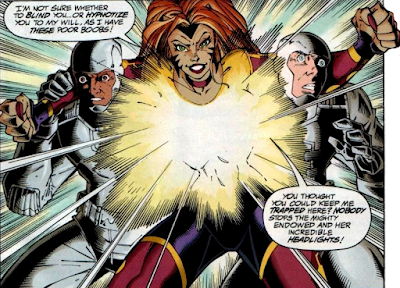
Mighty Endowed was once the archeologist Nina Dowd. She was directing an archeological dig to find ancient artifacts when she came across a wheel-looking device left behind by the New Gods. While her team was hesitant to get close to it, Nina waved off such concerns and went up to it. 

When she touched it she was encased in a strange cocoon. When she emerged, she was transformed into a New God, with the most notable change being the massive expansion of her chest, declaring herself the New God Mighty Endowed. She's a very obscure villainess, with one appearance in the main timeline being the first villain fought by Young Justice. 


How Strong is She?

Actually kinda hard to say. She was beaten very easily by Young Justice, though it's more fair to say she was beaten by herself. She seemed much stronger in the Dark Crisis Young Justice special where she fights Young Justice Conner, Tim, Cassie, and Bart at once but this was a false reality made by Mickey Mxyzptlk so whether that means anything is your prerogative with them even commenting she seems much stronger and like an actual threat. Assuming she could get around her own weakness in some way, most likely she would be equivalent to a weak New God. The bigger question is how strong are weaker New Gods? The New Gods are a race of Kardashev Scale Type 5+ conceptual civilizations from the Godsphere but when interacting with the physical realm they purposefully limit themselves to physical emanations to interact with them safely. 

If she is comparable to the lowest degrees of New Gods physically such as Parademons or Mister Miracle who is considered "powerless" for a new god, this may suggest some degree of superhuman stats with parademons doing things like bringing down planes or fighting Batman, and Mister Miracle one-shotting a human with bulletproof armor or kicking a robot's head off. That said while these are similar low tier New Gods physically, it's totally possibly Mighty Endowed doesn't scale to either of them. This is the range it's likely she would scale logically but nothing really suggests either way and her anti-feat kinda suggests otherwise...

Broadly speaking if you think Mighty Endowed should scale to the feats of other low tier New Gods, she should be at least Low Metahuman Tier. Without she has no physical feats, one physical anti-feat and one power and would probably be a Low Vigilante Tier. 


What are her powers?

Mighty Endowed's most famous power and the only one she's really demonstrated is that her breasts can emanate a bright light that can be used to disorient or hypnotize. 

If she has the abilities of other New Gods, even physically substantiated ones she'd likely have several other abilities. New Gods, like early depictions of Kryptonians, are considered a hyper-evolved race whose physical and mental statistics are evolved past that of normal biological species with superhuman strength, durability, speed, endurance, stamina, and intelligence. They're also ageless (ceasing aging at the equivalent of about age 30), an immunity to many toxins or diseases, and often mild psychic powers such as supernatural sensing or mild telekinesis. 


What are her weaknesses?

So most infamously Mighty Endowed's breasts were amplified to such an extent that she could not actually stand up under her own weight. This could be taken as a strength anti-feat but I would argue probably not. The world's largest breasts are Annie-Hawkins Turner's at 102 ZZZ which are larger then Mighty Endowed and she can still stand up. This is quite clearly a joke and if you are to take the anti-feat "seriously" Nina would have to be not just "not New God" level strength but genuinely a weakling compared to real world humans. Broadly I would just take this as a weakness that she has trouble standing without trying to examine the real world physics of it.

Also technically Nina would have the weakness of other New Gods to Radion which is like Kryptonite to the New Gods. 


In conclusion Mighty Endowed is probably a Low Meta due mostly to scaling to the physical capabilities of other relatively weak New Gods. As for how she would do against them, she would probably lose against almost any named New God as she has almost no experience as one and only one power, with many new gods having some level of resistance to regardless. She could probably beat a normal foot soldier from either New Genesis or Apokolips such as one of the Bugs or one of the Parademons respectively just by controlling them, but wouldn't rank too highly regardless.

Compared to most DC Vigilantes, I would presume most Metahuman tier characters could take her out so long as they can avoid being brainwashed by her and I even think a fair number of higher vigilante tier characters would be able to possibly beat her. Granted if they don't have an outright physical superiority they are probably going to at least need willpower strong enough to not be hypnotized as well as physical training and coordination strong enough to fight an evolved species like a New God, but that's certainly not unheard of from DC Street Tiers. I think her best matchups would be characters that are bricks with high strength/durability but without particular willpower feats, and her worst would be characters with high willpower and combat skill.